White dust from a humidifier
White dust is not dirt and not mould. It is the minerals in your water, turned into a fine powder by one kind of humidifier and settled on everything nearby. The fix is the water, not the cloth.
What it comes down to
- What white dust is
- Minerals from the water — mostly calcium and magnesium — that a humidifier has flung into the air and that have landed as a pale film. It is a sign of what is in the tank, not a sign the machine is dirty.
- Which units make it
- Ultrasonic (and impeller) humidifiers. They vibrate or fling water into a mist, and the minerals go with it. Evaporative and warm-mist units leave those minerals behind, so they do not coat your room.
- What water stops it
- Distilled or demineralised water. Tap water, filtered water and softened water all still carry minerals. Only water with the minerals removed stops the dust at the source.
- How to suppress it
- Change the water, then clean. Use distilled water, fit a demineralisation cartridge if the unit takes one, empty and dry the tank daily, and wipe the film off surfaces — it wipes off easily because it is just powder.
Look up white dust and most answers tell you to wipe it or buy a different humidifier. Neither is the useful part. The useful part is that the dust is your water, made visible, by the type of machine you own. This page separates it from the two things it gets confused with — scale and mould — names the unit type that causes it, and gives the one change that actually stops it.
What we read
We read the US Environmental Protection Agency’s published guidance on the use and care of home humidifiers and a humidifier manufacturer’s own cleaning guide. Both are named in the sources section, along with which claim each one supports.
We have not analysed a water sample for this page, and we are not a laboratory. Where a statement comes from a source it is named; where a reading is ours — for example, that the unit type is the lever, not the cleaning routine — the text says so.
What white dust actually is
White dust is the mineral content of your water, aerosolised. Hard water carries dissolved calcium and magnesium; an ultrasonic humidifier breaks the water into a mist so fine that those dissolved minerals travel with it and settle as a pale, chalky film on furniture, floors and electronics near the unit.
It is worth being precise about what it is not, because the three get mixed up:
- Not mould. Mould is alive. White dust is inert mineral powder. They need different responses, and treating dust as if it were growth wastes the effort. For the living version, see mould in a humidifier.
- Not scale. Scale is the same minerals after they have dried onto the inside of the tank or the heating plate. White dust is those minerals after they have left the unit. The cleaning routine for scale lives on the descaling page.
Which humidifiers make it
The unit type decides whether minerals leave the machine. This is the part most buying guides skip, and it is the only part that lets you stop the dust before it starts.
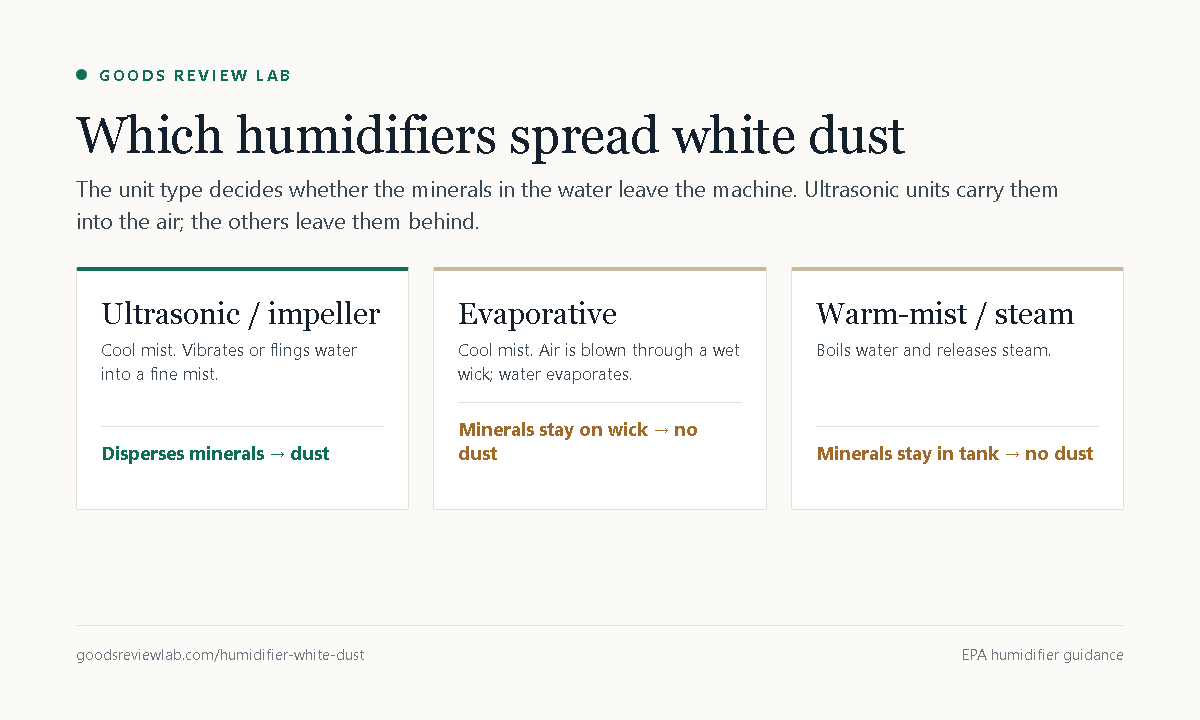
| Unit type | How it makes humidity | Does it spread white dust? |
|---|---|---|
| Ultrasonic / impeller (cool mist) | Vibrates or flings water into a fine mist | Yes — the minerals in the water go into the air with the mist |
| Evaporative (cool mist) | Blows air through a wet wick; water evaporates | No — the minerals stay on the wick, not in the air |
| Warm-mist / steam | Boils water and releases steam | No — minerals are left behind in the tank |
The EPA states the same mechanism in its guidance: ultrasonic and impeller humidifiers are efficient at dispersing whatever is in their tank into the room. That is why the agency names lower-mineral water first — the dust is the visible proof that the water you put in is now in the air you breathe.
What water to put in
Because the dust is the water, the single most effective change is the water itself. What you put in decides whether minerals reach the room.
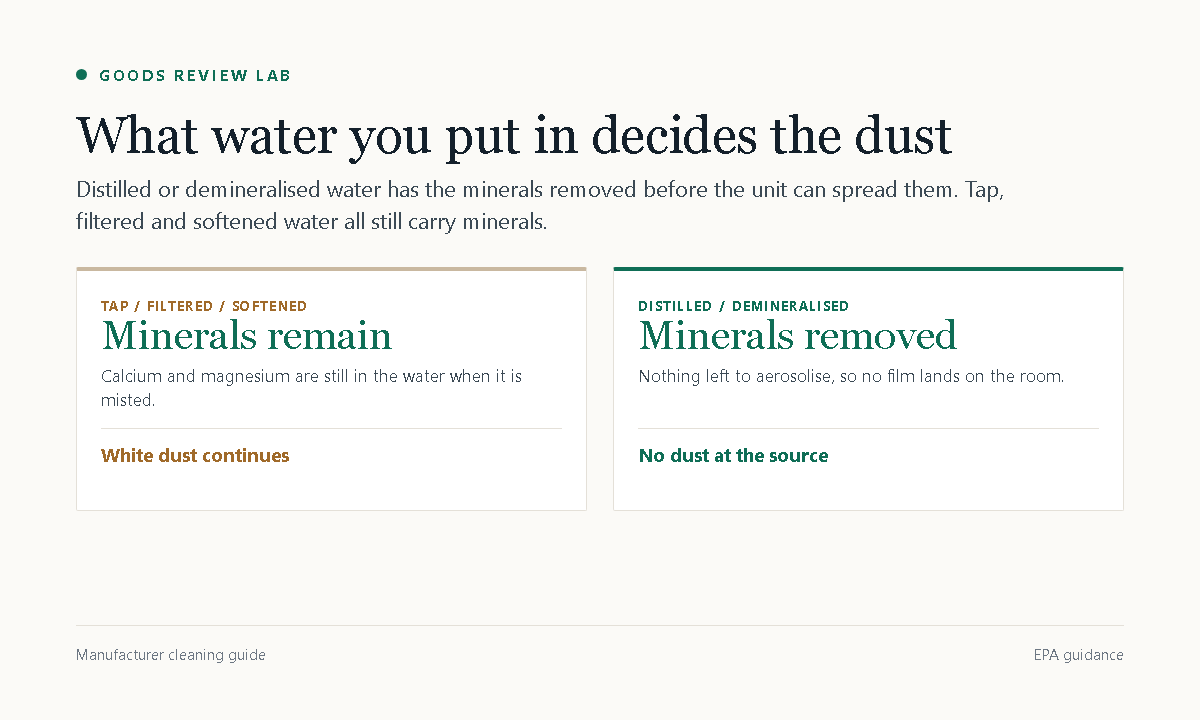
| Water you put in | Minerals left? | White dust result |
|---|---|---|
| Tap water (hard) | All of them | The most dust — this is the usual cause |
| Filtered / pitcher water | Most of them | Still dust; filters catch taste and contaminants, not calcium |
| Softened water | Yes — swaps calcium for sodium | Still dust, just a different mineral |
| Distilled / demineralised | Essentially none | No dust at the source |
A demineralisation cartridge is the partial fix when distilled water is inconvenient: it sits in the tank and pulls minerals out of the water before it is misted. The manufacturer’s guide we read treats distilled water as the first option and a cartridge as the second, with effectiveness that varies by how hard your water is. A cartridge reduces the dust; it rarely removes it the way distilled water does.
How to suppress it
If you already have dust, the order that matters is: stop the source, then clean the powder. The powder is the easy half.
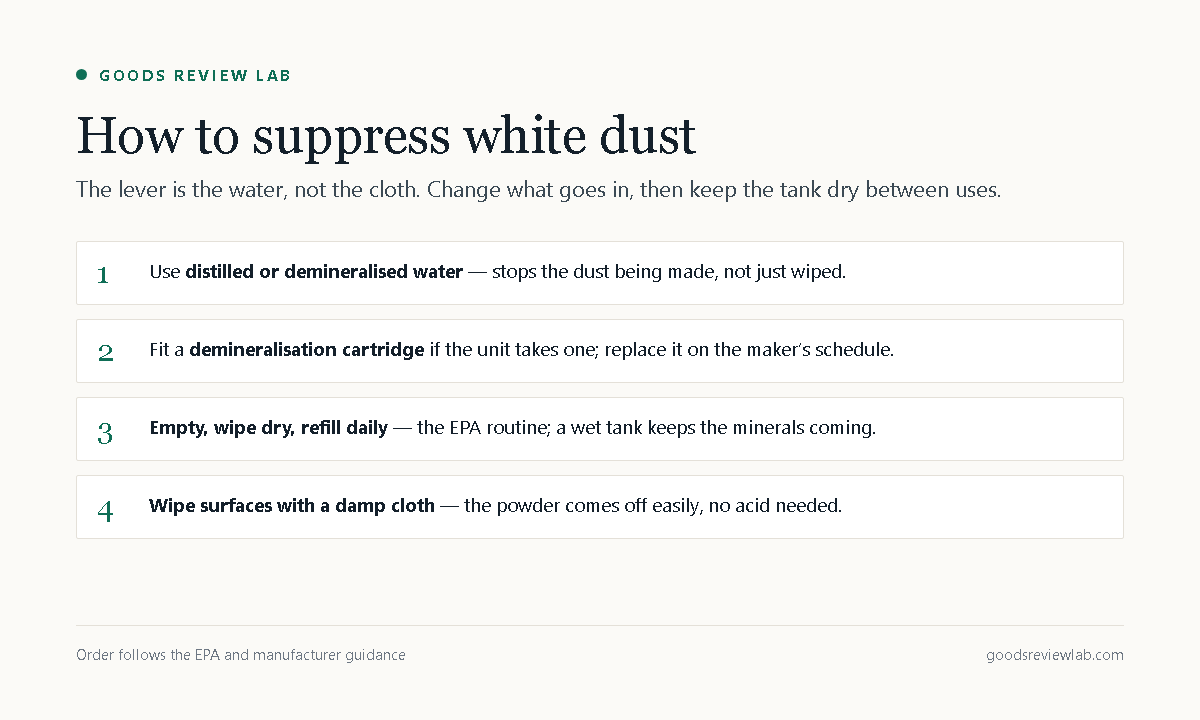
- Switch the water to distilled or demineralised. This is the step that stops the dust being made. Everything else only manages what is already there.
- Fit a demineralisation cartridge if your unit is designed for one, and replace it on the maker’s schedule — a spent cartridge stops working.
- Empty, wipe dry and refill daily. This is the EPA’s routine, and it matters here too: a tank left full and wet is where the minerals keep coming from.
- Wipe the film off surfaces with a damp cloth. White dust is just powder, so it comes off far more easily than scale does — no acid required.
The health question, kept calm
White dust is minerals, not microbes, and in small amounts it is the kind of household dust that already exists in any home. The reason it is worth naming rather than ignoring is the mechanism behind it: on an ultrasonic unit, whatever is in the tank goes into the air. The dust is the harmless half of that; the same path is why the EPA ties clean water to clean air on these units. Keeping the tank clean and the water low-mineral is the response that covers both.
How to clean the dust off surfaces
Because the deposit is powder, not a film, a damp microfibre cloth removes it without soap or vinegar. Wipe from the top down — the dust settles on higher surfaces first — and rinse the cloth often. If the same spots keep a pale film within a day or two of wiping, the water is still the source; no amount of surface cleaning fixes that until the water changes.
When distilled water isn’t the whole answer
Two situations come up that distilled water alone does not settle.
- The unit will not run on anything but tap water. If distilled water is impractical where you are, a demineralisation cartridge is the realistic option; accept that it reduces rather than eliminates the dust.
- You want the unit type to do the work. An evaporative or warm-mist humidifier cannot spread the dust in the first place, because it does not put the tank water into the air. For some households that is the cleaner fix than changing the water every day.
The question to ask instead
Not “which humidifier is best” — “what water am I putting in, and what kind of unit is this?”
The dust is the answer made visible. Get the water to carry no minerals, or get a unit that never puts the water in the air, and the film on the furniture stops being a weekly job. Skip that and you will wipe the same surfaces forever and still see it return.
Questions this page answers
- What is white dust from a humidifier?
- It is the minerals in your water — calcium and magnesium — that an ultrasonic humidifier flings into the air and that settle as a pale film. It is inert powder, not mould and not dirt.
- Which humidifiers cause white dust?
- Ultrasonic and impeller (cool-mist) units. They vibrate or fling water into a mist, carrying its minerals. Evaporative and warm-mist units leave those minerals behind, so they do not coat the room.
- Does distilled water stop white dust?
- Yes. Distilled or demineralised water has the minerals removed, so there is nothing left to spread. Tap, filtered and softened water all still carry minerals.
- Will a demineralisation cartridge stop it?
- It reduces the dust rather than removing it. The manufacturer's guide we read names distilled water first and a cartridge second, with effectiveness that varies by how hard your water is.
- Is white dust harmful?
- It is minerals, not microbes, and in small amounts it is ordinary household dust. The reason to act is the mechanism: on an ultrasonic unit whatever is in the tank goes into the air, so clean low-mineral water protects the air as well as stopping the film.
What this rests on
This page rests on one government source, one manufacturer-authored guide, and our own reading of them. Both were read on 25 October 2026.
- That ultrasonic and impeller humidifiers disperse the contents of their tank — including minerals and microorganisms — into indoor air; that distilled water is named first and a demineralisation cartridge second; that the tank should be emptied, wiped dry and refilled daily; and that relative humidity should not exceed 50%: the US Environmental Protection Agency’s published guidance on the use and care of home humidifiers. A government guidance document; it does not test a specific humidifier and does not endorse a brand.
- That distilled water limits mineral deposits; that a demineralisation cartridge reduces them with effectiveness that varies; and that the unit should be cleaned at least weekly: a humidifier manufacturer’s own published cleaning guide. The manufacturer has a commercial interest in the unit surviving its warranty; we have treated its frequency as a machine-protection figure rather than a health one.
- The separation of white dust from scale and from mould, the reading that the unit type is the lever rather than the cleaning routine, and the reading that a spent cartridge stops working: our reading of the sources above. These are not test results; no water sample was analysed for this page.
What we did not do and are not going to imply: we have not analysed the water from a specific home, and no manufacturer documentation we found gives a white-dust rate for a specific model. The manual that came with your unit is the only document that speaks to your parts. For the mineral half that stays in the tank, see what dissolves scale; for the living half, see mould in a humidifier; for the interval, see how often to clean a humidifier.
What this page deliberately does not do: name a best humidifier or a best water brand. The right call depends on your unit type and whether a cartridge fits yours, and a single recommendation that skips those is the failure mode this page exists to argue against. See Home Air for the rest of what we check in this category, plus how we get paid if you want to know what a commission can and cannot buy here.