Descaling a humidifier is two jobs, and the manual draws the lines
A scale removal and a disinfection are separate procedures with separate chemicals. The manufacturer also sets three limits, and ignoring the first one costs you the warranty.
The bottom line
- What dissolves the scale
- An acid, and the recipes are not the same. One manual puts 2 cups of undiluted distilled white vinegar in the tank and soaks it 15 to 20 minutes. A second manufacturer's support page puts 2 tablespoons into a half tank of warm water and leaves it 30 minutes.
- What disinfects, and why it is not the same job
- A different chemical, in a separate run. The manual that documents both jobs disinfects with 1 teaspoon of bleach in 1 gallon (3.8 L) of water, and states that the two processes must be performed separately and that the two solutions must never be mixed.
- The limit that costs the most
- You may not submerge the base. One manual says doing so will damage the humidifier and void the warranty; another says never immerse the base in water. The base gets the solution poured into it and poured back out, never dunked.
- Why it is more than a stain
- Scale is a fault. The same manual's troubleshooting table lists mineral deposits on the nebulizer as the cause of "little or no mist is produced". Descaling is a repair.
Most descaling advice gives you one liquid, one soak time and one job. The manufacturers whose manuals your warranty is attached to do not. They split the work into a scale removal and a disinfection, give each its own chemical, and then spend most of the instructions on the things you are not allowed to do. This page is about those limits: which part may see water and which may not, why the two solutions must never share a rinse, and where the scale actually collects.
Our method
We read three manufacturers' own instructions: the cleaning and troubleshooting sections of a Honeywell humidifier manual, the cleaning answer on a Crane humidifier support page, and the cleaning section of a Levoit humidifier manual. We read the EPA's published guidance alongside them, because it is the one document in this set written for the room rather than for the machine. Descaling one was out of scope for this page, and we have no laboratory. Where a figure comes from a document it is named in the sources section; where the page does arithmetic on those figures, the text shows the working.
Two jobs, not one
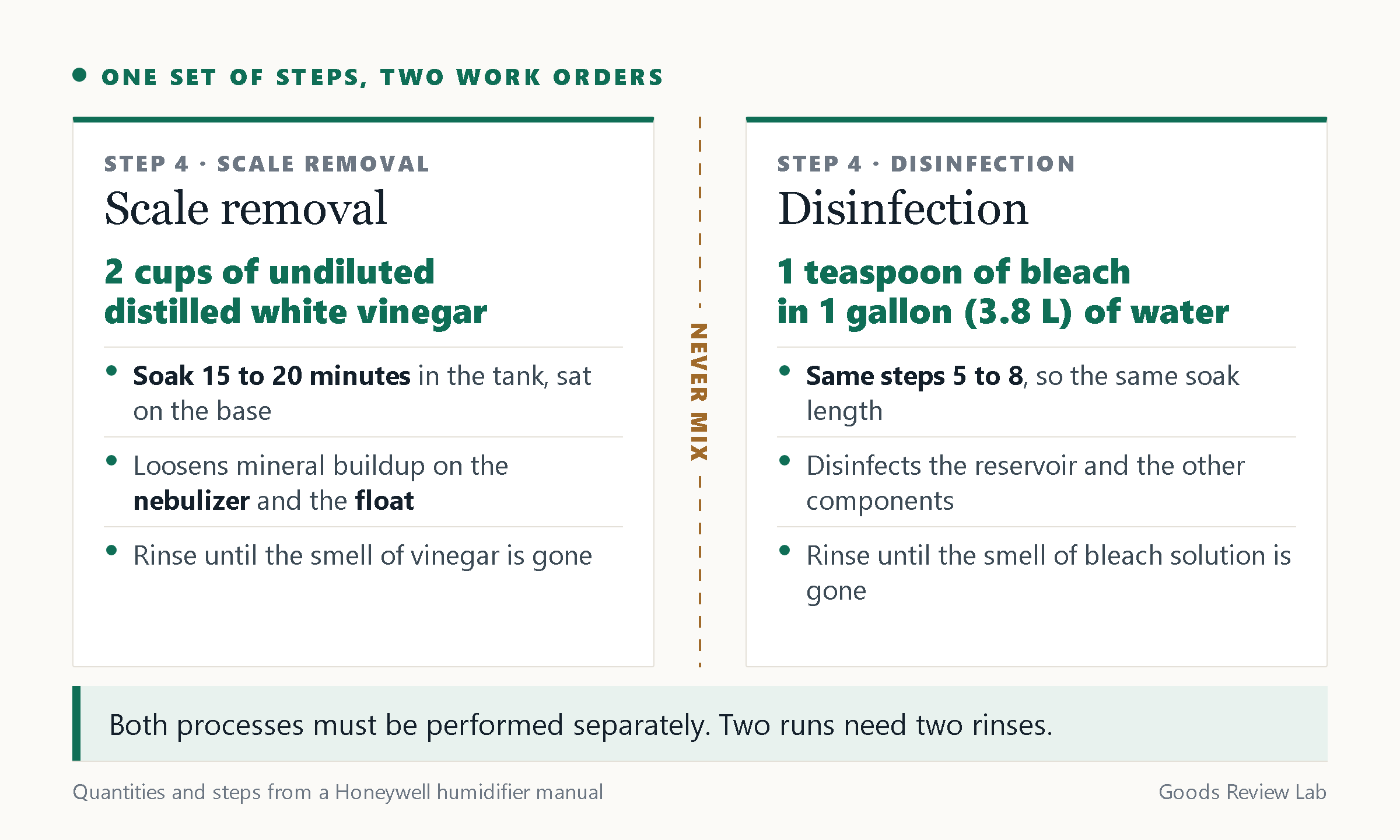
The clearest statement of this comes from the manual that documents both jobs. Its opening line under cleaning reads: "To properly clean your humidifier we recommend the separate processes of Scale Removal and Disinfecting shown below. These two processes MUST BE performed separately." A note under the disinfecting steps says it again from the other side: "Do not mix vinegar and bleach solutions together."
What makes that more than a warning label is how little the two jobs have in common: the same manual, the same eight numbered steps, the same parts, the same rinse, the same soak length. They differ in exactly one step. Step 4 is where the liquid goes in — 2 cups of undiluted distilled white vinegar in the scale-removal run, 1 teaspoon of bleach in 1 gallon (3.8 L) of water in the disinfecting one.
| The step | Scale removal | Disinfection |
|---|---|---|
| What goes into the tank | 2 cups of undiluted distilled white vinegar | 1 teaspoon of bleach in 1 gallon (3.8 L) of water |
| What it is for | Loosening mineral buildup on the nebulizer, the float and the bottom of the tank | Disinfecting the water reservoir and the other components |
| The soak | 15 to 20 minutes | The same steps and the same length, because steps 5 to 8 are shared |
| The rule attached to it | Do not mix vinegar and bleach solutions together | Using more than 1 tsp of bleach per gallon of water may result in damage to your humidifier |
Read that table as a pair of work orders and the separation stops looking like caution and starts looking like arithmetic. Acid dissolves a deposit; a disinfectant kills what grows in the water. Vinegar does one of those jobs and not the other. The rinse is where the separation is enforced: rinse the reservoir and the tank until the smell of vinegar, or of bleach solution, is gone. Two runs need two rinses, because you cannot disinfect a tank that still smells of the acid you used on it last.
The three limits the manufacturer sets
The limits are the part of the instructions nobody repeats. Three appear in this set of documents, each written as a prohibition rather than a preference.
One. The base may not be submerged
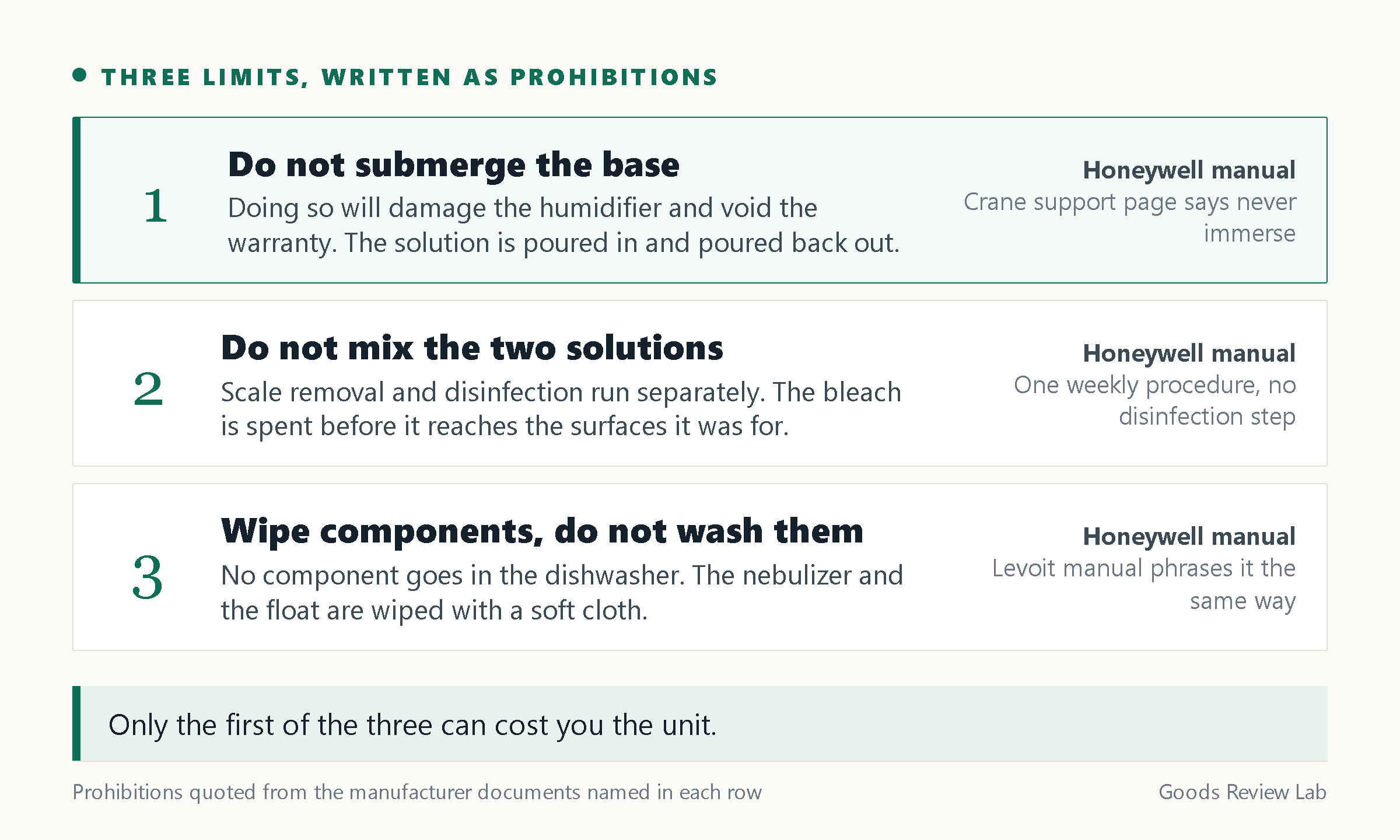
This is the expensive one. The Honeywell manual carries the line in capitals under its scale-removal steps: "CAUTION: Do not submerge base in water. Doing so will damage the humidifier and void the warranty." The Crane support page says the same thing as a standalone warning: "NEVER IMMERSE HUMIDIFIER BASE IN WATER."
So how does the base get cleaned? By pouring a measured solution into it and pouring it back out. The Crane page fills the base with warm water, adds 1 tablespoon of white vinegar, leaves it 30 minutes, empties it and rinses it, with the detail that you pour the water away from the fan outlet when you empty it. The Honeywell manual reaches the base the long way round, with the tank sitting on top of it: the solution drains into the water reservoir and loosens the buildup on the nebulizer and the float as they soak in it. Both manuals are careful where the water goes next: none inside the fan opening in the back of the base, and none near the control panel. A base is an electrical appliance that happens to have a basin in it, and the manuals treat it that way.
Two. The two solutions never meet
The Honeywell manual puts it plainly: "Do not mix vinegar and bleach solutions together." The Crane page never mentions a second job at all, because the machine it describes has one documented weekly procedure. There is a mechanical reason too: both runs use the same tank, reservoir, float and nebulizer, and both end with the rinse that clears the smell of the chemical you used. Run them together and the bleach is spent before it reaches the surfaces it was meant to disinfect.
Three. Components are wiped, not washed
The parts that actually collect the scale are the parts you touch with a cloth rather than put under a tap. The Honeywell manual says to wipe the nebulizer and the float with a soft cloth, and to use the solution from the reservoir to wipe the underside of the mist outlet. The Crane page says to clean the nebulizer with a damp cloth or a cotton swab after soaking, and the Levoit manual phrases it the same way. Two more prohibitions sit alongside those: the Honeywell manual says not to wash any components in the dishwasher, and not to clean the accessory at all. Neither document leaves you detergent either: the same manual's troubleshooting table lists a tank or base washed with detergent as a possible cause of water overflowing from the reservoir.
| The limit | What the document says | Which document |
|---|---|---|
| Do not submerge the base | Doing so will damage the humidifier and void the warranty | Honeywell manual |
| Do not immerse the base | Never immerse the base in water; pour the solution in and pour it out | Crane support page |
| Do not mix the solutions | Do not mix vinegar and bleach solutions together; the two processes must be performed separately | Honeywell manual |
| Do not clean the accessory, and do not use detergent | Cleaning the accessory will damage it; a tank or base washed with detergent is listed as a cause of water overflowing from the reservoir | Honeywell manual |
Where the scale actually sits
Three parts collect it, and the manuals are specific about each one. The Honeywell manual names the nebulizer and the float as the two parts the vinegar reaches as it drains from the tank into the reservoir, and adds the bottom of the tank as a third. The mist outlet is a fourth: step 6 says to wipe the underside of it with the solution from the reservoir, the only mention of it in that document.
A third manufacturer's troubleshooting section adds the one that stops the machine working: "Water outlet may be blocked by mineral buildup. Clean the water outlet valve assembly with vinegar." That sentence sits under a heading about the unit not behaving, not about appearance.
The Honeywell manual's own troubleshooting table says the same thing in table form. Under the problem "little or no mist is produced", the possible cause is listed as mineral deposits on the nebulizer. Read that against the weekly cleaning chart in the same manual, which tells the owner to clean the nebulizer and to rinse until there is no foam or smell of cleaning solution, and the picture is coherent: scale on the nebulizer is what stops a humidifier making mist. Descaling is not cosmetic. It is one of the repairs.
Two manuals, two recipes
| Document | The tank | The base | The soak it states |
|---|---|---|---|
| Honeywell manual | 2 cups of undiluted distilled white vinegar, with the tank sat on the base so the solution drains into the reservoir | Reached by that drain, not by immersion | 15 to 20 minutes |
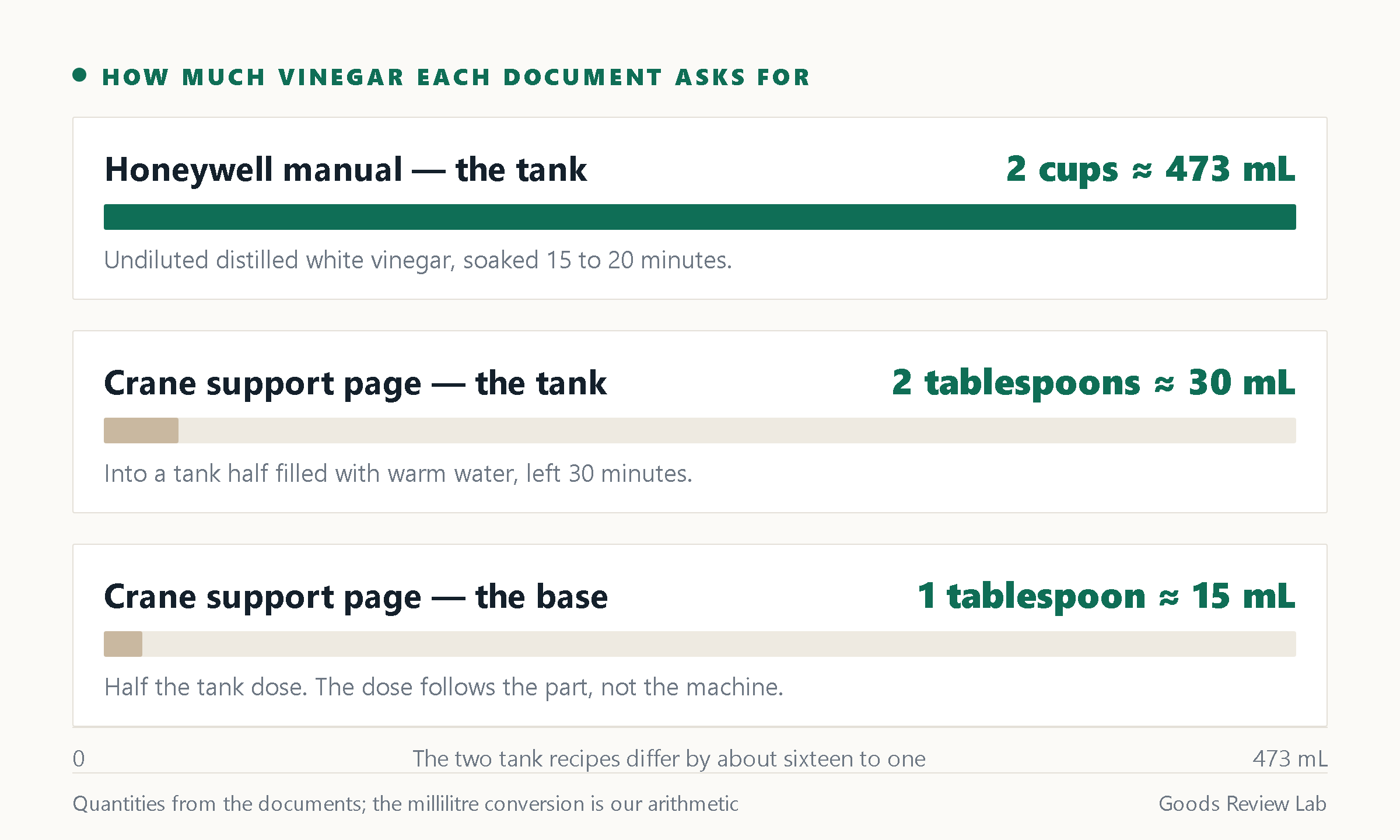
| Crane support page | 2 tablespoons of white vinegar in a tank half filled with warm water | 1 tablespoon of white vinegar in warm water, left 30 minutes | 30 minutes |
| Levoit manual | Soak with distilled white vinegar, no quantity or dilution stated | The same phrase, with the base chamber named alongside the tank | Not stated |
Here is our arithmetic, not a published figure. A US cup is about 237 mL, so 2 cups is roughly 473 mL of undiluted vinegar; a tablespoon is about 15 mL, so 2 tablespoons is about 30 mL and 1 tablespoon about 15 mL. The ratio of vinegar the two tank steps ask for is therefore roughly sixteen to one — and one of the two is undiluted while the other is diluted into a half tank of warm water, so the difference in the tank itself is larger still.
We cannot put those two recipes on a single acid-per-litre scale, and we will not guess a tank capacity to do it: none of the three documents publishes one in its cleaning section. So the claim is narrower: the manufacturers are not publishing two versions of one recipe, and the only thing the three of them agree on is the set of things you must not do.
One more detail is worth keeping. The Crane page gives the base half the dose it gives the tank, which tracks the parts: the tank is a reservoir, the base a smaller chamber with its own mist-making part in it. The dose follows the part, which is another argument against one number for the whole machine.
How often
None of the three documents publishes a descaling interval for a model, which is worth knowing before you go looking for one in them. The one schedule any of them publishes is a weekly routine, and the EPA's general guidance asks for a full clean every third day — two numbers that answer different questions and are the subject of how often to clean a humidifier on its own. For the recipe and the part-by-part table, see how to clean a humidifier with vinegar; for the smell a clean tank still leaves, see mold in a humidifier.
The honest answer
Descaling a humidifier is not one job with one recipe. It is a scale removal and a disinfection, they run separately, and the second one is not vinegar. The part that collects the most scale is the part you may not put in water at all: you pour the solution into the base, let it sit, and pour it out. The manuals disagree by more than an order of magnitude on how much vinegar to use, without either being wrong. What they agree on is the list of things you must not do, and that is the part worth reading twice: do not submerge the base, do not mix the two solutions, do not put a component in a dishwasher, and do not reach for detergent in the tank.
Questions this page answers
- Can I descale and disinfect a humidifier at the same time?
- No. The manual that documents both jobs calls them two separate processes and says they must be performed separately, and it says the vinegar and the bleach solutions must not be mixed.
- Can I put the humidifier base in water to descale it?
- No. One manual says submerging the base will damage the humidifier and void the warranty; another says never to immerse the base in water. The solution is poured into the base and poured back out.
- How much vinegar does one humidifier need to strip its scale?
- The documents in this set disagree by about sixteen to one. One manual asks for 2 cups of undiluted vinegar left for 15 to 20 minutes; another asks for 2 tablespoons in a tank half filled with warm water, left 30 minutes.
- Will descaling fix a humidifier that is not making mist?
- Sometimes, and that is the point. One manual lists mineral deposits on the nebulizer as the cause of little or no mist, which makes scale a fault rather than a stain.
What this rests on
This page rests on three manufacturers' own documents and one government guidance document. All four were read in full for this revision on 3 November 2026.
- That cleaning is split into a scale removal and a disinfection which must be performed separately; that the scale removal uses 2 cups of undiluted distilled white vinegar left for 15 to 20 minutes and the disinfection uses 1 teaspoon of bleach in 1 gallon (3.8 L) of water with the same steps 5 to 8; that vinegar and bleach solutions must not be mixed; that the base may not be submerged because doing so will damage the humidifier and void the warranty; that no component may be washed in the dishwasher and the accessory may not be cleaned; that the nebulizer and the float are wiped with a soft cloth; that the tank and reservoir are rinsed until the smell of the vinegar or the bleach solution is gone; and that mineral deposits on the nebulizer are listed as a cause of little or no mist: the cleaning, weekly cleaning and troubleshooting instructions of a Honeywell humidifier manual. Honeywell builds these humidifiers, so its warranty terms shape what its instructions are allowed to say. We have used its stated quantities, its stated prohibitions and its own troubleshooting table.
- That the weekly maintenance routine is to fill the tank halfway with warm water, add 2 tablespoons of white vinegar, shake vigorously and leave it 30 minutes, then to fill the base with warm water, add 1 tablespoon of white vinegar and leave it 30 minutes, to clean the nebulizer with a damp cloth or cotton swab after soaking, and never to immerse the base in water: the cleaning article on a Crane humidifier support page. This is a manufacturer's own support article, written by the company that sells the unit. It describes one weekly procedure and mentions no disinfection step.
- That scale buildup inside the water tank or base chamber is removed by soaking with distilled white vinegar and wiping with a cloth and cotton swab; that water outlet may be blocked by mineral buildup and the water outlet valve assembly should be cleaned with vinegar; and that water must not be let inside the air outlet or near the control panel: the cleaning and troubleshooting sections of a Levoit humidifier manual. Levoit builds this humidifier. It states the vinegar and the wiping but no quantity and no soak time, so the figures on this page come from the two documents above, not from this one.
- That a 3% hydrogen peroxide solution is the default cleaning or disinfecting agent where the manufacturer specifies no product; that the tank must be rinsed thoroughly afterwards to avoid releasing chemicals into the air; that portable humidifiers should be emptied, dried and refilled daily and cleaned every third day; that ultrasonic and impeller humidifiers disperse the contents of their tanks into the air; and that scale can be a breeding ground for microorganisms: the US Environmental Protection Agency's published guidance on the use and care of home humidifiers. This is a government guidance document. The document names no particular machine and recommends no particular brand. Its peroxide default is for units whose manufacturer specifies no product, which is not the case for any of the three machines in this set.
- The conversion of the two tank recipes into millilitres, the ratio between them, and the observation that the Crane base step uses half the tank dose: our arithmetic, on the quantities stated in the two manufacturer documents above, using a US cup of about 237 mL and a tablespoon of about 15 mL. We have not converted either recipe into acid per litre, because no tank capacity is published in the cleaning section of any of the three documents.
What this page does not do, and does not imply: no humidifier was descaled for it. Three gaps stay open rather than being filled. No document in this set publishes a tank capacity, so the two recipes cannot be put on one scale. None publishes a descaling interval for a specific model. And the EPA's peroxide default is a fallback here, not an instruction for the machines described here.
What we are deliberately not doing here: putting one descaler on a pedestal. Which of the two jobs you are doing, and what your water leaves in the tank, decide the answer; one bottle that ignores both is the mistake this page is written against. The wider set of rules we apply to every appliance on this site sits on Home Air, and how we get paid sets out what a commission does and does not change on this page.