Three manuals, three vinegar recipes for the same humidifier
One manual says two cups of undiluted vinegar. Another says two tablespoons in half a tank of water. A third says vinegar but gives no quantity at all. They are all talking about the same job, and yours is the one that matters.
What it comes down to
- The first recipe
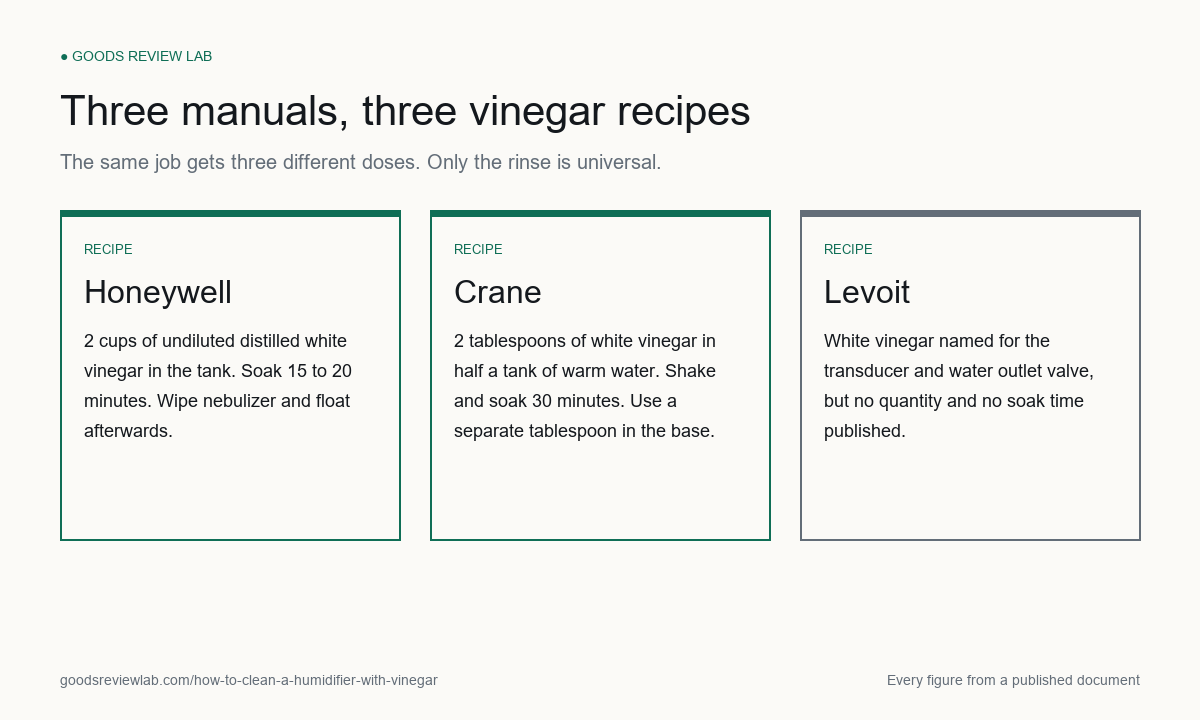
- 2 cups of undiluted distilled white vinegar in the tank, soaked 15 to 20 minutes. The manual that publishes this one also says to wipe the nebulizer and float with a soft cloth afterwards.
- The second recipe
- 2 tablespoons of white vinegar in half a tank of warm water, shaken and left 30 minutes. A separate tablespoon goes into the base with warm water for the same length of time.
- The third recipe
- Vinegar, with no quantity and no soak time. The manual names it for the transducer and the water outlet valve, and gives a brush and a cloth — but no measure.
- What they share
- The rinse. All three say to rinse until the smell is gone. The EPA makes the reason explicit: whatever is left in the tank is what the room breathes.
Look up how to clean a humidifier with vinegar and you get one dilution, one soak time, and a confident tone. The three manufacturers whose manuals your warranty is attached to do not agree on any of that. One pours two cups of neat vinegar and waits twenty minutes. Another dilutes two tablespoons into warm water and waits twice as long. A third does not commit to a number. This page puts the three side by side, separates what they share from what they do not, and leaves the decision where it belongs: with the manual that came with your machine. Vinegar is still the right chemical for mineral scale. The question is which recipe, and the answer is not ours to pick.
What we read
We read three manufacturers’ own instructions for cleaning a humidifier: the cleaning and scale-removal section of a Honeywell humidifier manual, the weekly cleaning answer on a Crane humidifier support page, and the cleaning and troubleshooting section of a Levoit humidifier manual. We read the US Environmental Protection Agency’s published guidance on the use and care of home humidifiers alongside them, because it is the one document in this set written for the room rather than for the machine.
We have not cleaned a humidifier for this page and we are not a laboratory. Where a figure comes from a source, the sources section names it; where a reading is ours — why the three recipes differ, or what vinegar will not fix — the text says so.
Three manuals, three recipes
The same job — dissolve the mineral scale left behind by tap water — gets three different sets of numbers from three different manufacturers. None of them is wrong. They differ because the machines differ, and because the manuals are written to protect the parts they know about.
| Manual | What goes in the tank | Dilution | Soak time |
|---|---|---|---|
| Honeywell HUL535 | 2 cups of distilled white vinegar | Undiluted | 15–20 min |
| Crane support page | 2 tablespoons of white vinegar in half a tank of warm water | Diluted (roughly 1:24 by volume in a half tank) | 30 min |
| Levoit Dual100 | White vinegar (quantity not published) | Not published | Not published |
The Honeywell recipe uses roughly 474 mL of undiluted vinegar (two US cups at about 237 mL each). The Crane recipe uses about 30 mL (two tablespoons at about 15 mL each) diluted into warm water. That is a difference of roughly sixteen to one in the amount of acid going in — and the Honeywell soak is shorter, not longer. More acid, less time; less acid, more time. The third manual names vinegar for the transducer and the water outlet valve but gives no measure, so the figures on this page come from the other two, not from it.
The conversion above is our arithmetic, not the manuals’. No document in this set publishes a tank capacity, so the two recipes cannot be put on one concentration-per-litre scale. That gap stays open.
Why the recipes are not the same
The difference is not a mistake. It is two manuals protecting two different machines in two different ways.
The undiluted recipe comes from a warm-mist unit whose heating plate scales hardest. Neat vinegar attacks that crust fast, and the shorter soak limits how long the acid sits on plastic and seals. The diluted recipe comes from an ultrasonic unit whose nebulizer is more delicate; less acid over more time is gentler on the part that makes the mist, and the shaking step distributes it without needing it to be strong enough to dissolve on contact.
What this means for you: your manual’s recipe is calibrated to your machine’s parts. A stronger mix than your manual calls for may damage the seals or the nebulizer; a weaker one may not dissolve the crust in the time given. The soak time matters more than the concentration — twenty minutes to an hour of contact does more than a stronger mix poured on and rinsed off — but the concentration is not yours to vary if the manual has given you a number.
The one step all three agree on
The rinse is the only step where the three manuals and the EPA converge. All three say to rinse the tank until the smell of vinegar is gone. The EPA states the reason in terms that make it non-negotiable: if you use a cleaning or disinfecting agent, rinse the tank thoroughly afterwards, because the point is to avoid releasing chemicals into the air.
That only makes sense once you know how the machine works. On an evaporative unit the rinse is good practice. On an ultrasonic or impeller unit it is the difference between cleaning the machine and dosing the room — whatever is left in the tank is what the room breathes. Several changes of water, until there is no smell and no film, then a full dry before it goes back together.
What vinegar does not fix
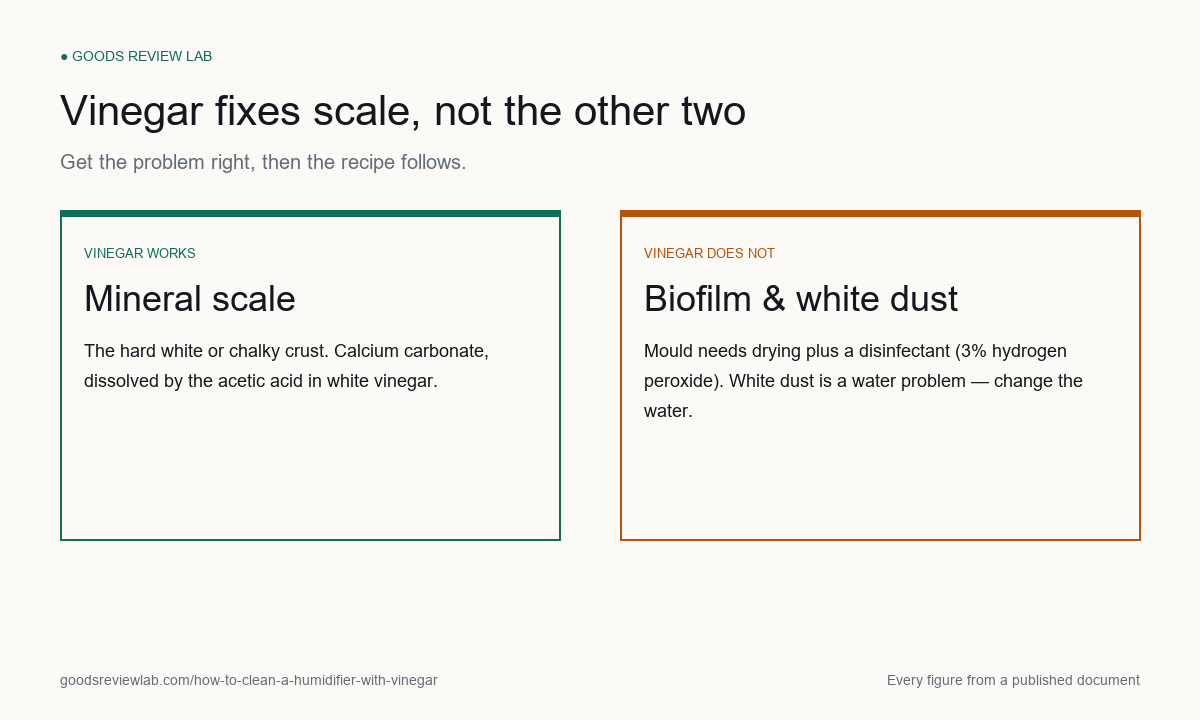
Two of the three problems in a dirty humidifier are not acid problems, and no amount of vinegar — undiluted or diluted — changes that.
Biofilm and mould. A slippery film, pink or black spotting, or a musty smell that returns within days is a living layer, not a mineral one. Vinegar has mild antimicrobial action, but it is not a registered disinfectant, and it is not the EPA’s fallback. The agency’s default where the maker specifies nothing is a 3% hydrogen peroxide solution, and the daily empty-and-dry routine is aimed at this problem, not at scale. That problem has its own page — see mold in a humidifier.
White dust. White dust settling on furniture near the unit is not scale left in the tank — it is minerals that were in the water, dispersed into the room. Vinegar in the tank does not stop it, because the dust is what leaves the tank, not what stays in it. The fix is upstream: lower-mineral water, with distilled named first by the EPA.
Which humidifier you have changes the recipe
The manual wins where it disagrees with any general guide, and the three recipes above map onto three different unit types.
- Warm-mist (boiling) units: the heating plate scales hardest. The undiluted recipe is written for this type, and the shorter soak limits contact with heat-resistant plastic.
- Ultrasonic and impeller units: the nebulizer is the part that makes the mist, and it is delicate. The diluted recipe protects it; the rinse is critical here, because any vinegar left behind is something the room breathes.
- Evaporative (wick) units: the wick is paper or cellulose. Do not soak it in vinegar — replace it. Vinegar the tank and base only.
- Console and whole-house units: follow the manual; some use a filter you replace rather than a tank you soak.
Vinegar vs cleaning tablets
Commercial cleaning tablets and balls are a convenience, not a different chemistry. Most are either acid-based (descaling, like vinegar) or peroxide-based (aimed at biofilm, like the EPA’s default). That distinction decides what they can do.
An acid tablet does the same job as vinegar and costs more. A peroxide tablet addresses the biofilm that vinegar does not — but it still needs the rinse and the dry, and it still does nothing for white dust. Read the label before assuming a tablet covers everything: an acid product will not fix a musty tank, and a peroxide product will not dissolve a thick crust. Never mix cleaning products.
The question to ask instead
Not “what ratio should I use” — “which manual came with my machine, and which of the three problems do I actually have?”
Vinegar is the right chemical for mineral scale, and it is the cheapest one there is. The ratio and the soak time are your manual’s to set, not ours. For biofilm it is the wrong tool and the EPA’s peroxide-and-dry routine is the right one. For white dust, no cleaner works, because the problem is the water. Get the problem right and the recipe follows; get it wrong and you will clean the tank every week and still have the smell or the dust.
Questions this page answers
- Why do different guides give different vinegar ratios?
- Because the manuals they come from are written for different machines. One manufacturer publishes two cups of undiluted vinegar for a warm-mist unit whose heating plate scales hardest; another publishes two tablespoons diluted for an ultrasonic unit whose nebulizer is more delicate. Your manual’s ratio is calibrated to your machine’s parts, and that is the one to follow.
- Which vinegar ratio should I use?
- The one in your humidifier’s manual. If it gives a quantity, use that quantity and that soak time. If it gives no quantity, start with a 1:1 mix of white vinegar and warm water soaked for 30 minutes, and check whether the scale has loosened before scrubbing. Plain white vinegar at about 5% acetic acid is what the manuals specify; do not use cider vinegar or cleaning vinegar with additives.
- Can I use a stronger vinegar mix to clean faster?
- Not safely. A stronger mix attacks scale faster, but it is harsher on the plastic and the seals, and the manuals that publish undiluted recipes pair them with shorter soak times for that reason. The soak time matters more than the concentration: twenty minutes to an hour of contact does more than a stronger mix poured on and rinsed off.
- Can I use vinegar to kill mould in a humidifier?
- Not reliably. Vinegar has mild antimicrobial action but is not a registered disinfectant, and it is not the EPA’s fallback. The agency’s default where the maker specifies nothing is a 3% hydrogen peroxide solution, plus the daily empty-and-dry routine. See our page on mold in a humidifier for that problem.
- Will vinegar stop white dust?
- No. White dust is the minerals in tap water, dispersed into the room by ultrasonic and impeller units. Cleaning the tank does not remove it; the fix is lower-mineral water, with distilled named first by the EPA.
What this rests on
This page rests on three manufacturers’ own documents and one government guidance document. All four were read in full for this revision on 4 November 2026.
- That 2 cups of undiluted distilled white vinegar added to the water tank and soaked for 15 to 20 minutes is the scale-removal method; that the nebulizer and float should be wiped with a soft cloth to remove loosened mineral deposits; that the tank should be rinsed until the smell of vinegar is gone; and that bleach can damage components: the cleaning and scale-removal instructions of a Honeywell humidifier manual. Honeywell builds this humidifier, so its instructions are written to protect its own parts and its own warranty. We have used its stated quantities as one of the three recipes on this page.
- That 2 tablespoons of white vinegar in half a tank of warm water, shaken vigorously and left for 30 minutes, is the weekly cleaning method; that a separate tablespoon of white vinegar goes into the base with warm water for the same length of time; that the nebulizer should be cleaned with a damp cloth or cotton swab after soaking; and that the base must never be immersed in water: the cleaning article on a Crane humidifier support page. This is a manufacturer's own support article, written by the company that sells the unit. We have used its stated quantities as the second of the three recipes.
- That scale buildup inside the water tank or base chamber is removed by soaking with distilled white vinegar and wiping with a cloth and cotton swab; that the water outlet may be blocked by mineral buildup and the water outlet valve assembly should be cleaned with vinegar; and that water must not be let inside the air outlet or near the control panel: the cleaning and troubleshooting sections of a Levoit humidifier manual. Levoit builds this humidifier. It states vinegar for the transducer and the water outlet valve but no quantity and no soak time, so it appears on this page as the third recipe with a gap rather than a number.
- That a 3% hydrogen peroxide solution is the default cleaning or disinfecting agent where the manufacturer specifies no product; that the tank must be rinsed thoroughly afterwards to avoid releasing chemicals into the air; that portable humidifiers should be emptied, dried and refilled daily and cleaned every third day; that ultrasonic and impeller humidifiers disperse the contents of their tanks into the air; and that scale can be a breeding ground for microorganisms: the US Environmental Protection Agency’s published guidance on the use and care of home humidifiers. A government guidance document; it does not test a specific humidifier and does not endorse a brand. Its rinse instruction is the one step all three manufacturer recipes share.
- The conversion of the two tank recipes into millilitres, the ratio between them, the observation that more acid pairs with less time and less acid with more, and the separation of white dust from tank scale: our reading and our arithmetic, on the quantities stated in the two manufacturer documents above, using a US cup of about 237 mL and a tablespoon of about 15 mL. We have not converted either recipe into acid per litre, because no tank capacity is published in the cleaning section of any of the three documents.
What this page does not do, and does not imply: no humidifier was cleaned for it. Three gaps stay open rather than being filled. No document in this set publishes a tank capacity, so the two recipes cannot be put on one concentration-per-litre scale. The third manual publishes no quantity, so its recipe appears as a gap. And the EPA’s peroxide default is a fallback here, not an instruction for the machines described here. See what descaling actually involves for the two-jobs structure behind these recipes, and how often to clean a humidifier for the interval question.
What this page deliberately does not do: name a best cleaner or a best humidifier. The right method depends on your water, your unit type and which of the three problems you actually have, and a single recommendation that skips those is the failure mode this page exists to argue against. See Home Air for the rest of what we check in this category, plus how we get paid if you want to know what a commission can and cannot buy here.