Mold in a humidifier: the side you cannot reach
Cleaning a humidifier means taking the tank off and washing it. The mould that keeps coming back is often not in the part you washed. This page is about the other side: the base, the mist path and the parts that do not come apart, what the maker’s own documents say you may and may not do to them, and why a room that is already damp will keep feeding the problem no matter how clean the machine is.
What it comes down to
- Where the mould actually is
- On the side you cannot dismantle. The tank, the top cover and the mist tube come off and can be washed. The transducer, the mist outlet and the water outlet valve assembly stay in the machine, and the manuals treat them with a brush and a cloth rather than a soak.
- Why cleaning the tank does not end it
- Because the room keeps supplying the moisture. The EPA states that dampness in the air can by itself supply enough moisture for mould growth, and that mould will grow on virtually any organic material where moisture and oxygen are present.
- What the manuals allow on that side
- Brush and vinegar, never immersion. One manual says to clean the transducer with a cleaning brush and white vinegar; another says the nebulizer is wiped with a damp cloth or cotton swab after soaking. Both say the base must never be immersed.
- When to replace rather than clean
- Look at the fixed film, not the tank. If the deposit is bonded to a part that does not come apart and the maker’s method does not shift it, the machine has reached the end of its usable life. A clean tank does not argue against that.
Almost every guide on mould in a humidifier is written around one instruction: take the tank off and wash it. That instruction is right, and it is also the reason people clean the same machine every month and smell it again by the weekend. The tank is the one part built to be removed. The part that makes the water mist — the transducer on one machine, the nebulizer on another — does not come apart at all, and the manufacturer’s own cleaning instructions for it are conspicuously gentler than the ones for the tank. That difference is the whole story. Underneath it sits a second fact from the EPA: a damp room keeps supplying moisture on its own, so a spotless machine in a damp room is still a machine in a mould-friendly environment.
What we read
We read the US Environmental Protection Agency’s mould course on where mould grows, the agency’s separate guidance on the use and care of home humidifiers, the user manual for one top-fill ultrasonic unit, and a manufacturer’s published support answers on cleaning. Each of the four is listed in the sources section with the claim it carries.
Nothing was opened, swabbed or cultured for this page, and no laboratory sits behind it. Where a number comes from a source, the source is named. Where a reading is ours — in particular, the split between the parts that come apart and the parts that do not — the text says so.
Every humidifier has two sides
Take any humidifier apart and the pieces sort themselves into two groups. One group is designed to be removed: the tank lifts off, the top cover unscrews, and on the ultrasonic unit in our manual the mist tube comes out of the bottom of the tank when you press its tab and pull. The other group is bonded in place. The transducer, the mist outlet and the water outlet valve assembly sit inside the base and stay there.
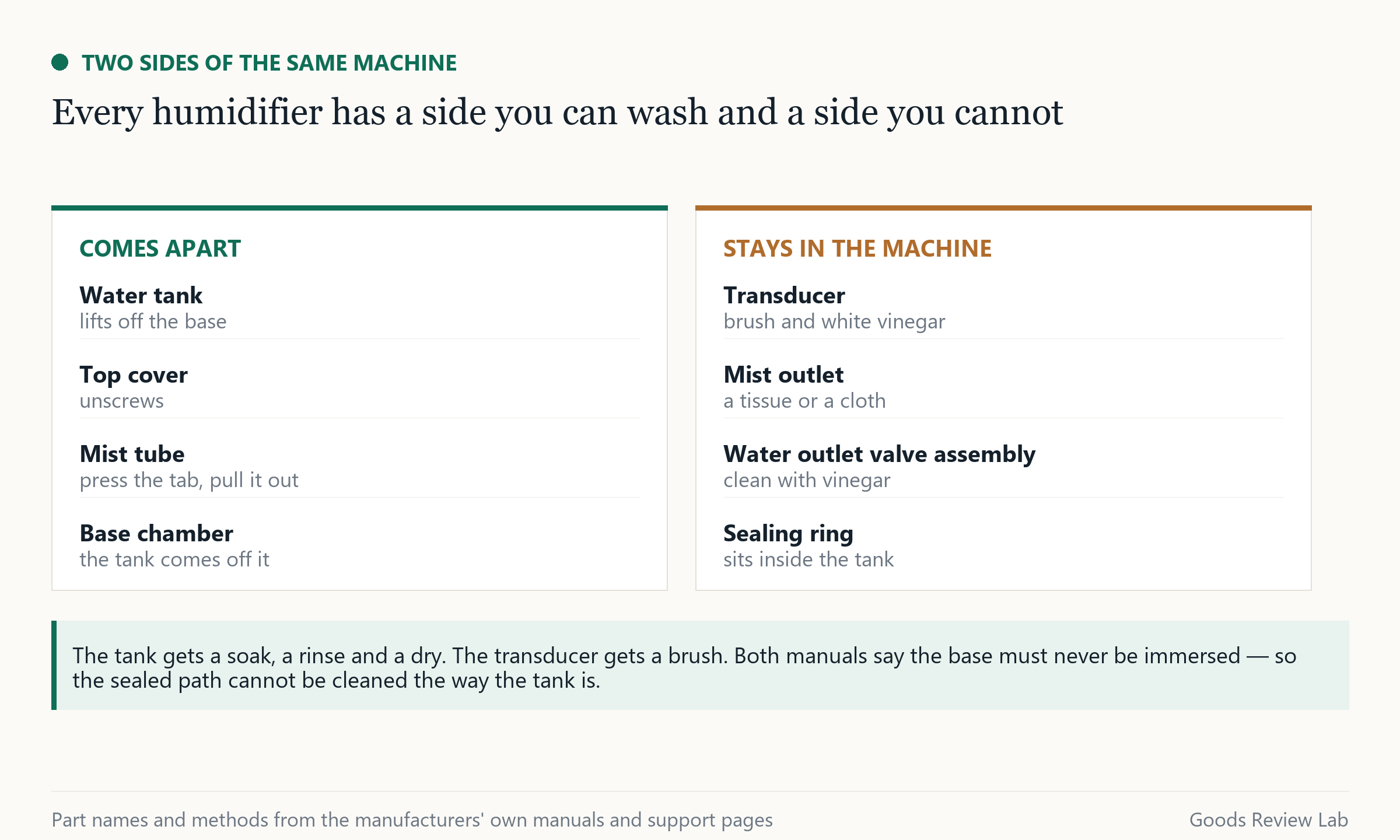
The manuals treat those two groups differently, and the difference is where the advice actually lives. The tank gets a soak, a rinse and a dry. The transducer gets a cleaning brush and white vinegar. The nebulizer on the other machine gets a damp cloth or a cotton swab, after the tank has soaked. Both manuals say in the same breath that the base must never be immersed — one adds that it must not go in a dishwasher either.
That is not a knock on the manuals. It is the honest shape of the machine: the sealed path cannot be soaked without destroying the electronics under it, so the published method is the gentler one. The consequence for a reader is that the tank and the sealed path are two different jobs, and the second one cannot be done the way the first one is done.
Why the tank keeps smelling
Clean the tank, dry it, refill it, and the smell comes back. The instinct is that the tank was not cleaned well enough. Sometimes that is true. But there is a second supply, and it is in the room rather than the machine.
The EPA’s mould guidance makes two statements that bear on this directly. The first is that humidity or dampness in the air can supply enough moisture for mould growth on its own. The second is that mould can grow on virtually any organic material as long as moisture and oxygen are present. Neither statement needs a dirty tank. Together they mean a room held above the humidity the agency recommends is an environment that is already mould-capable, and a humidifier running in it adds moisture to the same air.
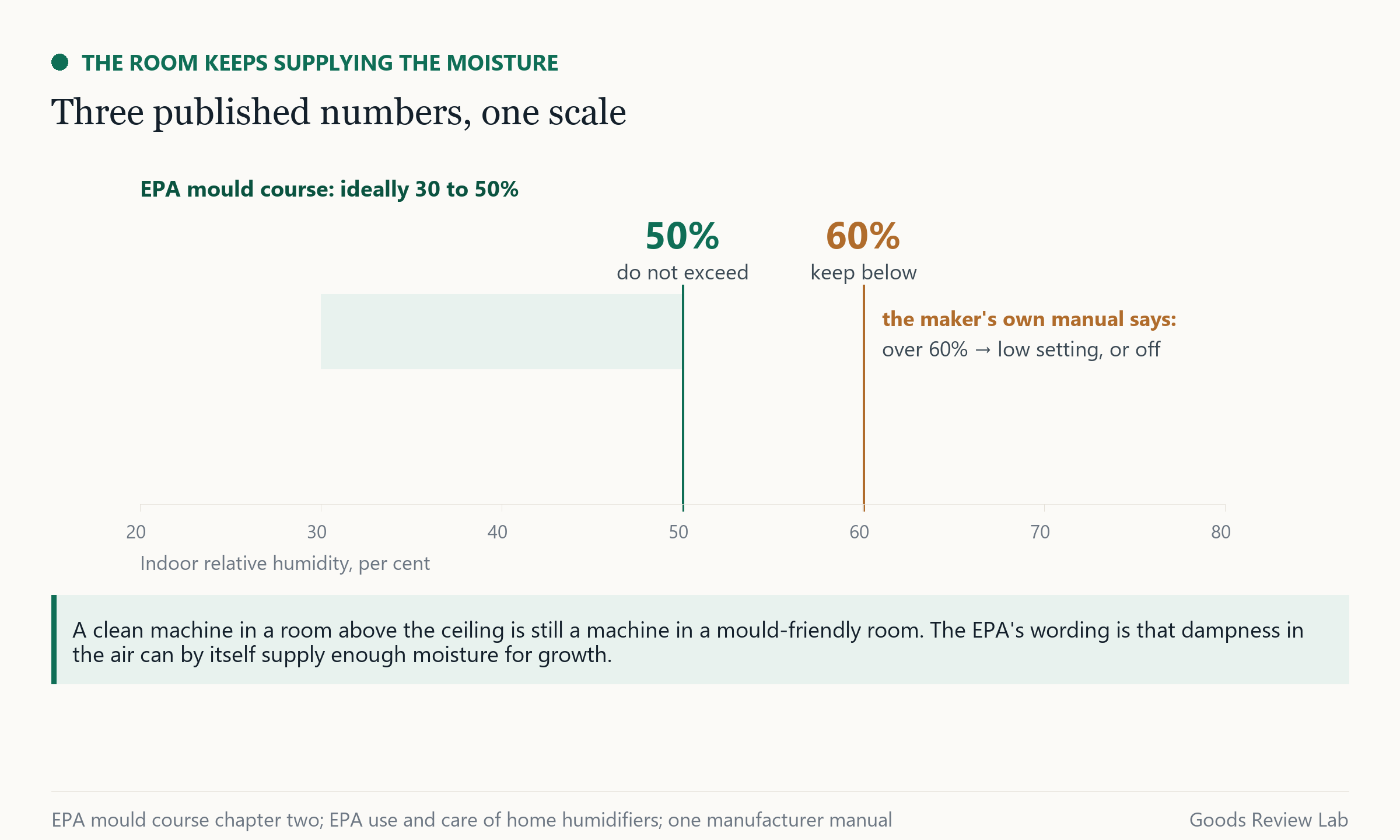
The same EPA page puts the ceiling at below 60% relative humidity, ideally between 30% and 50%, and separately names 60% itself as the definition of high humidity. The humidifier guidance is stricter still: do not exceed 50%. One manufacturer’s manual makes the same point in the other direction, telling the reader that if the room is over 60% the unit should be turned down or switched off, and that excessive humidity can cause health problems and mould growth.
There is also a drying rule in the EPA material that is about time rather than humidity: wet building materials must be dried within 24 to 48 hours to avoid mould growth. No source we read gives a number for how long mould takes to appear in a humidifier, and this page will not invent one. What the sources support is the order of things — moisture present, then time, then growth — and the interval the agency publishes is the window for getting material dry, not a countdown to mould.
What the manuals say about the fixed side
Here is the actual text, laid out by part. Everything below comes from the two manufacturers’ documents named in the sources section.
| Part | Does it come apart | What the manual says to do |
|---|---|---|
| Water tank | Yes — lifts off the base | Pour out, rinse, soak with vinegar for scale, wipe with a cloth and cotton swab, dry completely |
| Top cover | Yes | Remove and wash |
| Mist tube | Yes — press the tab and pull it out | Rinse, dry, and press it back until the tab clicks into place |
| Transducer | No | Clean with a cleaning brush and white vinegar — named in the troubleshooting table as the remedy when the water is dirty or there is mineral build-up inside the base |
| Mist outlet | No | Wipe with a tissue or cloth, regularly. Do not cover it while the unit runs |
| Water outlet valve assembly | No | Clean with vinegar — named as the fix when the outlet is blocked by mineral build-up |
| Base chamber | The tank comes off it; the base stays on the desk | Rinse with room-temperature water, soak for scale, dry with a cloth — and never immerse it, never put it in a dishwasher |
| Sealing ring | No — it sits inside the tank | Check it is seated, and clean it if needed |
Two readings come out of that table, and both are ours rather than the manuals’. The first is that the parts that cannot be removed are the parts most likely to be skipped, because the manuals talk about the tank in the imperative and about the transducer in the conditional — as a remedy to reach for when something is already wrong. The second is that a fixed film and a loose deposit are different faults with the same symptom, and they do not have the same answer.
Clean it or replace it
This is the decision the tank-washing guide never reaches, because it assumes the tank is where the problem is. The question is not whether the tank is clean. It is whether the deposit is on a surface you can reach.
- If the deposit comes off the tank and the base when you wash them, and the smell still returns, the problem is elsewhere. It is either on the fixed side, where the published method is a brush, or in the room, where the published fix is a humidity reading.
- If the deposit is bonded to the transducer, the mist outlet or the valve assembly, and the maker’s method does not shift it, you have reached the limit of what cleaning does. Those parts have no replacement procedure in the documents we read, and the manuals do not offer one because the parts are not sold as spares.
- If the tank, the base and the room are all clean and the smell is still there, the likely source is a part of the machine whose own manual lists it as a smell cause: essential oils diffused through the base, or a new unit whose plastics are still off-gassing. The manual’s remedy in the first case is vinegar; in the second it is to leave the tank in a cool, dry place for twelve hours.
One caution about the smell itself. No source we read establishes that a musty odour is mould. The same reasoning applies here as it does to an air purifier that smells: a smell is a signal to go and look, not a diagnosis of what is growing. The look is where the table above is useful — it tells you which surfaces to examine.
The routine that covers both sides
The EPA’s humidifier guidance is built around frequency and drying, and it applies to the machine as a whole rather than to the tank alone. The agency’s routine is to empty the tank, wipe all surfaces dry and refill daily, and to clean portable units every third day, removing scale, deposits or film from the sides of the tank and interior surfaces and wiping everything dry again. Where the maker specifies no product, the agency’s default for surfaces that come into contact with water is a 3% hydrogen peroxide solution, and any cleaning agent must be rinsed through with several changes of tap water so that no chemical is dispersed into the room during use.
On the fixed side the manuals are stricter about method, not about frequency. The manufacturer who specifies white vinegar says explicitly not to use detergents, and gives a weekly cleaning interval rather than the agency’s three days — the frequency protects the machine, the agency’s protects the air. The other says to allow the tank and base to air dry with the cap off until the next use, and to change the water daily. Both also give the storage instruction that matters for a machine sitting unused: if the unit will not be used for a week or longer, do not leave water inside it; dry it and store it instead.
On ultrasonic and impeller units the room is downstream of the tank, because the agency states that those machines disperse materials such as microorganisms and minerals from their water tanks into indoor air. That is the reason the rinse is not optional and the reason the fixed side matters: on those machines, what sits on the transducer becomes part of what the room breathes.
The question to ask instead
Not “how do I kill the mould in my humidifier?” — “which side of this machine is the problem on?”
One question, and it splits the work in half. If the answer is the tank, the vinegar page has the method and the timing. If the answer is the fixed side, the method is a brush and a cloth, the frequency is the manufacturer’s, and the honest question becomes whether a new machine is the cheaper answer. And if the answer is the room, no amount of cleaning will settle it — the EPA’s own ceiling is a number you can measure.
The card below puts the whole table on one sheet of paper: every part, whether it comes apart, what the manual prints for it, and which document says so — plus the room factors that feed the problem from outside the machine. It is the same material as this page, laid out to sit on a shelf beside the humidifier instead of on a screen.
What the card assumes. Three things, and they are worth stating because the numbers on it come from four documents that do not agree. The split between parts that come apart and parts that do not is our reading of the manufacturers’ parts lists, not a printed category. A cleaning frequency protects the machine, while the agency’s shorter interval protects the air — where they differ, the card shows both instead of picking one. And the 24-to-48-hour figure is the window for getting wet material dry, not a countdown to mould appearing.
Questions this page answers
- Why does mould keep coming back in my humidifier after I clean it?
- Two causes, and the first of them is the room rather than the machine. The EPA states that dampness in the air can by itself supply enough moisture for mould growth, and that mould grows on virtually any organic material where moisture and oxygen are present. The second is the part of the machine that does not come apart: the tank, top cover and mist tube can be washed, but the transducer, mist outlet and water outlet valve assembly stay in place, and the manuals give them a brush and a cloth rather than a soak.
- Can I soak the whole humidifier in vinegar to get rid of mould?
- No — both manuals rule that out in as many words. The base must never be immersed in water and must not go in a dishwasher; one maker also says not to use detergents at all and to use distilled white vinegar only. The tank and top cover can be soaked. The transducer gets a cleaning brush and vinegar, and the nebulizer on the other machine gets a damp cloth or cotton swab.
- How do I clean the part of the humidifier I cannot take apart?
- The way the manual says, and it is deliberately gentler than the tank. For the transducer, a cleaning brush and white vinegar, named in one manual as the fix for dirty water or mineral build-up inside the base. For the mist outlet, a tissue or cloth, regularly. For the water outlet valve assembly, vinegar. For the nebulizer on the other machine, a damp cloth or cotton swab after the tank has soaked.
- Is the musty smell from my humidifier proof that it is mould?
- No. No source we read establishes that a musty odour is mould, and the same reasoning applies to an air purifier that smells: a smell is a reason to go and look, not a diagnosis of what is growing. The published list of causes is broader than mould - essential oil diffused through the base, a new unit whose plastics are still off-gassing, water that has been standing too long - and the manuals give a different remedy for each.
- Should I clean my humidifier or replace it?
- It depends on which side of the machine the deposit is on, not on whether the tank is clean. If it is on the tank and the base, clean them. If it is bonded to a part that does not come apart and the maker's method does not shift it, cleaning has reached the end of what it can do, because the manuals publish no replacement procedure for those parts. If the machine is clean and the room is damp, no amount of cleaning will settle it - the EPA's ceiling is a number you can measure.
What this rests on
Four documents carry this page: two published by the US government, and two written by the manufacturers of the machines in question. Every one of them was opened and read on 2 November 2026.
- That humidity or dampness in the air can by itself supply enough moisture for mould growth; that mould can grow on virtually any organic material as long as moisture and oxygen are present; that indoor relative humidity should be kept below 60%, ideally between 30% and 50%; that 60% is itself named as high humidity; and that wet building materials must be dried within 24 to 48 hours to avoid mould growth: the US Environmental Protection Agency’s mould course, chapter two. A government guidance document; it describes conditions for mould growth generally and does not test any humidifier.
- That the tank should be emptied, wiped dry and refilled daily; that portable humidifiers should be cleaned every third day; that the default for surfaces coming into contact with water, where the maker specifies no product, is a 3% hydrogen peroxide solution; that any cleaning agent must be rinsed through with several changes of tap water; that ultrasonic and impeller units disperse microorganisms and minerals from the tank into indoor air; that scale can be a breeding ground for microorganisms; that distilled water is named first; and that indoor relative humidity should not exceed 50%: the agency’s published guidance on the use and care of home humidifiers. A government guidance document that evaluates no particular machine and recommends no make.
- That the transducer is cleaned with a cleaning brush and white vinegar; that the mist outlet is wiped with a tissue or cloth; that the water outlet valve assembly is cleaned with vinegar; that the mist tube is removed by pressing its tab; that the base must never be immersed and must not go in a dishwasher; that detergents must not be used and only distilled white vinegar should be; that the unit should be cleaned every week; that the water should be changed daily; that an unused unit should be dried and stored rather than left with water inside; and that a new unit with an unusual smell should have its tank left in a cool, dry place for twelve hours: the user manual for one top-fill ultrasonic humidifier. The maker earns its keep from a machine that outlives its warranty, so we have taken the weekly interval as a way of protecting the unit rather than the household — which is why it does not match the agency’s three days.
- That the nebulizer is cleaned with a damp cloth or cotton swab after soaking, that the base must never be immersed in water, that the tank and base should be allowed to air dry with the cap off, and that the tank and base are cleaned weekly with white vinegar: a manufacturer’s published support answers on cleaning. A manufacturer support page; like the manual above, its interval is a machine-protection figure.
- The split between the detachable parts and the fixed parts, the reading that the parts which cannot be removed are the parts most likely to be skipped, the distinction between a bonded film and a loose deposit, and the decision about cleaning versus replacement: our reading of the four documents above. These are not test results; no humidifier was opened, swabbed or cultured for this page, and no source we read gives an interval for how long mould takes to appear.
What this page does not do, and is not going to pretend to: no humidifier was opened for it, and no document we found publishes a mould-removal interval or a part number for the transducer. The booklet that shipped with your own unit outranks anything written here. For the method on the parts that do come off, see how to clean a humidifier with vinegar; for the mineral half of the job, see what dissolves mineral scale; for the interval, see how often to clean a humidifier.
What this page deliberately does not do: name a best disinfectant, a best vinegar, or a best humidifier, and it does not tell you how many days mould takes to appear, because no source we read publishes one. What is right for one machine is wrong for the next, because the parts differ and the manuals disagree about which of them may be soaked; a recommendation that ignores that is exactly what this page argues against. The other pages in this category are gathered on Home Air, and how we get paid sets out what a commission can and cannot buy here.