Air purifier smells: four places the smell can live
Most advice on a smelly purifier assumes the filter. A purifier has four places a smell can come from, the fix is different for each, and two of the four are not fixed by cleaning at all. This page sorts the smell by the state of the part rather than by what it resembles — because the same smell can come from two different parts, and one part can smell two different ways.
What it comes down to
- Where the smell is
- One of four places: a filter that stayed damp, a carbon layer that is full, the plastics in a new unit, or dust sitting on the intake and the outlet. They are different faults with different fixes, and only two of them are fixed by cleaning.
- The case where the machine is not the answer
- A musty, mould-like smell. The EPA’s guide to air cleaners states that portable air cleaners and furnace filters do not address the cause of mould and musty odours — that cause is a moisture problem in the building. The machine can take particles out of the air; it cannot dry a wall.
- What the number on the box cannot tell you
- Anything about smell. CADR is a particle rating, and the EPA states there are no widely used performance rating systems for filters designed to remove gases. The one published lever for odour is how much carbon is in the filter: effective “provided that there is a large amount of material used”, and thicker is better.
- What not to buy to fix it
- Anything that makes ozone on purpose. The EPA states that no agency of the federal government has approved these devices for use in occupied spaces, and that at concentrations which do not exceed public health standards, ozone is not effective at removing many odour-causing chemicals.
A purifier that smells is usually answered with one instruction: change the filter. That instruction is right about a third of the time. The machine holds a coarse screen, a pleated particle filter, a carbon layer, a plastic housing and a fan, and a smell can be coming off any of them — or off none of them, because it is coming out of the wall behind the machine. What separates those cases is not the smell. It is the state of the part: wet, full, new, or dusty. This page takes the four states one at a time, gives the test that tells them apart, and is explicit about the one case where the honest answer is that a purifier was the wrong purchase.
What we read
Four documents, all named and dated in the sources section: the EPA’s Guide to Air Cleaners in the Home (second edition), the EPA’s page on ozone generators sold as air cleaners, the EPA’s page defining volatile organic compounds, and one air purifier manufacturer’s published maintenance guide.
The manufacturer sells replacement filters, so its calendar protects the machine and its filter business at the same time. We have used it for the parts that are mechanical instructions — the washable layer, the drying condition, the two-month wipe, the clearance figure — and labelled its replacement timing as the manufacturer’s figure rather than a neutral one. The EPA documents carry the health and chemistry claims, because those are the ones where a seller has an interest in the answer.
We did not take a purifier apart for this page and we are not a laboratory. Where a number comes from a document, the document is named and the date it was read is given; where a reading is ours, the sentence says so.
Four places, four different faults
The reason a single instruction fails is that the four states do not share a fix. A damp filter needs to be dried and the moisture source found. A full carbon layer cannot be cleaned at all — the material is spent, and no procedure in any document we read restores it. A new unit smells because something in it is still releasing gas, and the answer to that is air, not a wash. Dust at the intake and outlet is the only one of the four that a cloth actually solves.
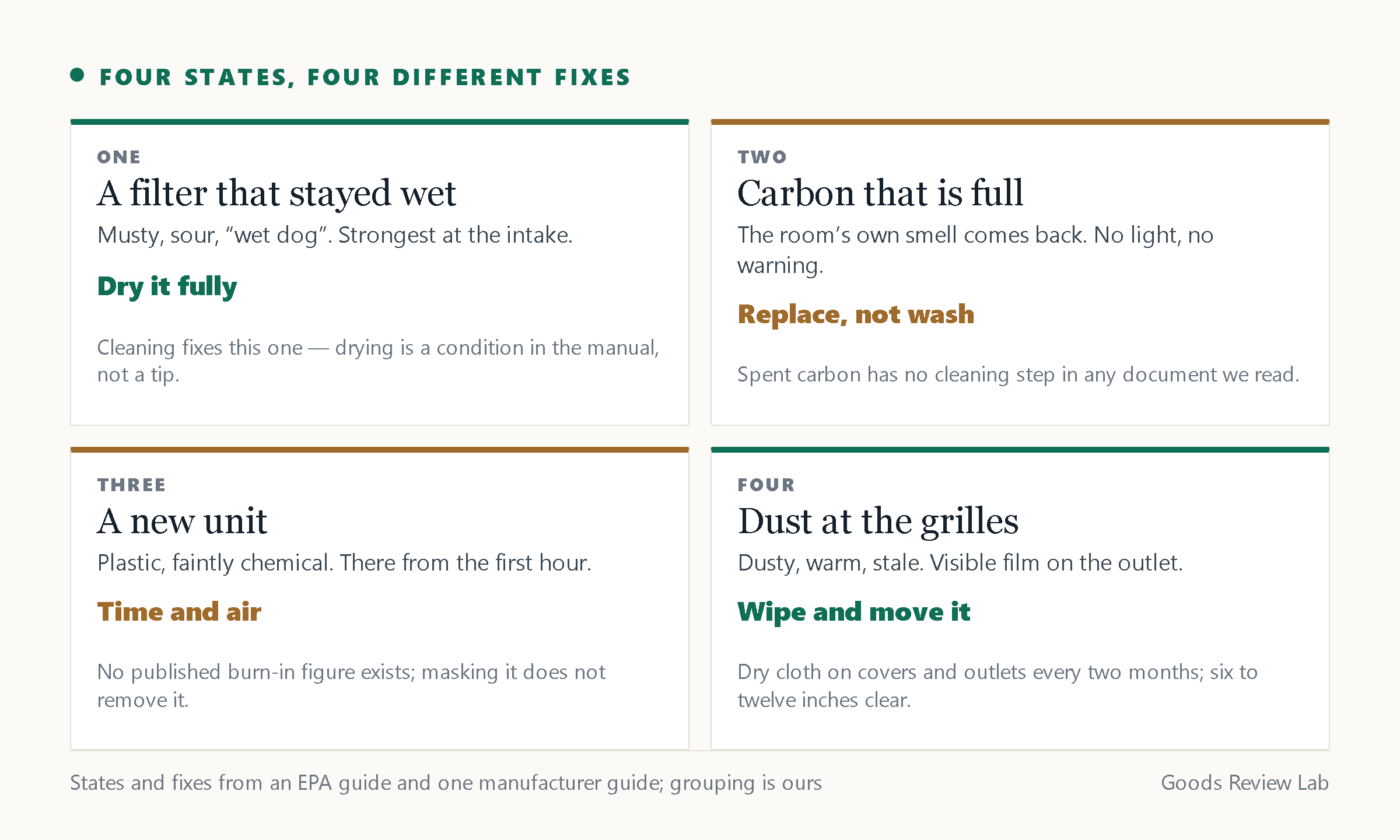
The table below is the whole page in one screen. The right-hand column is the part that most advice skips: whether the action available to you can actually remove the smell, or only move it.
| State of the part | What it smells like | How to tell it is this one | What removes it |
|---|---|---|---|
| Filter that stayed damp | Musty, sour, “wet dog” | The smell is strongest at the intake, and it appeared after a wash or a humid stretch | Dry it fully, then find the moisture. The manufacturer’s instruction is to let the pre-filter dry completely before reinstalling |
| Carbon layer, spent | Nothing, then everything — the room smell comes back | The smell is the room’s own smell, no longer being taken out; the unit is months old | Replace the layer. There is no cleaning step, and no sensor tells you when it is done |
| New unit, plastics and adhesives | Plastic, “new”, faintly chemical | It was there from the first hour and is fading on its own | Time and ventilation. No manufacturer we read publishes a duration, and none of the three technologies the EPA reviewed is shown to remove the gases |
| Dust at intake and outlet | Dusty, warm, stale | Visible film on the outlet grille; the unit sits against a wall or in a corner | Wipe it and move it. The guide asks for a dry soft cloth on covers and outlets every two months, and six to twelve inches of free space at the openings |
Note what the second column is not: a diagnosis. The words people arrive with — wet dog, sour, fishy, plasticky, musty — are not a key to the four rows. Two different rows can produce the same word, and the fishy one in particular is not assigned to any single component by any document we read. That is why the third column exists: the test sorts the state, and the state picks the action.
One: a filter that stayed wet
The washable pre-filter is the only layer in the machine that is meant to get wet, and the manufacturer’s own instruction attaches a condition to it rather than a tip: rinse or vacuum it every two to four weeks, allowing it to dry completely before reinstalling. That word “allowing” is doing real work. A pre-filter that goes back damp puts a wet surface in front of two dry layers and inside a moving air stream, and from outside the machine looks exactly like a clean one.
This is where the smell names crowd in. Owners describe the result as musty, sour or like a wet dog, and the queries that reach this subject treat those as three problems. They are one state. A medium that stayed damp is a surface with water on it, and what grows on a damp surface does not care what the room calls the smell.
The part of this that is ours, not the manufacturer’s: the guide says to dry the filter completely, and it does not say that a damp filter causes odour. The link between the two is our reading of the instruction — the drying condition only makes sense as a control on exactly that outcome. We are labelling it rather than presenting it as a published finding.
The test is cheap and it takes a minute: take the pre-filter out, hold it up, and smell it on its own, away from the machine. If the smell is in the filter, it is this row. If the filter smells of nothing and the machine still does, the smell is downstream of it — which in a purifier means the carbon layer, the housing, or the room.
Drying is not the whole fix, because a filter that stayed damp did so for a reason. A unit in a basement, a bathroom wall, or a room where a humidifier runs nearby will keep collecting the same condition. The washing procedure itself is on how to clean an air purifier filter, which also covers the layers that must never go in water.
Two: carbon that is full
A carbon layer does not get dirty, it gets used up. It holds gas molecules on its surface, and when the surface is occupied the layer stops taking more. Nothing about that process is visible, and nothing in the machine reports it: the filter light on the units we read about follows a countdown, not a measurement of what the carbon has absorbed. The manufacturer’s guide states its indicator rule as “up to one year” — a rule of thumb about time, which is the one thing gas loading does not follow.
This is also the layer where the industry’s own measuring system stops. The EPA’s guide says plainly that CADR — the number on the box, the number every buying guide compares — is a particle rating, and that there are no widely used performance rating systems for filters designed to remove gases. A purifier can carry a high CADR and a token carbon mat at the same time. The number is not lying; it was never about smell.
What the same document does say about gas removal is short and physical: activated carbon can be effective provided that there is a large amount of material used in the filter, and the thicker the material the better. It also closes two escape routes that the market sells hard — that research has not yet shown plasma, photocatalytic oxidation or ultraviolet light to remove gases effectively in portable residential air cleaners. For a smell, the quantity of carbon is the only published lever.
In practice this changes what you do about a room smell that will not leave. Replacing the carbon layer is the action that follows from the documents; washing it is not an action that any document supports. If the replacement layer in your unit is a thin mat behind the pleats, the honest expectation is that it will saturate again on the same schedule, and that no setting on the panel will tell you when.
Three: a new unit
A new purifier that smells of plastic is not faulty in any way the documents describe. The smell is gases coming off materials — the EPA’s page on volatile organic compounds lists adhesives and glues among the products that emit them, and notes that concentrations of many VOCs are consistently higher indoors than outdoors. A housing, a gasket and a fresh filter are all sources of that class of emission, and a fan that moves room air through them is a very effective way to notice it.
What no document we read provides is a number for how long it lasts. Product pages in this category suggest a few days; none of the four documents states a burn-in period, and we are not going to invent one. What the documents do support is the direction of the fix: the emission falls off with time, and it is diluted by air, so ventilation and running the unit in a room you are not sitting in both act on the same variable. Masking it does not.
The experiment worth knowing about: the EPA’s ozone document describes a laboratory test in which ozone was mixed with chemicals from new carpet. The ozone did reduce many of those chemicals, including the ones that produce new-carpet odour — and the reaction produced a variety of aldehydes, so that the total concentration of organic chemicals in the air increased rather than decreased. That is the mechanism behind the next section, in one paragraph.
Four: dust at the intake and the outlet
The fourth state is the only one a cloth fixes, and the manufacturer’s guide gives it a clock: wipe the exterior covers and air outlets with a dry, soft cloth at least every two months, so that air is flowing freely. The same guide asks for about six to twelve inches of free space wherever air flows in or out of the unit. Those two instructions are the whole of the published advice on this row.
Put a unit in a corner with four inches behind it and the same air is drawn through the same grille repeatedly; the film that builds there is room dust, and warm dust has a smell of its own that people attribute to the machine. The test is visual and takes ten seconds: look at the outlet grille with the unit off. If you can see a grey film, that is the row.
This is also where the machine’s own sensor gets involved, and it is the part almost nobody cleans. The guide asks for the air-quality monitor to be wiped with a cotton swab about every two months — the same clock as the exterior. A dust-covered sensor does not make the room smell; it makes the machine choose a fan speed for a room it is no longer measuring correctly, which is a different problem with the same cause.
The answer that makes it worse
Search for a smell that will not leave and a whole product category arrives to meet you: ozone generators, “odour eliminators”, and purifiers with an ozone or ioniser stage sold on the strength of odour. The EPA has a document about exactly this claim, and it is unusually direct.
Two sentences carry most of it. First: no agency of the federal government has approved these devices for use in occupied spaces — and the document notes that some vendors suggest otherwise. Second: at concentrations that do not exceed public health standards, ozone has little potential to remove indoor air contaminants, and there is evidence that it is not effective at removing many odour-causing chemicals. One example in the same document is worth keeping: body odour may be masked by the smell of ozone but is not removed by it.
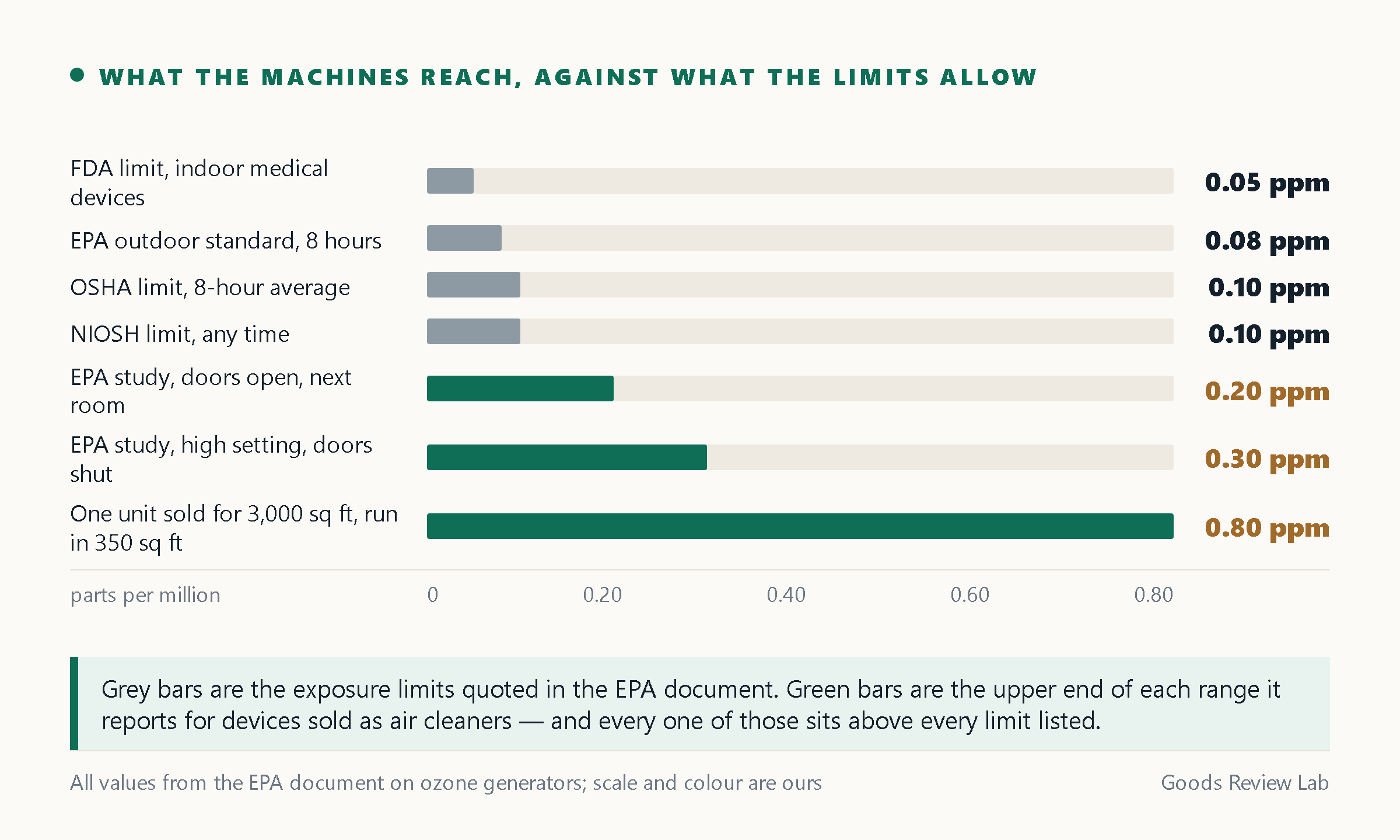
The numbers behind that figure come from the same document. A unit recommended by its manufacturer for spaces up to 3,000 square feet, placed in a 350 square foot room and run on high, took the room to 0.50 to 0.80 ppm — five to ten times the public health limits it lists. In a separate EPA study, some devices run on high with interior doors closed frequently reached 0.20 to 0.30 ppm, and a powerful unit on high with the doors open reached 0.12 to 0.20 ppm in adjacent rooms. For scale, the limits in the document are 0.05 ppm for indoor medical devices (FDA), 0.10 ppm averaged over eight hours (OSHA), and 0.10 ppm not to be exceeded at any time (NIOSH).
There is a second thing to check before buying, and it is free. The EPA’s guide to air cleaners warns that air cleaners containing electrostatic precipitators, ionisers, UV lights without adequate lamp coatings, and plasma units may emit ozone, and it points to two published lists of units tested and shown to emit little or no ozone — one maintained by the California Air Resources Board, one by the Association of Home Appliance Manufacturers. That is a check you can run on a specific model, which is more than the CADR number can offer you on a smell.
The order to test them in
Four states, and no reason to test them in the order they appear above. The order below goes from the cheapest test to the most expensive action, which is the only ordering that makes sense when three of the four tests cost nothing.
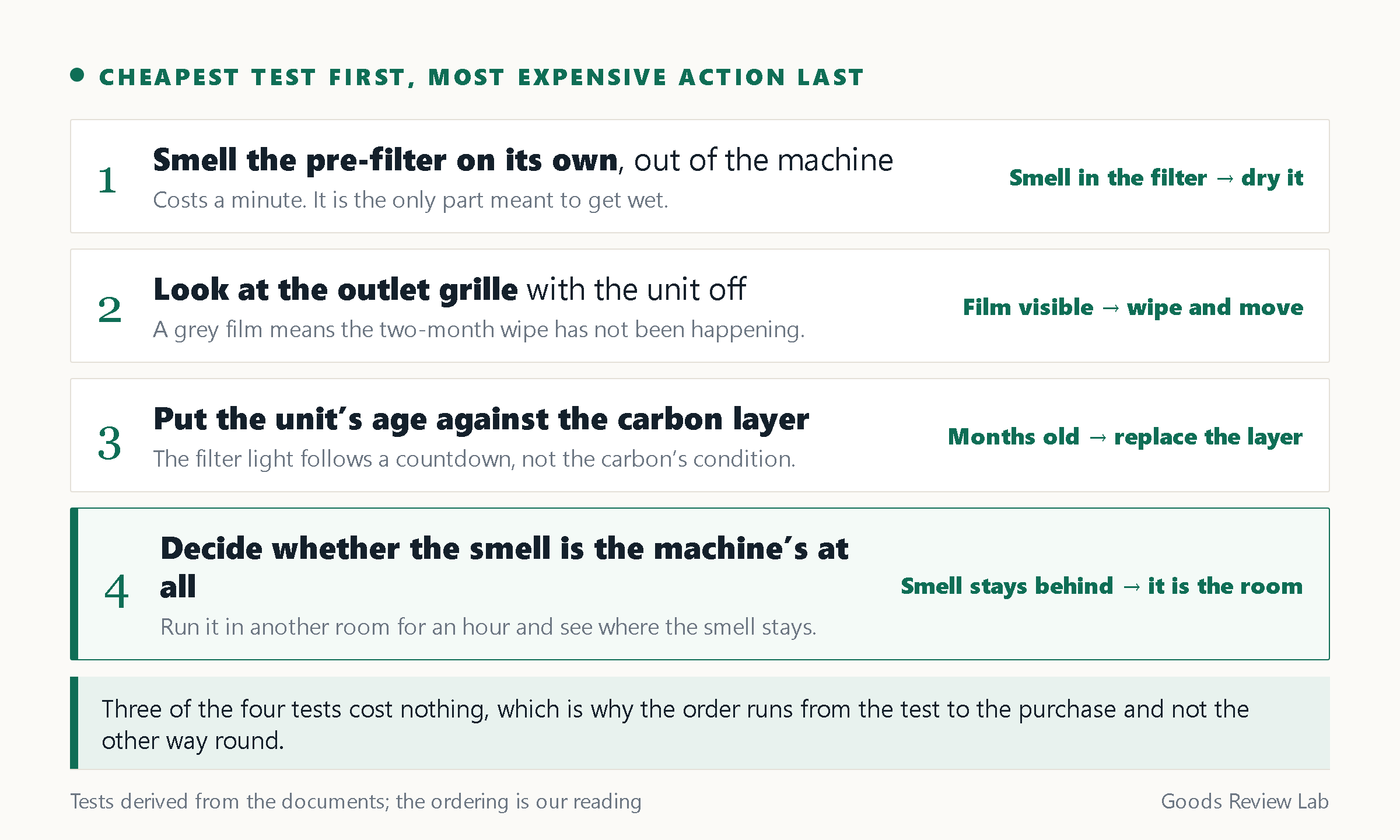
- Smell the pre-filter on its own. Out of the machine, held away from it. Smell in the filter means the damp row; no smell in the filter means look further in.
- Look at the outlet grille with the unit off. A visible grey film means the dust row, and it means the two-month wipe has not been happening.
- Put the unit’s age against the carbon layer. If the layer is months old and the smell is the room’s own smell coming back, the carbon is the row — and no amount of washing changes it.
- Decide whether the smell is the machine’s at all. Run the unit in a different room for an hour. If the smell stays where the machine is not, the source is the room.
When the machine is not the answer
One case deserves its own heading because the honest answer is that this page cannot help and neither can the purifier. The EPA’s guide answers the question “can portable air cleaners solve mould problems?” with a flat no: they do not address the cause of mould and musty odours, because that cause is a water or moisture problem in the building. The same paragraph allows that a purifier may remove some of the particles mould generates and may in some cases help reduce odours — and then closes it: they will not resolve a mould and moisture problem.
If that is what you are smelling, the sequence is to find the moisture and clean up the mould, and the machine is at most a way to take particles out of the air while you do it. A purifier bought to fix a damp basement will run for a year, filter a great deal of air, and leave the smell exactly where it was.
The same logic applies to the humidifier in the next room, which is a wet object by design. If a humidifier is running nearby, the moisture it adds is part of the room the purifier is sampling; mould in a humidifier covers that side of it, and cleaning a dehumidifier covers the machine that is supposed to be removing the water rather than adding it.
What this page deliberately does not do: rank purifiers by smell, or name a model that will not smell. Nothing in the documents we read supports that ranking, because the gas side of the category has no rating system in wide use — which is the finding, not a gap in our research. What you can check on a specific model is whether it appears on the low-ozone lists, and what your own manual says about the carbon layer. For the rest of what we look at in this category, see Home Air, and for how the site is funded, disclosure.
Questions this page answers
- Why does my air purifier smell?
- Because one of four things is happening: the pre-filter stayed damp, the carbon layer is full, the unit is new and its plastics are still releasing gas, or dust has built up on the intake and outlet. They are different faults and only the first and last are fixed by cleaning.
- Why does my air purifier smell like wet dog?
- The most likely state is a pre-filter that went back into the machine damp. The manufacturer guide we read asks for the pre-filter to dry completely before it is reinstalled, and a wet medium in front of two dry layers is the condition that produces a musty, animal smell. Take the filter out and smell it on its own to confirm.
- Do air purifiers actually remove smells?
- Only the gas side does, and that side is the one with no rating. The EPA states that CADR, the number on the box, is a particle rating, and that there are no widely used performance rating systems for filters designed to remove gases. What the same document gives is physical: activated carbon works when there is a large amount of material, and thicker is better.
- Do ozone air purifiers remove odours?
- Not at levels that are safe to breathe. The EPA states that at concentrations which do not exceed public health standards, ozone has little potential to remove indoor air contaminants and is not effective at removing many odour-causing chemicals, and that no agency of the federal government has approved these devices for use in occupied spaces.
- What if the smell is mould or a damp basement?
- Then a purifier is not the answer. The EPA's guide states that portable air cleaners do not address the cause of mould and musty odours, because that cause is a water or moisture problem in the building; the machine may take some particles out of the air but will not resolve the problem. Find the moisture first.
What this rests on
Three EPA documents and one manufacturer maintenance guide, all four read on 27 October 2026. The manufacturer sells replacement filters; that interest is labelled below and again where its timing is used.
- That portable air cleaners do not address the cause of mould and musty odours, that they may remove some particles mould generates and may help reduce odours but will not resolve a mould and moisture problem, that air cleaners with electrostatic precipitators, ionisers, uncoated UV lamps or plasma may emit ozone, that two published low-ozone lists exist, that CADR is a particle rating measured at the highest speed, that there are no widely used performance rating systems for filters designed to remove gases, that activated carbon can be effective provided a large amount of material is used, and that research has not shown plasma, photocatalytic oxidation or UV light to remove gases effectively in portable residential air cleaners: the US Environmental Protection Agency’s Guide to Air Cleaners in the Home, second edition. A government guidance document; it tests no specific model and endorses no brand.
- That no agency of the federal government has approved ozone-generating devices for use in occupied spaces, that at concentrations not exceeding public health standards ozone has little potential to remove indoor air contaminants and is not effective at removing many odour-causing chemicals, that body odour may be masked by the smell of ozone but is not removed by it, that a unit sold for spaces up to 3,000 square feet reached 0.50 to 0.80 ppm in a 350 square foot room, that other devices reached 0.20 to 0.30 ppm on high with doors closed and 0.12 to 0.20 ppm in adjacent rooms with doors open, and the four exposure limits quoted (FDA 0.05 ppm; OSHA 0.10 ppm over eight hours; NIOSH 0.10 ppm at any time; EPA outdoor eight-hour standard 0.08 ppm): the US Environmental Protection Agency’s Ozone Generators that are Sold as Air Cleaners. A government review of peer-reviewed findings; it names no brand.
- That volatile organic compounds are emitted as gases from certain solids and liquids, that they are emitted by products numbering in the thousands including glues and adhesives, and that concentrations of many VOCs are consistently higher indoors than outdoors: the US Environmental Protection Agency’s page “What are volatile organic compounds (VOCs)?”. A definition page, last updated January 2026; it makes no claim about any purifier.
- That the pre-filter should be vacuumed or rinsed every 2 to 4 weeks and allowed to dry completely before reinstalling, that exterior covers and air outlets should be wiped with a dry soft cloth at least every two months, that the air-quality monitor should be wiped with a cotton swab about every two months, that six to twelve inches of free space should be kept wherever air flows in or out, and that the filter indicator is a rule of thumb of up to one year: a manufacturer’s published maintenance guide for its own Airmega line, published March 2025. The manufacturer sells the replacement filters this guide describes; its timing is labelled as the manufacturer’s figure.
- The reading that a smell name is not a diagnosis and that the state of the part is what sorts the four cases, the reading that the drying condition in the guide exists to control a damp-filter outcome the guide does not name, the reading that a countdown indicator cannot report gas loading, and the reading that the quantity of carbon is the only published lever on odour: our reading of the four documents above. These are not test results, and no purifier was dismantled for this page.
What we did not do and will not imply: we have not measured how much odour a filter change removes in a real room, because no document we read publishes that figure and we have no way to measure it here. The manual that came with your unit is the only document that speaks to your parts, and it outranks this page wherever the two disagree.