How long does a humidifier last? The number is in the warranty
No humidifier maker publishes an average lifespan, so the only duration you can plan against is the one printed in the warranty — and both warranties we read land on the same twenty-four months by two different routes. One gives it outright. The other gives twelve months and makes you ask for the rest inside fourteen days.
What it comes down to
- Is there an average lifespan?
- Not one that is published. Neither manual we read states how many years or hours a unit is expected to run. The only durations either document commits to are warranty terms and one consumable interval, so this page works from those and says plainly where the documents stop.
- The number to plan on
- Twenty-four months of cover, reached two ways. One warranty is two years from the original date of purchase with no action required. The other is one year, extended by one more if the unit is registered within fourteen days of purchase. Same total, different gate.
- What that number leaves out
- The parts that actually wear. The two-year term explicitly excludes the filter and the cleaning cartridge, and states that normal wear and tear is not a manufacturing defect. The one component with a printed replacement interval — thirty days — is the one the warranty does not cover.
- What shortens it faster than use
- Missing paperwork. Both warranties are conditional on proof of purchase, one is conditional on a fourteen-day registration, and one names mineral deposits as a way to void the term outright. A machine that is kept clean but cannot prove when it was bought has no warranty at all.
The question “how long does a humidifier last” has a published answer, but it is not the answer people are looking for. Nobody prints a service life. What two manufacturers do print, in the last pages of their own manuals, is a warranty term, an exclusion list and a set of conditions — and read together those three things describe the only span of time anyone is willing to put in writing. This page reads them side by side. It does not estimate an average, because estimating one would mean inventing a number that no document supports.
What we read
Two owner’s manuals and one federal fact sheet, all named and dated in the sources section: the manual for a Honeywell HUL535-series ultrasonic humidifier, the manual for a Levoit Dual 100, and the EPA fact sheet Use and Care of Home Humidifiers. The two manuals were already on this desk for a different question — why a humidifier stops working — and the warranty chapters at the back turned out to answer this one.
Both manuals are published by companies that sell humidifiers and the consumables that go in them, so neither has an interest in a short number. That cuts both ways: a long warranty is a marketing asset, and a wide exclusion list is how the same company keeps the promise affordable. We have used the manuals for what they are authoritative about — the term, the exclusions, the conditions, the claim procedure — and the EPA sheet for the cleaning cadence, because a seller has an interest in the cadence being lenient and a regulator does not.
One limitation, stated up front: two warranties are not a sample. They are two documents from two companies, chosen because they are the two manuals on this desk, and the fact that their terms converge is a fact about these two documents, not a survey of the category. Where we generalise below, the sentence says so.
The only two durations either manual prints
Read the Honeywell manual from the front and it describes a machine with no stated life at all. Read it to the back and two numbers appear. The first is a two-year limited warranty. The second is a sentence about an optional accessory: the Protec cleaning cartridge, which the manual says “keeps cleaning for 30 days”. Those are the only two time spans the document commits to, and they do not describe the same object.
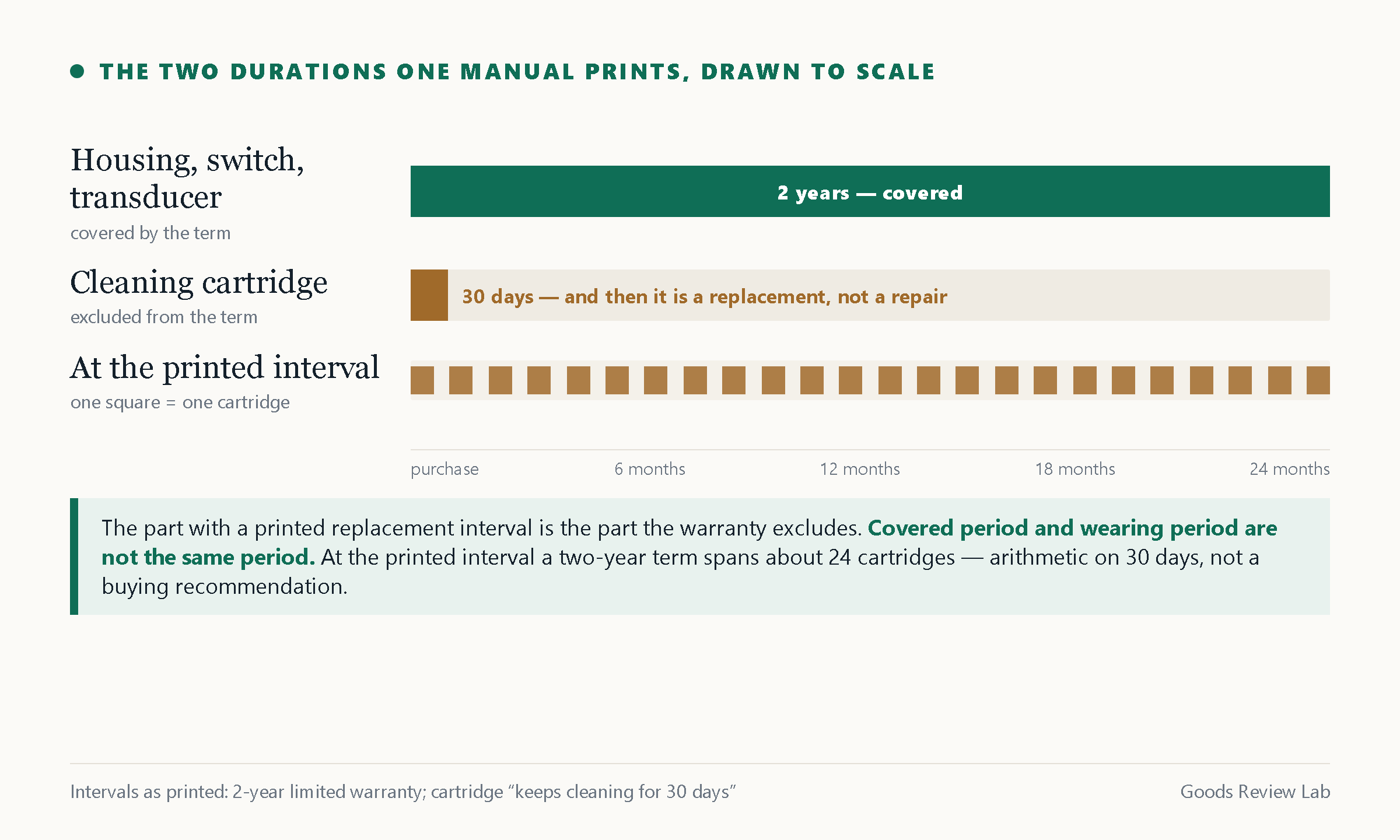
That pairing is the most useful thing on this page, and it is easy to read past. The part with a printed replacement interval is the part the warranty does not cover. The part the warranty covers for two years is the housing, the switch and the transducer — the components that have no stated interval because the manufacturer does not expect you to replace them on a schedule. So “two years” is not a statement about how long the machine works. It is a statement about how long the non-wearing parts are guaranteed, and the wearing part is sold separately, on a thirty-day clock, from the first day.
The Levoit manual has no equivalent consumable, and its term is written in one sentence: free from defects in material and workmanship, under normal use and conditions, for one year from the date of original purchase. What it adds instead is a second sentence that changes the arithmetic.
Two routes to the same twenty-four months
The Honeywell term is two years, applies only to the original purchaser, and starts on the original date of purchase. Nothing in it requires the buyer to do anything: registration is offered at the manufacturer’s site, and the reason given is product information updates and promotional offers, not an extension. Register or don’t, the term is the same two years.
The Levoit term is one year, and then a separate instruction: register the product within fourteen days of purchase and the one-year warranty is extended by an additional year. Add the two and it is twenty-four months — the same total as the other manual, reached by a route that has a deadline in it.
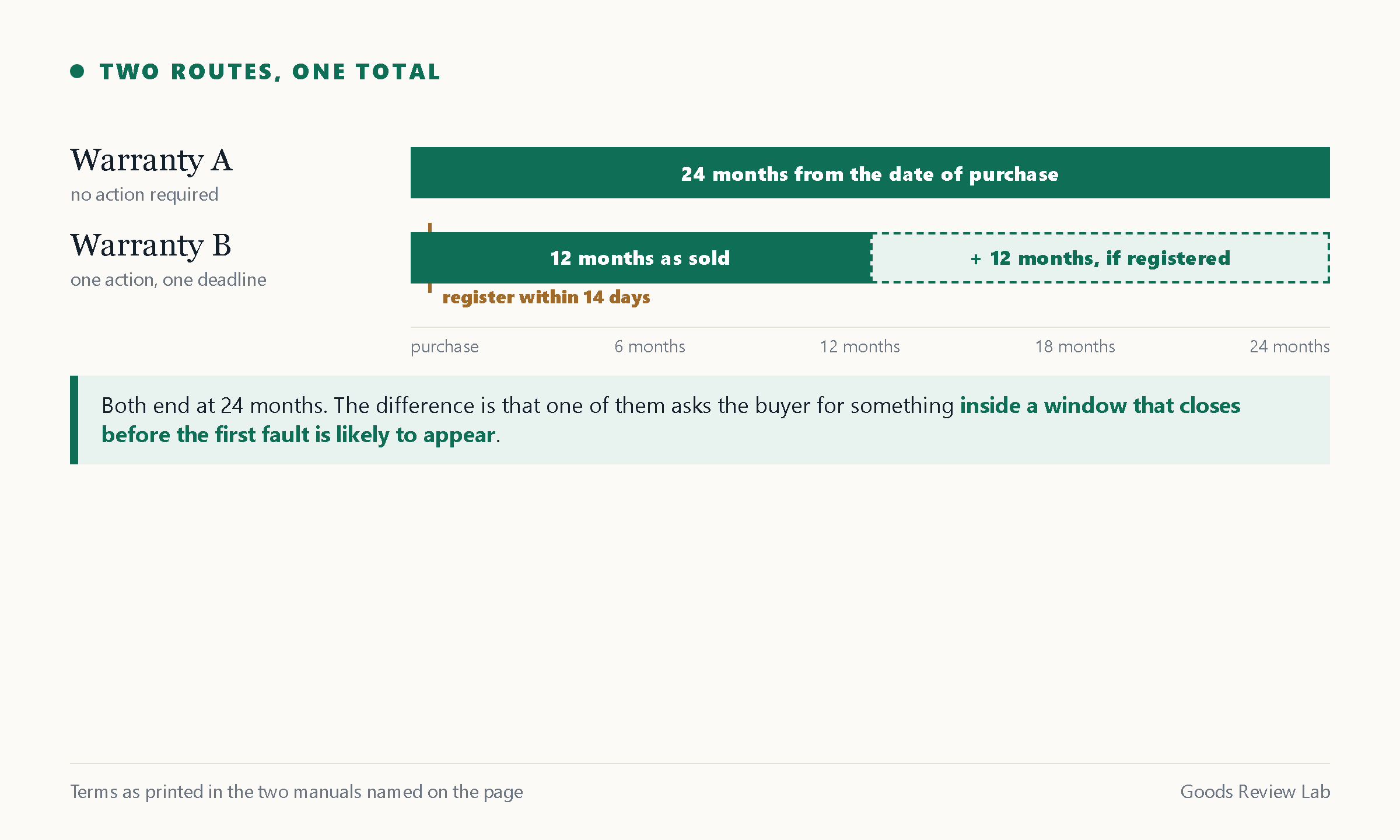
The practical consequence is asymmetric, and it is the reason this page exists. On the first route, a buyer who does nothing still has two years. On the second, a buyer who does nothing has twelve months, and the twelve months they lost are the ones furthest from the purchase — the period in which a fault is most likely to appear, because it is the period after the novelty has worn off and the machine has run through a full heating season. The window to claim the second year closes on day fourteen, which is before most people have taken the unit out of its box twice.
This is also the one place where the two documents disagree about what a warranty is for. One treats the term as a fixed promise attached to the product. The other treats half of it as something the buyer has to collect, and puts the collection point at the very start of ownership, when the receipt is still findable and the model number is still on the box.
What the twenty-four months does not cover
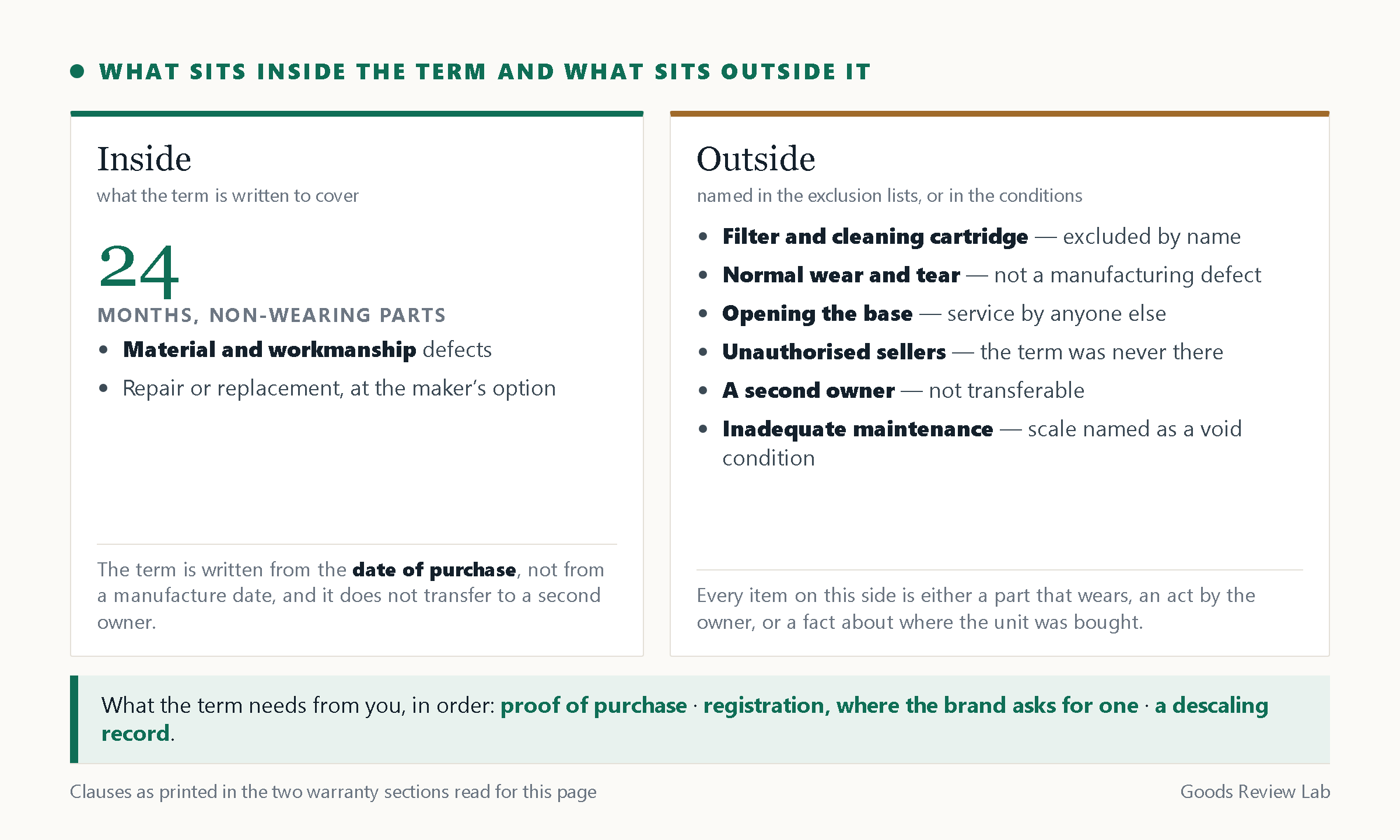
The term is the headline; the exclusions are the substance. Read the exclusion lists in full and a pattern appears that neither document states — our reading is that what is excluded is almost exactly what wears out, and what is covered is what does not.
| Clause | Honeywell HUL535 | Levoit Dual 100 |
|---|---|---|
| Term as printed | 2 years | 1 year, plus 1 more if registered |
| Starts on | The original date of purchase | The date of original purchase |
| Registration | Optional — offered for updates and offers, not for the term | Required within 14 days to reach the second year |
| Consumables | Filter and Protec cartridge explicitly excluded | No consumable is named in the warranty text |
| Normal wear | Not treated as a manufacturing defect | Improper or inadequate maintenance is excluded |
| Who can claim | Original purchaser only | Original consumer only; not transferable |
| Where it was bought | Not addressed in the warranty text | Products from unauthorised sellers excluded |
| Opening the unit | Unauthorised repair attempts not covered; the safety page says doing so voids the warranty | Service by anyone other than the manufacturer excluded |
| What a claim needs | Proof of purchase and a written description of the problem | A copy of the invoice and the order ID |
| What a claim costs | A $10 US handling fee plus prepaid shipping | Not stated in the warranty text |
Two rows in that table are worth stopping on. The first is consumables: one document says in as many words that the filter and cartridge are outside the term, and the same document gives the cartridge a thirty-day life. The second is who can claim: both warranties die with the first owner. A humidifier bought second-hand, or handed to a family member, carries no term at all — not a shortened one, none.
The two sentences that decide whether the term still exists
A warranty is not a clock that runs on its own. Both documents attach conditions, and both attach them to maintenance rather than to use, which is the opposite of what most owners assume. The Honeywell manual ends its troubleshooting table with a note, printed under the causes, that is easy to read as advice:
“Failure to keep this unit clean from mineral deposits normally contained in any water supply will affect the efficiency of operation of this unit. Customer failure to follow these instructions may void the warranty.”
Owner’s manual, Honeywell HUL535 series — note under the troubleshooting table
That is a warranty condition, not a tip. The same manual lists scale removal as a weekly task and gives the procedure — two cups of undiluted distilled white vinegar in the tank, swished, then left to drain into the reservoir so the nebulizer and float soak — and its safety page adds that attempting to repair or adjust electrical or mechanical functions voids the warranty. So the term survives only if the scale was dealt with and the base was never opened.
The Levoit list is written in the same spirit from the other direction. Among the things the warranty does not apply to: use that does not follow the manual, and damage from “improper or inadequate maintenance”. The manual then prints what adequate maintenance means — change the water daily, clean the humidifier every week and again before storage — so the condition and the cadence are in the same document, two pages apart.
Neither manual ships a log. That is the gap this page keeps coming back to: both warranties are conditional on a maintenance history, and neither gives you a way to record one. If a claim is ever contested, the thing that decides it is not what you did but what you can show.
The ten dollars nobody mentions
One clause in the Honeywell warranty is unusual enough to quote exactly. To return a defective unit, the owner sends it with proof of purchase and “a $10 US/$15.50 CAN check or money order for handling, return packing and shipping charges”, must prepay shipping, and is advised to keep tracking or delivery confirmation.
Read plainly, a claim under that warranty costs money before it returns anything: ten dollars, plus the cost of getting a humidifier to a returns address. On a fault that appears in month twenty of a two-year term, that changes the decision. A claim is worth making when the part is expensive or the unit is new; on a low-priced unit late in the term, the fee and the shipping can approach the value of what is being replaced. The document does not say this — it simply prints the fee — but the fee is the reason a warranty term and a repair budget are two different numbers.
The other manual has no fee and a different friction: contact support first, and do not dispose of the product before doing so. Both routes assume the same starting document, which is the receipt.
Three records that outlast the machine
Everything above collapses into one sentence: the warranty term is a property of your paperwork, not of the humidifier. Three records carry it, and they have different shelf lives.
- The proof of purchase. It fixes the start date, and the start date is the whole term. Without it neither warranty can be calculated, because both are written from the date of original purchase rather than from a manufacture date or a serial lookup.
- The registration, if the brand asks for one. On the Levoit route this is worth twelve months and expires in fourteen days. On the Honeywell route it is worth nothing to the term, which is why the two must not be treated as the same errand.
- The descaling record. This is the one nobody keeps. It is also the one the Honeywell warranty names as a condition, so it is the record that decides whether the term was ever valid, not merely whether the machine worked.
The Levoit manual does one small thing that deserves copying: it prints two blank fields, labelled order ID and date of purchase, and tells the owner to fill them in for their own reference. That is a manufacturer admitting, in the document, that the receipt will be lost.
The season boundary
The Honeywell manual has a section that most owners never reach, headed end-of-season care and storage. It asks for the cleaning procedure to be run whenever the unit will not be used for at least a week, for accessories to be removed and everything to dry completely before storage, and for the base, reservoir and tank to be stored without water in them.
The reason this belongs in a page about lifespan is arithmetic. A humidifier in a cold-climate home runs for one part of the year and sits for the rest, and the storage instructions are written for the sitting part. Water left in a base for months is the same mineral problem the warranty calls a void condition, arrived at by a different route — not through heavy use but through neglect at the moment the machine stops being interesting.
What ends a humidifier's use before the machine breaks
There is a fourth ending that no warranty covers, and the EPA fact sheet is where it appears. The sheet gives a cleaning cadence — empty, wipe dry and refill daily, clean every third day, keep indoor relative humidity at or below 50 percent — and then adds an instruction that is not about maintenance at all: stop using the humidifier and contact a physician if respiratory symptoms appear.
That is a different kind of endpoint. A machine can be inside its warranty, running exactly as designed, and still be a machine that should not be used in that room, because the humidity it is adding is feeding something. Nothing in either warranty addresses this, and nothing in either warranty would pay for it. It is the one ending that the owner decides, and it is decided by a number — the humidity reading — rather than by a fault.
So there are four ways a humidifier stops being used: a consumable reaches the end of its printed interval, scale takes the output down far enough to notice, the paperwork that would support a claim is gone, or the room should not be humidified any more. Only the second is usually described as wear.
The order that buys the most months
This ordering is ours, not the manuals’: it sorts the actions by what each one is worth in months rather than by how often it is recommended, and the list looks different from the usual advice. The top two items cost nothing but attention and one of them is worth twelve months.
- Register inside the window, if the brand has one. Worth twelve months, takes ten minutes, expires on day fourteen. Nothing else on this list returns as much.
- Keep the receipt where you keep tax paperwork, not in the box. This is what makes the term calculable at all. Photograph it the day the unit arrives.
- Buy from an authorised seller. One of the two warranties excludes units from unauthorised sellers outright, which means the term was never there to begin with.
- Descale on the manual's schedule. This protects the term rather than the machine: it is the condition the warranty names as a way to void itself.
- Do not open the base. Both documents exclude service by anyone other than the manufacturer, and one says plainly that doing it voids the warranty.
- Do not throw it away before calling. One manual says so in capitals. A unit in a landfill cannot be inspected, and inspection is the claim.
Notice what is missing: there is no seventh item about buying a better machine. The documents we read do not support one. They describe how a term is kept alive, not how a machine is chosen, and inventing a durability ranking out of two manuals would be exactly the kind of number this page refuses to print.
Where this page stops
This is a pass-through page, not a destination. It answers one question — how long the paperwork says the machine is covered, and what erodes that cover — and then hands the reader to the pages that answer the adjacent ones: what to do when the output drops, how to clean without voiding anything, and when the smell means stop.
Three things the documents do not say, recorded here so nobody has to look for them again: no hour count for the motor or the transducer, no replacement interval for the unit as a whole, and no statement of expected service life in years. If a page gives you a figure for any of those without naming a document, the figure came from somewhere other than the manufacturer.
Where the two sources disagree, the manual that came with your unit wins — including on the term, which is printed on the warranty page of your own booklet and may differ from both of the ones read here.
The card below puts the whole comparison on one page: each clause, both warranties, and the six actions in the order they are worth doing. It is the same content as this page, arranged to be kept with the receipt rather than read.
Questions this page answers
- How long does a humidifier last?
- No manufacturer publishes a figure. The longest duration either manual read for this page commits to is a two-year limited warranty, and that term covers material and workmanship in the housing rather than the whole machine — the filter and cleaning cartridge are excluded by name.
- Does a humidifier warranty cover the filter?
- No. One of the two warranties excludes the filter and the cleaning cartridge in as many words, and the same manual gives that cartridge a printed life of 30 days. The part with a replacement interval is therefore the part outside the term.
- Do I have to register a humidifier to get the full warranty?
- Only on one of the two. One term is two years from the date of purchase with no action required, and registration there is offered for product updates and offers. The other is one year, extended by one more only if the unit is registered within 14 days of purchase.
- Can I void a humidifier warranty by not cleaning it?
- Yes, on one of the two. That warranty says failure to keep the unit clean of mineral deposits may void it, and the same manual prints the scale-removal procedure. The other excludes damage from improper or inadequate maintenance, which is the same condition written from the other side.
- Does a humidifier warranty transfer if I sell it?
- No. Both warranties are limited to the original purchaser, so a second-hand unit carries no term at all rather than a shortened one. Neither document offers a way to transfer the remaining period to a new owner.
What this rests on
- That the limited warranty runs two years from the original date of purchase and applies only to the original purchaser, that it covers repair or replacement of product found defective in material or workmanship, that it does not apply to the filter or the Protec cartridge, that defects resulting from normal wear and tear are not manufacturing defects, that damage from unauthorised repair attempts or from use not in accordance with the manual is not covered, that a return requires proof of purchase plus a $10 US or $15.50 CAN handling payment and prepaid shipping, that registration is offered for product information updates and promotional offers, that failure to keep the unit clean of mineral deposits may void the warranty, that the optional cleaning cartridge keeps cleaning for 30 days, that scale removal uses two cups of undiluted distilled white vinegar, that attempting to repair or adjust electrical or mechanical functions voids the warranty, and that the unit should be cleaned before storage and stored without water in it: the owner’s manual for a Honeywell HUL535-series ultrasonic humidifier. Published by the company that sells the unit and the cartridge named in it; its warranty is quoted as that company’s term, not as an industry norm.
- That the product is warranted free from defects in material and workmanship under normal use for one year from the date of original purchase, that registering within 14 days of purchase extends the one-year warranty by an additional year, that the warranty does not apply to modified products, to use not in accordance with the manual, to damage from accident, abuse, misuse or improper or inadequate maintenance, to service by anyone other than the manufacturer, or to products purchased from unauthorised sellers, that it is not transferable to a subsequent owner, that a claim requires contact with support first and a copy of the invoice and order ID, that the product should not be disposed of before contacting support, that the water should be changed daily and the unit cleaned weekly and before storage, and that the manual prints blank order ID and date-of-purchase fields for the owner to fill in: the user manual for a Levoit Dual 100 humidifier. A manufacturer document; used for the term and the conditions, not for any health claim.
- That the tank should be emptied, wiped dry and refilled daily, that the unit should be cleaned every third day with scale and film removed, that scale can be a breeding ground for microorganisms, that indoor relative humidity should not exceed 50 percent, and that use should stop and a physician be consulted if respiratory symptoms appear: the EPA fact sheet Use and Care of Home Humidifiers, PDF dated June 2022, page last updated 29 April 2026.
- The reading that the only two durations either manual prints are a warranty term and a thirty-day cartridge interval, the reading that the covered part and the wearing part are therefore different parts, the arithmetic that one year plus one year equals the other warranty’s single term, the reading that a claim fee changes whether a late claim is worth making, the reading that both warranties are conditional on a maintenance history that neither document provides a way to record, and the ordering of the six actions by what each is worth: our reading of the three documents above. These are not test results, and no humidifier was run to failure for this page.
What we did not do and will not imply: we have not measured how long any humidifier lasts, because that would require running units to failure over years, and we have not surveyed warranty terms across the category, because two documents are not a survey. Where this page gives a number, the number is printed in one of the three documents named above. Where it gives a judgement — that the covered period and the wearing period are different periods, that the fourteen-day window is the whole difference between the two warranties — the judgement is ours and is labelled as ours.