Humidifier not working: three states, not one fault
“Not working” covers three different states: a machine that refuses to start, a machine that runs without making mist, and water that ends up where it should not be. The fixes do not overlap. This page separates the three using the troubleshooting tables the manufacturers print, and is explicit about the half of “leaks” that are not leaks at all.
What it comes down to
- What “not working” is
- Three states, not one. The machine refuses to start, the machine runs and produces no mist, or water leaves the machine. Each state has its own short list of causes, and the checks below are in the order that costs the least to run.
- The first thirty seconds
- Look at the power light. Both manufacturer tables put “no water in the tank” and “unit is not level” on the same row as “not plugged in” and “no power at the outlet”. A dark light is a water-level and level-surface signal as much as an electrical one, so the first check is not the socket.
- If it runs and stays dry
- Feel the housing. Warm and dry means the mist tube is not seated — the manual states that without the tube the unit makes no mist and the water temperature rises, and that this is not dangerous. Cold and dry points at scale on the nebulizer, a setting, or detergent left in the tank.
- If water is coming out
- Find where the water is before touching a seal. Inside the base, under the machine, or on the windows and walls. The third is not a leak: it is condensation, and the same manufacturer lists it as a cause of “water leaks from the humidifier”. Turning the mist down is the fix, not a new gasket.
A humidifier that has stopped working gets one piece of advice, and it is usually “clean it”. That advice is right for part of the problem and wrong for the rest, because the three states fail for reasons that have nothing in common. One is a switch that will not close. One is a part that is not where it belongs. One is a volume of water that is larger than the room can absorb. What follows is built from the tables the manufacturers themselves print, plus one federal fact sheet that contradicts both manuals on a number that matters.
What we read
Four documents, all named and dated in the sources section: the owner’s manual for a Honeywell HUL535-series ultrasonic unit, the user manual for a Levoit Dual 100, a three-article support page from Crane USA, and the EPA’s fact sheet Use and Care of Home Humidifiers.
The three manufacturer documents are written by companies that sell humidifiers and the consumables that go in them, so their interests are not neutral on the question of whether a fault is your fault or the machine’s. We have used them for what they are good for: the mechanical instructions, the part names, the order of assembly, and the causes each company is willing to print under its own product’s symptom. The EPA fact sheet is used for the cleaning cadence and the humidity ceiling, because those are the two places where a seller has an interest in the answer being lenient.
No humidifier was taken apart for this page and we are not a laboratory. Where a cause is printed in a manual, the manual is named. Where the connection between two printed statements is ours, the sentence says so.
Three states that share a phrase
The reason a single instruction fails is that the three states are not degrees of the same problem. A machine that will not start is being held off by something it can sense. A machine that runs dry has a part out of position or a surface that has stopped vibrating properly. A machine that puts water on the floor has either an assembly error or a room that is already saturated. The first needs a check, the second needs a part seated or a surface cleaned, the third usually needs the output turned down.
Before the three sections, one observation about the tables themselves, because it changes how you read them. Both tables are organised by symptom. Neither is organised by cause, and the causes cross rows freely. In the Honeywell table, the row for water overflowing from the reservoir and the row for condensation forming on windows and walls share their last two causes: the mist intensity is set too high for the room, and the unit is too close to a wall or window. That means a wet windowsill and an overflowing base are, in that document, the same fault reported two ways.
The second observation is about what the causes actually are. Sorted by what you would have to do about them, everything on both tables falls into five kinds:
| Kind of cause | What is on the tables | What it costs you |
|---|---|---|
| Power | Not plugged in; no power at the outlet | Nothing — a different socket |
| Water | No water in the tank; dirty water; mineral deposits; detergent residue | Nothing — refill, rinse, or soak in vinegar |
| Placement | Unit not level; too close to a wall or window; standing on carpet or a surface with fibres that block the air inlet | Nothing — move it |
| Assembly | Mist tube not seated; float not installed; sealing ring not in place; tank not aligned on its marks; tank cap not tight | Nothing — put the part back |
| A damaged part | A cracked or dropped tank; a missing cap seal | A replacement part. These are the only two on either table |
Four of the five kinds cost nothing to rule out, and two of them are things you can see without any tool at all. That is the argument for checking in this order rather than starting with a cleaning, which is the step that takes longest and, as the next section shows, is itself on the list of causes.
One: the light is off
The Honeywell table’s first row is “Power Knob is turned On and the Power Knob light is off”, and it lists four causes underneath: the unit is not plugged in, there is no power at the outlet, there is no water in the tank, and the unit is not level. Three of those four are not electrical. The Levoit table answers the same symptom with “unplug the humidifier and plug it back in” and “fill the water tank if it is empty” — again, one electrical answer and one water answer.
So the light going dark is not a reliable statement about the power supply. It is a statement that the machine has decided not to run, and the water level and the machine’s attitude on the surface are both inputs to that decision. Neither manual describes the mechanism that enforces it; what they do is print the cause and print the remedy (“place on a level surface”) in the same row, which is enough to act on.
The fourth cause is the one people skip: the air inlet. On the Levoit, the inlet is in the base, and the manual’s placement instruction is explicit that the unit should not go on floors, carpets, rugs or surfaces with fibres that may block it. A machine standing on a deep rug is a machine with its intake covered, and the same document pairs a covered intake with a unit that runs hot.
Two: it runs and makes no mist
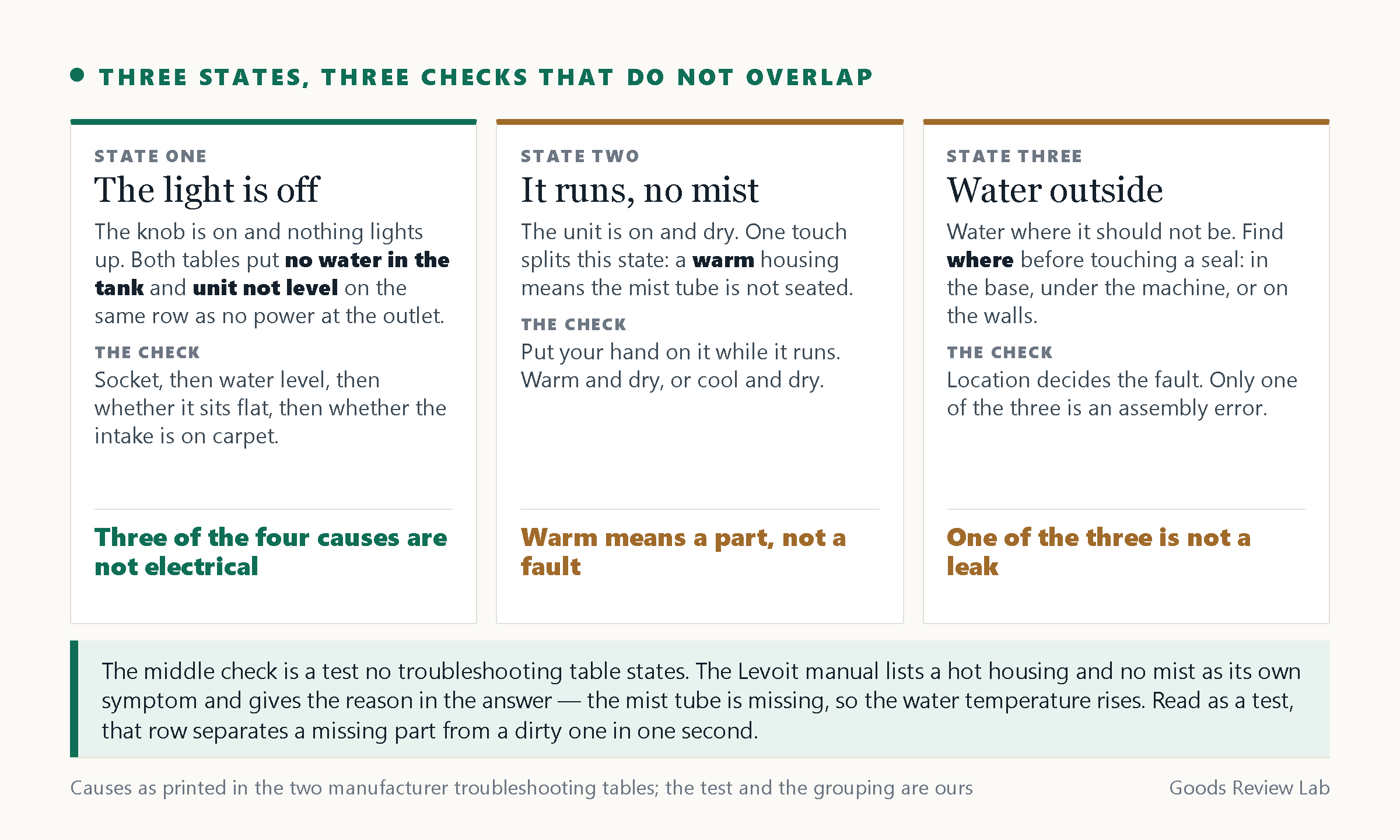
This is where the two manuals give you something no summary of them does: a way to split the state in one touch. The Levoit table has a separate row for “humidifier is hot (or the water inside is hot), and little or no mist comes out”, and its answer is that the mist tube is not in place. The manual then states the consequence in its own words: without the tube the unit will not create mist and the water temperature will rise, that this is not dangerous, and that the unit will not work correctly until the tube is put back.
Which gives a test that costs one second and needs no tools. Put your hand on the housing while it is running:
| What you find | Most likely state | What the documents print |
|---|---|---|
| Warm housing, no mist | The mist tube is not seated | Levoit: “If the mist tube is not in place, the humidifier will not create mist, and the water temperature will rise.” Press it down until the tab clicks |
| Cool housing, no mist | Scale on the nebulizer or transducer | Honeywell lists mineral deposits on the nebulizer first; Levoit says to clean the transducer with a brush and white vinegar |
| Cool housing, no mist, recently washed | Detergent residue | Honeywell lists “Water Tank or Base were washed with detergent” as a cause; the remedy is rinsing until there is no foam or smell |
| Water standing above the mark in the base | Too much water in the base | Levoit: “Make sure the water level in the base is not too high” |
| Mist at the outlet, room still dry | Output too low, or aimed at a wall | Honeywell: raise the setting, and move the unit off the wall or turn the outlet away from it |
The detergent row deserves a paragraph of its own, because it inverts the advice everyone gives. Washing the tank with dish soap is the obvious response to a machine that has stopped misting, and on the Honeywell table it is a cause of a machine that has stopped misting. The remedy printed next to it is not a better cleaning; it is rinsing with clean water until there is no foam and no smell of cleaning solution. The EPA fact sheet makes the same point from the health side: if you use a cleaning or disinfecting agent, rinse the tank thoroughly, to avoid releasing chemicals into the air during use. A machine that was cleaned harder is a machine that can fail for the cleaning.
Three: the water is outside the machine
Both tables treat “leaking” as one row, which is why the advice for it is a list of six things to check in no particular order. The list sorts itself if you look at where the water actually is, because the three locations have three different answers and only one of them is about a seal.
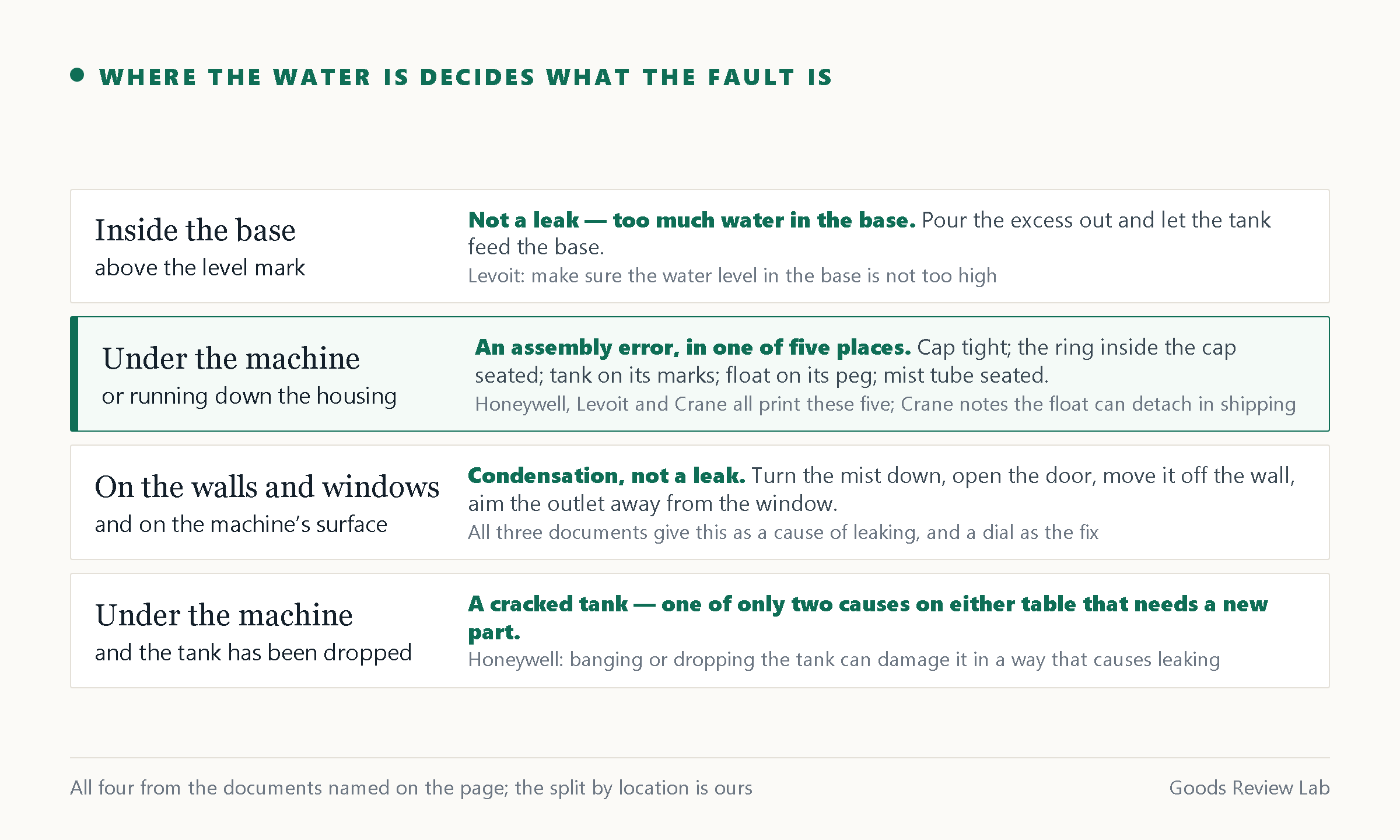
| Where the water is | What it usually is | What to do |
|---|---|---|
| Inside the base, above the level mark | Not a leak — too much water in the base | Pour the excess out and let the tank feed the base |
| Under the machine, or running down the housing | An assembly error, in one of five places | Tank cap tight; the rubber sealing ring inside the cap present and seated; tank aligned on its indicator marks; float installed; mist tube seated |
| On the machine’s surface, the windows, the walls | Condensation, not a leak | Turn the mist down, open the door, move the unit off the wall, aim the outlet away from the window |
| Under the machine, and the tank has been dropped | A cracked tank | Replace the tank. Honeywell states that banging or dropping it can damage it in a way that causes leaking |
The five assembly points are not equally likely, and one of them arrives already wrong. The Crane support page answers “what is loose at the bottom of my humidifier” with the explanation that during shipping the water-level sensor float and its cap can detach from the base, and the fix is to place the float — the white washer — onto the tall thin peg and press the cap down until it snaps. A unit that has never worked since it came out of the box is therefore not necessarily a broken unit. It can be a unit with one plastic part still in the packaging.
The same support page gives the leak instruction that is easiest to follow and hardest to remember: if you move the humidifier often, carry the tank and the basin separately. A tank carried while seated sloshes against a seal that is only designed to hold still water.
The fault you can create while fixing it
Cleaning is the answer to most of what is above, so it is worth being precise about the cadence, because the documents do not agree on it. The EPA fact sheet asks for two different things at two different intervals: empty the tank, wipe all surfaces dry and refill daily, and clean the portable humidifier every third day with a brush, removing scale and film from the tank walls and interior surfaces. The three manufacturer documents all describe a weekly cleaning. Seven days against three is a little over twice the interval, and the two numbers are not measuring the same thing.
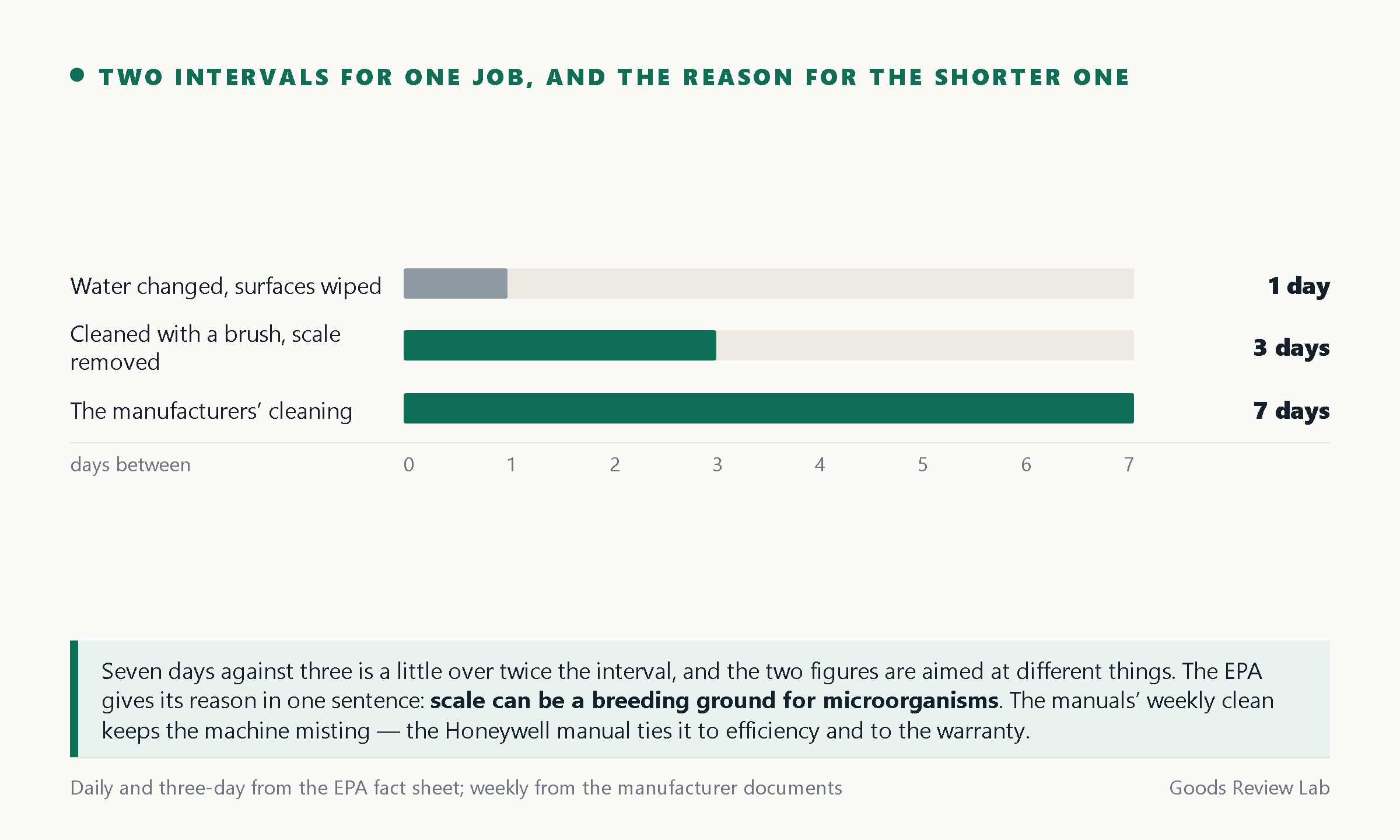
The reason is in the EPA’s own text: scale can be a breeding ground for microorganisms. A manufacturer’s weekly clean is written to keep the machine misting — the Honeywell manual even ties the warning to the warranty, stating that failure to keep the unit clean from mineral deposits will affect efficiency. The EPA’s three-day clean is written to stop the deposit becoming a surface that things grow on. Both are honest about their own goal. If you are cleaning to protect the machine, weekly is the figure the maker stands behind; if you are cleaning because the machine puts water into the air you breathe, the shorter interval is the one from the agency with no product to sell.
Two practical notes from the same documents. First, the EPA asks for a rinse with several changes of water after any cleaning or disinfecting agent, for the reason quoted above. Second, neither manual asks you to immerse the base: the Crane page puts it in capitals, and the Honeywell scale-removal steps keep the water in the tank and the reservoir. The part that must not get wet is the part with the electrics in it, which is also the part the water ends up on when a seal fails.
The number that outranks the fault
There is one figure in these four documents that settles more arguments than any troubleshooting row, and the two kinds of source disagree about it. The EPA fact sheet says not to humidify to indoor relative humidity levels exceeding 50 percent, and gives the reason: higher levels may encourage the growth of biological organisms in the home. The Honeywell manual says a comfortable humidity level is between 40 and 60 percent.
Put the two together and the band that both documents support is 40 to 50 percent. The manual’s upper figure sits on the side of the EPA’s ceiling that the EPA describes as encouraging growth. This is not a contradiction either document resolves; it is a case where the neutral source is stricter than the seller, and the overlap is the only part of the range where you are not choosing between them.
It also explains the most common “leak” report. The EPA tells you what to do if water condenses on windows, walls or pictures: relocate the humidifier, lower the humidistat setting, or reduce its use. That is the same instruction the Honeywell table gives for condensation, and the same one the Levoit table gives as the last cause of a leak. Three documents, one action, and it is a dial rather than a repair.
When it is not the machine
Four things that look like this fault and are not, each with the page that covers it: white dust settling on furniture is a mineral content problem in the water rather than a defect, and is covered on the white dust page; a smell coming off the unit is a growth problem in the tank and wick, covered on the mould page; mist that is fine but weak because the wick or filter is spent belongs to filter replacement; and a dehumidifier that ices over is a different machine with a different cause, on the freezing page.
The order to check them in
- Look at the light. If it is off, check the socket, then the water level, then whether the machine is sitting flat, then whether its intake is on carpet. Those four cover every cause the two tables print for a dark light.
- Touch the housing while it runs. Warm and dry sends you to the mist tube; cool and dry sends you to scale, the setting, or detergent residue.
- Find the water before touching a seal. In the base, under the machine, or on the walls. Only the second one is an assembly problem.
- Check the five assembly points in the order they are easiest to see. Cap tightness, the ring inside the cap, the tank on its marks, the float on its peg, the mist tube seated.
- Then clean, and rinse until there is no foam. A residue left behind is on the list of causes.
- Then read the hygrometer, not the machine. If the room is above 50 percent, the correct action is to turn the output down, and no repair will fix a room that is already saturated.
One caution the EPA prints and neither manual does: stop using the humidifier and speak to a physician if you have respiratory symptoms you believe are connected to using it, even if you have followed the maintenance directions. That is not a troubleshooting step. It is the agency telling you that a machine which passes every check on this page can still be the wrong thing to run.
Where the documents stop helping
Both troubleshooting tables end the same way, and it is worth noticing what that ending is. The Honeywell table’s last instruction for a missing cap seal is to contact consumer relations; the Levoit table closes by telling the reader to contact customer support if the problem is not listed. Neither manual offers a seventh check, and neither lists a part inside the base as something the owner is expected to replace. The only two parts either document tells you to buy are a tank and a cap seal, and both are on the outside.
So there is a point where the honest answer stops being “check one more thing”. If the light is on, the housing is cool, the tube is seated, the base is not overfilled, the water is clean, and the nebulizer has been soaked, then the causes left are the ones the manuals do not ask you to service. That is the point to call the manufacturer rather than to take the base apart — not because the fault is unknowable, but because the documents that would tell you what to do next do not exist for this class of machine.
The card below puts the whole ladder on one page: each state, the check that identifies it, what the check points at, and the action the documents print for it. It is the same content as this page, arranged to be used next to the machine rather than read.
Questions this page answers
- Why is my humidifier not working?
- Because one of three things is happening: the machine is being held off by something it can sense, it is running without making mist, or water is leaving it. The three have no fix in common, so the first check is the power light — both manufacturer tables we read put no water in the tank and a unit that is not level on the same row as no power at the outlet.
- Why is my humidifier on but not misting?
- Feel the housing while it runs. Warm and dry means the mist tube is not seated: the Levoit manual states that without the tube the unit makes no mist and the water temperature rises, and that this is not dangerous. Cool and dry points at scale on the nebulizer, a setting that is too low, or detergent left in the tank.
- Why is my humidifier leaking water?
- Find where the water is before touching a seal. Inside the base it is overfilled, under the machine it is one of five assembly points, and on the walls and windows it is condensation rather than a leak. Only the second is a fault in the machine, and a cracked tank is the only cause on either table that needs a new part.
- Why won't my new humidifier turn on?
- A unit that has never worked since it left the box may have a part that came loose in transit. The Crane support page states that during shipping the water-level sensor float and its cap can detach from the base, and gives the refit: the white washer onto the tall thin peg, then the cap pressed down until it snaps.
- Why is my humidifier not misting after I cleaned it?
- Because detergent residue is itself a listed cause. The Honeywell table puts tanks and bases washed with detergent under little or no mist, and the remedy is rinsing with clean water until there is no foam and no smell of cleaning solution — the EPA gives the same instruction for any cleaning agent, so that nothing is released into the air during use.
What this rests on
- That a turned-on power knob with the light off can be caused by no water in the tank or by the unit not being level, that mineral deposits on the nebulizer and washing the tank or base with detergent both stop mist, that water overflowing from the reservoir and condensation on windows and walls share their last two causes, that a dropped tank can be damaged in a way that causes leaking, that a comfortable humidity level is between 40 and 60 percent, and that the unit must sit on a level surface: the owner’s manual for a Honeywell HUL535-series ultrasonic humidifier. The manual is published by the company that sells the unit; its 40–60 percent figure is quoted here as the manufacturer’s figure, not as a health limit.
- That without the mist tube the unit makes no mist and the water temperature rises and this is not dangerous, that a unit with no water in the tank will not turn on, that the water level in the base can be too high, that scale is cleaned from the transducer with a brush and white vinegar, that the tank must be aligned on its indicator marks and the sealing ring seated, that the float must be installed, that condensation when humidity is too high is listed as a cause of leaking, that a blocked water outlet can be cleaned with vinegar, that the inlet is in the base and the unit should not stand on carpet or fibres, and that the unit should be kept at least 15 cm from walls and furniture: the user manual for a Levoit Dual 100 humidifier. A manufacturer document; used for the mechanical instructions and the printed causes, not for any health claim.
- That the mist output can be too high for the space and the test is to see the mist rise rather than fall onto a surface, that the rubber ring inside the tank cap must be secure, that the tank and basin should be carried separately, that the water-level sensor float and cap can detach during shipping and are refitted by pressing the white washer onto the peg until it snaps, and that the base must never be immersed: three support articles published by Crane USA. A manufacturer support page; it sells the units it describes.
- That portable humidifiers should have the tank emptied, wiped dry and refilled daily, that they should be cleaned every third day with scale and film removed from the tank and interior surfaces, that scale can be a breeding ground for microorganisms, that a cleaning or disinfecting agent must be rinsed out thoroughly, that indoor relative humidity should not exceed 50 percent, and that use should stop and a physician be consulted if respiratory symptoms appear: the EPA fact sheet Use and Care of Home Humidifiers, PDF dated June 2022, page last updated 29 April 2026.
- The reading that the three states are separable by one touch of the housing, the reading that the printed causes sort into five kinds of which only one costs money, the reading that the two leak rows in the Honeywell table describe the same fault, the reading that the two cleaning intervals are aimed at two different goals, and the reading that the overlap between the EPA ceiling and the manual’s comfort band is 40 to 50 percent: our reading of the four documents above. These are not test results, and no humidifier was dismantled for this page.
What we did not do and will not imply: we have not run a humidifier through these faults and timed the repair, because that would be a test and this page is a reading of published instructions. The manual that came with your unit is the only document that speaks to your parts, and it outranks this page wherever the two disagree — including on the humidity figure, where the two sources quoted above already disagree with each other.