What size dehumidifier for 500 sq ft: 20–30 pints, or 40?
At 500 square feet a damp room at home is the chart’s cell: 20 to 50 pints, one unit. The drying formula, for materials that got wet, is a count from the restoration class the formula was written for. In that class both readings fit one machine, and the next rung up — 1,000 square feet — is where the count starts. What the two readings disagree about is capacity; the tank, not the pint rating, is what you will notice.
In short
- The chart’s answer
- 20–30 pints per day if the space is slightly to moderately damp, 25–40 if very damp, 30–50 if wet. That is the published cell for every floor area under 2,000 ft², so 500 has no row of its own.
- The formula’s answer
- 500 ft² at an eight-foot ceiling is 4,000 ft³. The standard’s class factors are 100, 50 and 40, so 4,000 ÷ 100 = 40, 4,000 ÷ 50 = 80 and 4,000 ÷ 40 = 100 pints per day. The two inputs are 4,000 ft³ and those three factors; the division is ours.
- Why both are one machine here
- Even the formula’s wettest answer, 4,000 cubic feet divided by the class-3 factor of 40, which is 100 pints, is below the 130–147 pints per day of the largest single LGR unit in the restoration class the formula was written for. So within that class the two readings never split into a count; they disagree about capacity, not about how many boxes to buy. The next rung, 1,000 ft², is where that stops: the middle class asks 160 pints against the same ceiling, so it needs two.
- What you will notice: the tank
- 20–100 pints a day is 2.5–12.5 US gallons. A two-gallon tank is emptied 1 to 6 times a day, every day. At this size that is the constraint, not the pint number.
- Which one is yours
- A lived-in room with nothing wet: the chart’s cell, rounded up. Materials that got wet: the formula, and one machine in the restoration class. A space that runs cold: neither figure was measured at your temperature.
Two answers to the same question
Ask how big a dehumidifier a 500 square foot space needs and there are two families of answer in circulation, both published, both arithmetic, and neither of them a guess. The first is the room chart: two axes, a floor-area band and a dampness condition, returning a range of pints per day. The second is the formula the drying trade uses on a water loss: affected cubic feet divided by a class factor, returning the pints per day of capacity required.
Run both on the same room and they do not agree — but at this size they do not disagree about the purchase. Below, the first two columns are the chart’s published cells and our division of 4,000 ft³ by the formula’s factors, and the last is how many of the largest single machines that division implies.
| Condition, in the chart’s words | Room chart, pints/day | Drying formula, pints/day | Units the formula implies |
|---|---|---|---|
| Slightly to moderately damp — 50–75% relative humidity | 20–30 | 40 | 1 |
| Very damp — 75–90% | 25–40 | 80 | 1 |
| Wet — 90–100% | 30–50 | 100 | 1 |
Why the two readings stop disagreeing here
At 2,000 square feet the same two readings stop describing one purchase: the formula’s answer passes the ceiling of the largest single unit, and that page is about a count of machines. At 500 the opposite is true. The formula’s wettest answer, 4,000 cubic feet divided by the class-3 factor of 40, which is 100 pints, is still below the 130–147 pints per day of the largest single LGR unit in the restoration class the formula was written for, so within that class the count stays at one. The ceiling is a restoration-fleet figure, not a consumer retail one. What is left to argue about is how much capacity to buy, not how many boxes.
That is the whole difference between this page and the 2,000 sq ft one. The arithmetic is the same; the conclusion is not. Here both readings land on one machine, and the decision moves to the tank.
The tank, at 2.5 to 12.5 gallons a day
A pint per day is a rate, and the rate is what fills the tank. Eight pints make a US gallon, so the chart’s 20–50 pints is 2.5–6.25 gallons a day and the formula’s 40–100 is 5–12.5. A two-gallon tank holds 16 pints, so it is emptied roughly 1 to 6 times a day. The division is ours; the pint cells are the published ones.
A floor drain is rare at this size, so a hose or pump is optional and the tank is the default.
Where the count starts
“One machine” has been doing a lot of work on this page without being shown. It is one division per row: the formula’s answer for the area, divided by the largest single unit the arithmetic is allowed to use. Put three areas through it and the last column does not move at 500 at all.
| Floor area | Cubic feet | Formula, mild / middle / wet | Units at a 130–147 pint single unit |
|---|---|---|---|
| 500 ft² | 4,000 | 40 / 80 / 100 | 1 / 1 / 1 |
| 1,000 ft² | 8,000 | 80 / 160 / 200 | 1 / 2 / 2 |
| 2,000 ft² | 16,000 | 160 / 320 / 400 | 2 / 3 / 3–4 |
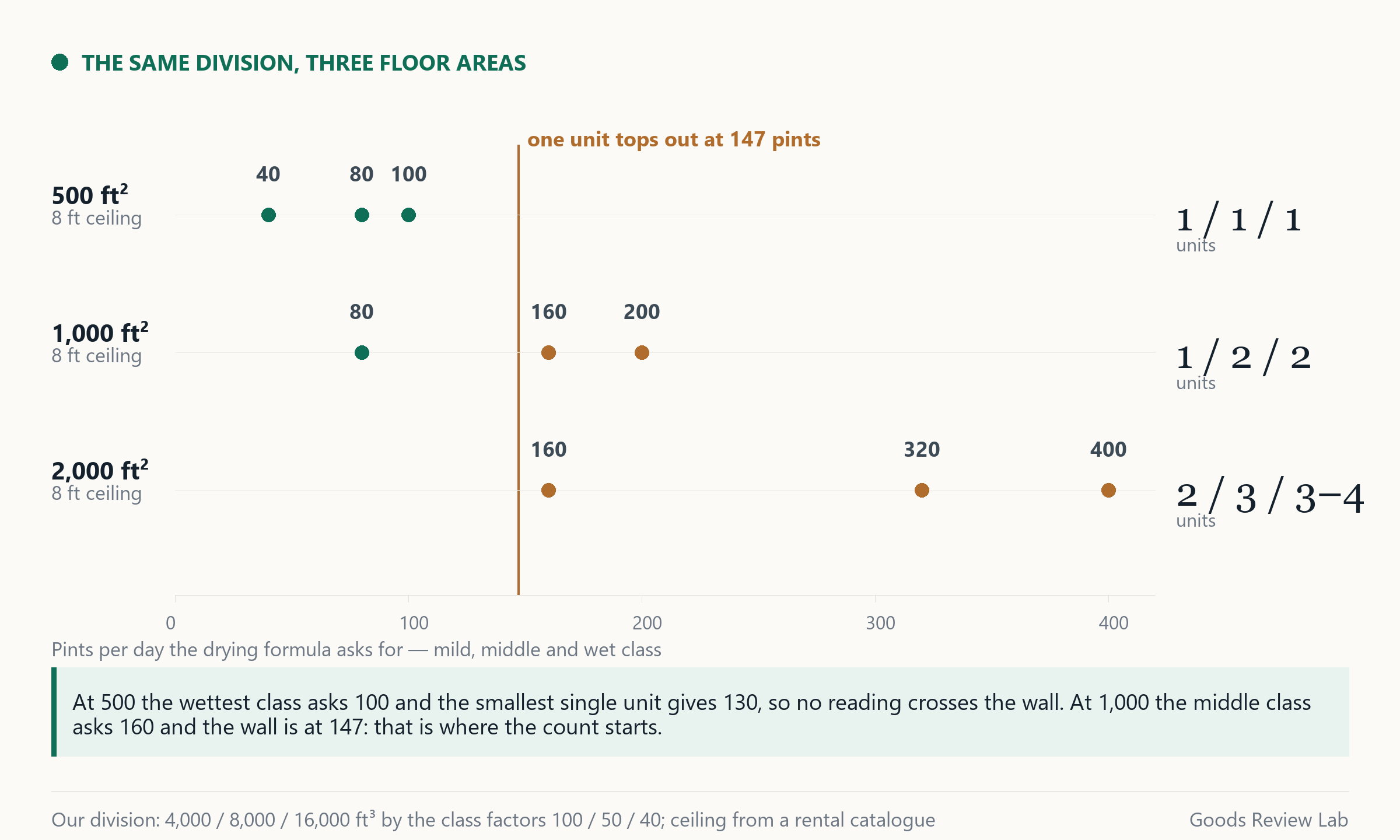
Read that last column as the answer to a different question. At 500 the wettest class asks 100 pints and the bottom of the ceiling, 130, is still above it, so no reading here crosses. At 1,000 the middle class asks 160 against a ceiling of 147: the margin is gone, and the wet class at 200 needs a second machine.
One limit on the table. The ceiling is a restoration-fleet figure, not a consumer retail one. Everything else in that column is our division of published class factors by a published ceiling, on units assumed identical; no document we read states how two smaller units compare with one larger one in the same room, so this page does not claim it.
Which reading is yours
A lived-in room with no water event: use the chart’s cell for your condition and round up. Materials that got wet: use the formula, and expect one machine, not a count. A space that runs cold: neither figure was measured at your temperature, and the fix is a unit rated for the cold, not a bigger pint number.
What neither reading covers
- A cold room. Capacity is measured at a fixed test temperature, and the rule text allows for units running from about 55 to 80 °F. Below roughly 65 °F the coil can frost and the unit cycles without removing water. A 500 sq ft basement is the room most likely to be cold.
Questions this page answers
- What size dehumidifier do I need for 500 sq ft?
- It depends which of two published methods fits your space. For a room you live in with nothing wet, the sizing chart returns 20 to 30 pints per day if it is slightly to moderately damp, 25 to 40 if very damp and 30 to 50 if wet. For materials that got wet, the drying formula returns 40, 80 or 100 pints per day on the same floor at an eight-foot ceiling. The chart sizes air; the formula sizes water in materials.
- Why do two calculators give different answers for 500 sq ft?
- Because they are not the same measurement. The chart's pints come from a rating taken at 65 degrees Fahrenheit under the current federal procedure; the drying formula is written in the older AHAM rating at 80 degrees. One also sizes the air in a room, the other the water in wet materials.
- Is 500 sq ft one dehumidifier or two?
- One in the restoration class the formula was written for: its wettest answer, 4,000 cubic feet divided by the class-3 factor of 40, which is 100 pints, is below the 130 to 147 pints per day of the largest single LGR unit there. That is where 500 differs from 2,000, where the same formula needs two or three units even in the restoration class.
- At what floor area does the answer stop being one machine?
- At 1,000 square feet, and only in the wetter water classes. On an eight-foot ceiling the formula asks 160 and 200 pints a day there, while the largest single unit in the catalogue the formula reads is rated 130 to 147, so both of those need two. At 500 the wettest class asks 100, which even the bottom of that range covers.
- Does the water class change how many units 500 square feet needs?
- No. All three classes return 40, 80 and 100 pints a day on 4,000 cubic feet, and the lowest rating in that single-unit range is 130, so the count stays at one whichever class applies. The class changes how much capacity to buy, not how many boxes.
- How many units do 1,000 and 2,000 square feet need?
- Two at 1,000 and two to four at 2,000, measured against the restoration ceiling. At 1,000 the mild class returns 80 pints, which one unit covers, and the middle and wet classes return 160 and 200, which take two. At 2,000 the classes return 160, 320 and 400, so two, three, and three or four depending on which restatement of the class factors you use.
- How often will I have to empty the tank in a 500 sq ft space?
- At the chart's wet band the cells are 30 to 50 pints a day, which is 3.75 to 6.25 US gallons; the formula's wet answer is 100 pints, or 12.5 gallons. A two-gallon tank holds 16 pints, so it is emptied roughly 1 to 6 times a day. The division is ours; the pint cells are the published ones.
- Does 500 sq ft get the same answer as 1,900 sq ft?
- On the chart, yes. Its floor-area axis has two rows, under 2,000 and over 2,000, so 500 and 1,900 return the same three cells. The dampness axis is what separates them, if anything does.
- My 500 sq ft space is cold. Does that change the answer?
- It can change whether any answer works. Capacity is measured at a fixed test temperature, and the rule text allows for units running from about 55 to 80 degrees Fahrenheit. Below roughly 65 degrees the condensing coil can frost and the unit cycles without removing water, so the fix is a model specified for low temperatures rather than a larger pint figure.
- Should I buy a bigger unit than the cell says?
- The cell for a 500 sq ft room in the table above gives numbers only: 20 to 30, 25 to 40 or 30 to 50 pints a day, depending on which dampness description fits. It prints no word such as minimum and it does not state what to do above those numbers. Reading that cell as a starting point rather than a limit is our inference. On that reading, taking the value the table suggests for your area and moving to a larger band is a use of the table itself, and we label it as ours because no wording in the table states it.
Where these numbers come from
The chart’s cells, the three condition descriptions and their humidity ranges are from ENERGY STAR’s dehumidifier sizing guidance, the AHAM-derived table, and its pints are on the current 65 °F federal rating basis. The drying formula — affected cubic feet divided by a class factor — is written in the older 80 °F AHAM basis the restoration trade still uses, and the class factors are the IICRC S500 restoration standard’s, as restated by the published restoration calculators we read: two print the four factors as 100 / 50 / 40 / 40 and one prints them as 100 / 40 / 30 / 50. The 130–147 pints per day ceiling on a single LGR unit in the restoration class is the top of the range in Allied Rental Company’s equipment catalogue, the rental catalogue this page reads; it is a restoration-fleet figure, not a consumer retail one. The rating temperatures, the definition of capacity in section 2.14 of appendix X1, the move from 80 °F to 65 °F in AHAM DH-1-2017, and the 55–80 °F field range are from the Department of Energy’s dehumidifier test-procedure rule text. The divisions of 4,000 cubic feet by 100, 50 and 40, the conversions from pints to gallons, the tank arithmetic, the unit counts in the ladder table and the six crossover areas — rating times class factor, divided by the eight-foot ceiling — are our arithmetic and are labelled as ours. No number on this page was estimated, and none of it is a test we ran.