What size dehumidifier for 1,000 sq ft: 20–30 pints, or 80?
Two published methods will size the same 1,000 square foot room tonight, and they disagree by a factor of four. Neither is a mistake. They are measuring different water, at different temperatures, and only one of them is describing the room you are standing in.
In short
- The room chart’s answer
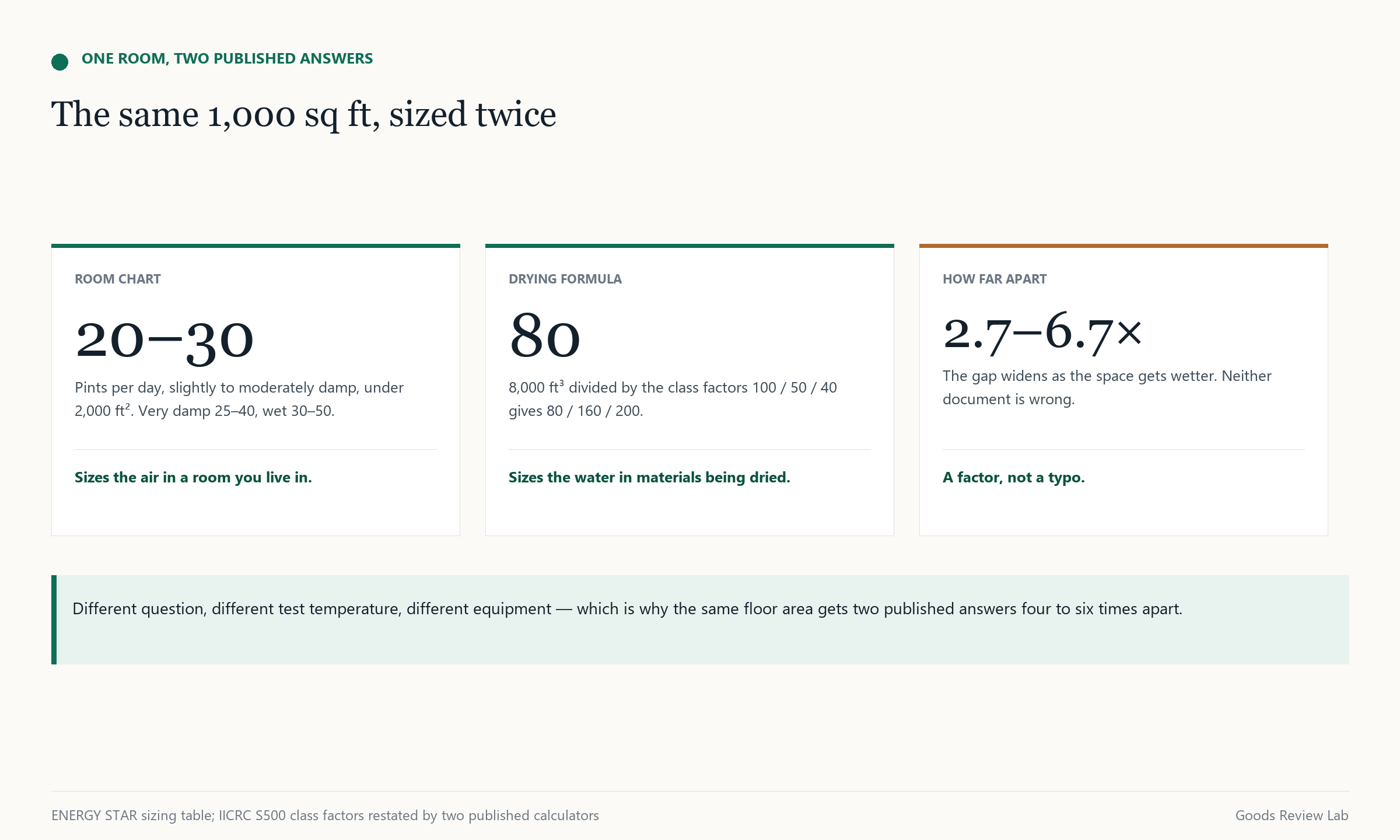
- 20–30 pints per day if the space is slightly to moderately damp, 25–40 if it is very damp, 30–50 if it is wet. That is the published cell for every floor area under 2,000 ft², so 1,000 has no row of its own.
- The drying formula’s answer
- 1,000 ft² at an eight-foot ceiling is 8,000 ft³. Divide by the restoration standard’s class factors and you get 80 / 160 / 200 pints per day. Our division; the factors are the standard’s.
- Why both are published
- One sizes the air in a room you live in. The other sizes the water in materials being dried to a documented standard. Different question, different test temperature, different equipment — and a four-to-six-fold gap that is not a typo on either side.
- Which one is yours
- A lived-in room with no water event: the chart’s cell, rounded up. Materials that got wet: the formula, and expect more than one machine. A space that runs cold: neither number survives the trip — see the pint.
Two answers to the same question
Ask how big a dehumidifier a 1,000 square foot space needs and there are two families of answer in circulation, both published, both arithmetic, and neither of them a guess. The first is the room chart that sits behind almost every consumer sizing answer: two axes, a floor-area band and a dampness condition, returning a range of pints per day. The second is the formula the drying trade uses on a water loss: affected cubic feet divided by a class factor, returning the pints per day of capacity required.
Run both on the same room and they do not converge. They do not even come close. Below, the left two columns are the chart’s published cells, the third column is our division of 8,000 ft³ by the formula’s factors, and the last column is the gap between them.
| Condition, in the chart’s words | Room chart, pints/day | Drying formula, pints/day | How far apart |
|---|---|---|---|
| Slightly to moderately damp — 50–75% relative humidity | 20–30 | 80 | 2.7–4× |
| Very damp — 75–90% | 25–40 | 160 | 4–6.4× |
| Wet — 90–100% | 30–50 | 200 | 4–6.7× |
The formula’s side of that table is not as settled as it looks, and that is worth knowing before you use it. Three published calculators restate the same standard, and they do not restate it identically: two use factors of 100 / 50 / 40 / 40 for water classes 1 to 4, and a third uses 100 / 40 / 30 / 50. Class 2 is therefore either 160 or 200 pints on the same 8,000 cubic feet, depending on which page you open, and the third page labels its own numbers “planning figures”. We used the first set here and the difference is a fifth of the answer.
None of that makes the formula wrong. It makes it a field number rather than a label: it is the capacity a technician wants on site to dry a structure on a schedule, and the equipment that delivers it is not the box in a hardware aisle. A rental catalogue for this work lists single refrigerant units up to roughly 130–147 pints per day. The formula’s answer for a wet 1,000 square feet, 200 pints, is a two-machine number before anything else is decided.
The word “pint” is not the same measurement in both columns
Here is the part that makes the gap hard to argue with, and hard to explain away. Both methods quote pints per day. They do not quote the same pint.
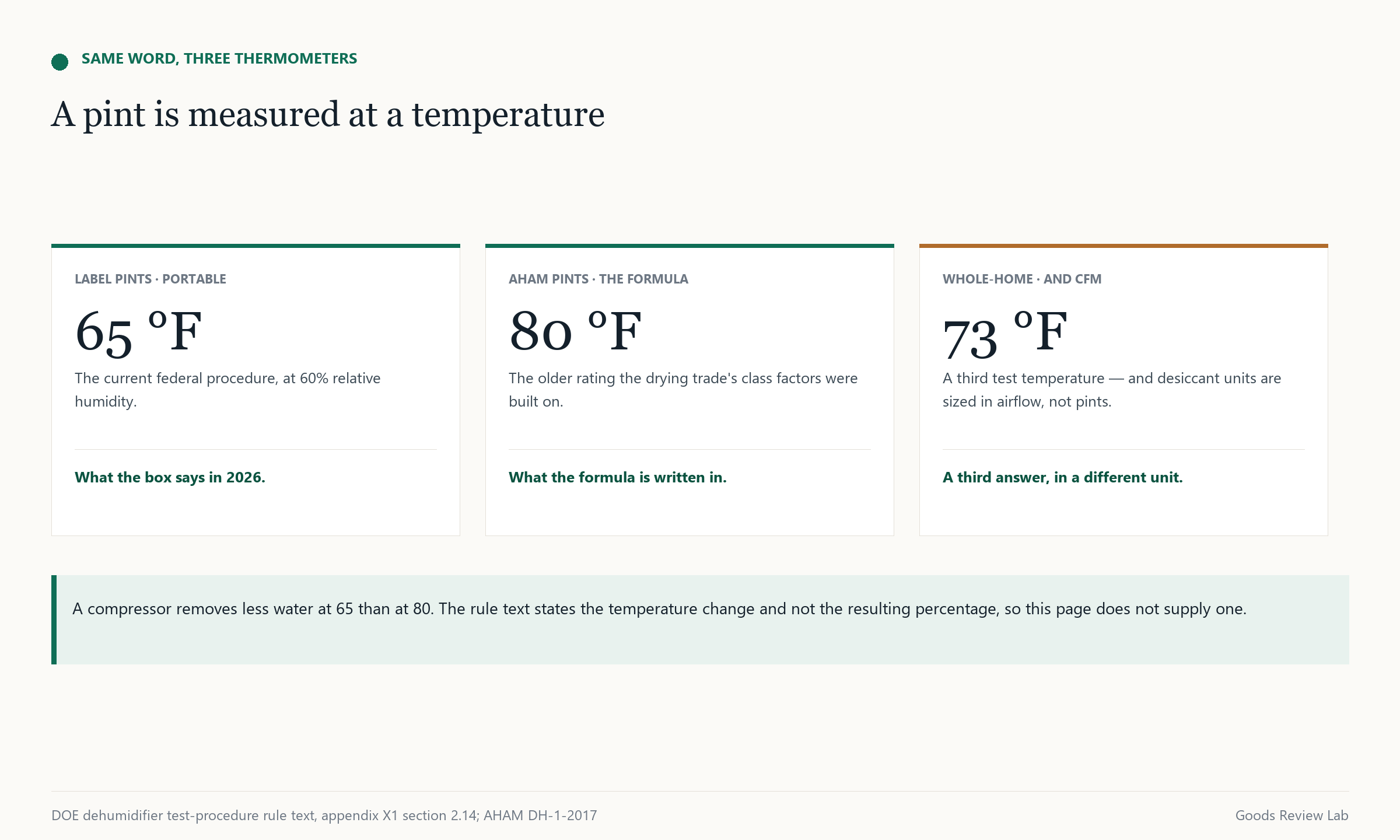
The restoration side inherited its rating from AHAM DH-1-2008, which rated capacity at 80 °F dry-bulb and 60% relative humidity. The federal test procedure that a 2026 label is written against does not use that temperature. It tests portable units at 65 °F and whole-home units at 73 °F, holding the same 60% relative humidity, and defines capacity as the pints removed per day normalised to that standard ambient — section 2.14 of appendix X1. The change is documented: AHAM DH-1-2017 lowered the standard dry-bulb condition from 80 °F to 65 °F and tightened the allowed tolerances at the same time.
So a chart cell of “30 pints” and a formula result of “80 pints” are not 30 and 80 of the same thing. One is a warmer measurement of the same physical quantity the other is a colder measurement of. A compressor removes less water at 65 °F than at 80 °F, which is the direction the rule text describes; the documents we read state the temperature change but not the resulting percentage, and we are not going to supply a number the rule does not give.
That cuts both ways for a reader. Your basement in January is colder than either test condition, and the federal rule text itself notes that units may meet anything from 55 °F to 80 °F depending on where they are installed. A number measured at 65 and a number measured at 80 are both warmer than the room you are standing in.
Three units behind one word
- Label pints, 65 °F
- What the box says, and what the federal procedure defines: pints per day at 65 °F dry-bulb and 60% relative humidity for a portable unit.
- AHAM pints, 80 °F
- What the drying formula is written in: the older rating temperature, still the one the trade’s class factors were built around.
- CFM, no pints at all
- Desiccant units are sized by airflow, not by pints per day. A room with two published pint answers also has a third answer in a different unit entirely, and it applies to a different machine.
At 1,000 sq ft, ceiling height moves one answer and not the other
The formula’s input is volume, so the ceiling is part of the question. The chart’s input is floor area, so it is not. Three ordinary ceiling heights, the same 1,000 square feet, and the middle water class:
Same floor, three ceilings, one method
Pints per day required by the drying formula at water class 2, on 1,000 ft², as the ceiling changes. The room chart returns the same 25–40 cell at all three heights, because floor area is its only size input.
Our arithmetic: 1,000 ft² × 7 / 8 / 10 ft, divided by the class 2 factor of 50. Three feet of ceiling is worth 60 pints in this method. In the room chart it is worth nothing, which is the point of putting them side by side.
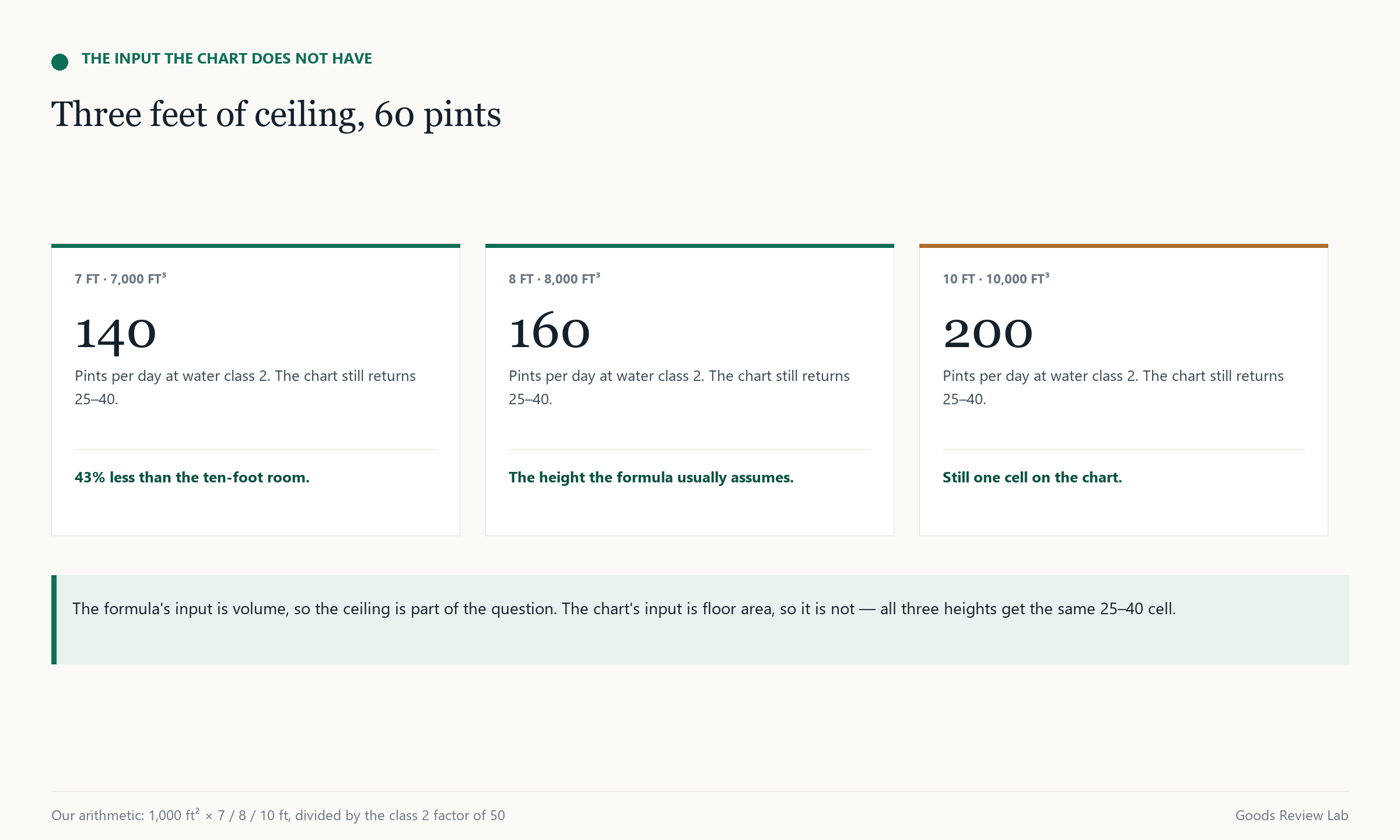
This is not a technicality about tall rooms. A 1,000 square foot basement with a seven-foot ceiling and the same basement with a ten-foot ceiling are the same number on the chart and a 43% different number in the formula. If you are drying materials, the ceiling is a real input and you should measure it. If you are keeping a lived-in room at a target, the chart is telling you, correctly, that it does not think the ceiling is the thing that decides your purchase.
The chart gets vaguer exactly where the answer matters more
One more property of the room chart, visible only when you read the two axes against each other. Its descriptions of the space get narrower as the space gets wetter, and its answers get wider at the same time.
Precision runs in opposite directions
Top group: how many percentage points of relative humidity each published description covers. Bottom group: how many pints per day wide the cell it returns is. Each group is scaled to its own maximum, so read the direction, not the bar lengths against each other.
Both groups are arithmetic on the published table: 50–75, 75–90 and 90–100 give the top row; 20–30, 25–40 and 30–50 give the bottom one. The table narrows its description of your room by 15 points and widens its prescription for it by 10 pints over the same three steps.
The practical consequence is uncomfortable. The wetter your space is, the more precisely the table can describe it and the less precisely it can size it — and the advice to round up costs the most exactly where the table is vaguest. On a wet 1,000 square feet, rounding up from the cell means buying 50 pints a day against a formula that wanted 200. The rounding is not the error. The method is doing what it was built to do: keep a room that is already dry enough from getting wet again, not dry a structure that got wet.
Which answer is yours
The two methods are not competitors, and the choice between them is not a matter of taste. It is decided by one fact about your space, and you already know it.
Three rooms, three answers
- A room you live in, nothing got wet
- Use the chart’s cell and round up. Read the condition off the space with the machine off, because the tiers describe a room behaving on its own. This is the case the chart was written for, and the drying formula’s 160 pints is not an upgrade here — it is a different job’s equipment.
- Materials that got wet
- Use the formula, with the ceiling measured and the water class taken from what is actually soaked. Expect the answer to exceed one machine: the catalogue of rental units for this work tops out near 147 pints per day per unit, so 160–200 means two. And expect the number to be a drying target on a schedule, not a comfort setting.
- A space that runs cold
- Neither number as printed. Both are measurements taken at 65 °F or warmer, and the rule text allows for units running anywhere from 55 to 80 °F in the field. Check what the unit is rated to do at your temperature before comparing pints at all.
What neither method covers
- A whole house through ducts. Sized from a moisture load on the building, not from one room’s floor area, and the whole-home test temperature is a third number again.
- A sealed crawlspace. Neither document addresses it, and the formula’s volume input is the affected volume, which in a crawlspace is rarely the volume you would measure standing up.
- Standing water or a live leak. That is a drainage problem, and no capacity figure wins it. Pump it out first; size afterwards.
- Anything above 2,000 ft² on the chart. Past that line the published cells become open-ended, and an open-ended figure is a floor rather than a size. The 2,000 sq ft page deals with that line; the 500 sq ft page sits at the other end of the same band.
If you want the chart’s cell named for your own numbers rather than read off a band, the dehumidifier calculator runs the same table and shows which cell it used. If the space is a basement, the basement sizing page carries the basement-specific catches — and the cost side of running whatever you buy is worked through on the running-cost page.
Questions this page answers
- What size dehumidifier do I need for 1,000 sq ft?
- It depends which of two published methods fits your space. For a room you live in with nothing wet, the sizing chart returns 20 to 30 pints per day if it is slightly to moderately damp, 25 to 40 if very damp and 30 to 50 if wet. For materials that got wet, the drying formula returns 80, 160 or 200 pints per day on the same floor at an eight-foot ceiling. The chart sizes air; the formula sizes water in materials.
- Why do two calculators give different answers for the same room?
- Because they are not the same measurement. The chart's pints come from a rating taken at 65 degrees Fahrenheit under the current federal procedure; the drying formula is written in the older AHAM rating at 80 degrees. One also sizes the air in a room, the other the water in wet materials, so the answers differ by four to six times before either is adjusted.
- Does ceiling height change the size I need?
- For the drying formula, yes: 1,000 square feet is 7,000, 8,000 or 10,000 cubic feet under a seven, eight or ten foot ceiling, which is 140, 160 or 200 pints per day at water class 2. For the room chart, no: its only size input is floor area, so all three heights return the same 25 to 40 cell.
- Is 1,000 sq ft one dehumidifier or two?
- One, if it is a lived-in room and you are buying to the chart's cell. Two or more, if you are drying wet materials: the formula's 160 to 200 pints per day is above the largest single rental unit for that work, which is rated around 130 to 147 pints per day.
- My space is cold. Which number applies?
- Neither one as printed. Capacity ratings are taken at 65 degrees Fahrenheit for portable units under the current procedure, and at 80 degrees in the older AHAM basis the drying formula uses, while the rule text allows for units running between 55 and 80 degrees in the field. Check the unit's low-temperature rating before comparing pints.
Where these numbers come from
The room chart’s cells, the three condition descriptions and their humidity ranges are from ENERGY STAR’s dehumidifier sizing guidance, which is the AHAM-derived table. The drying formula — volume in cubic feet divided by a class factor — and the factors 100 / 50 / 40 / 40 are as restated by two published restoration calculators; a third restates the same standard as 100 / 40 / 30 / 50 and calls its own output planning figures, and we have said so rather than picking the version that suited the page. The rating temperatures, the definition of capacity in section 2.14 of appendix X1, the move from 80 °F to 65 °F in AHAM DH-1-2017 and the 55–80 °F field range are from the Department of Energy’s dehumidifier test-procedure rule text. The divisions by 100, 50 and 40, the ceiling comparisons and the two width calculations in the figures are our arithmetic and are labelled as ours. No number on this page was estimated, and none of it is a test we ran.