What size dehumidifier for 2,000 sq ft: one unit, or three?
At 2,000 square feet the published chart stops giving a range and starts giving a floor, while the drying formula starts giving a count. Read one way you are buying a bigger box. Read the other you are buying two or three of them.
In short
- The chart’s answer
- 30 or more, 40 or more, 50 or more pints per day, by how damp the space is. That is the published cell for every floor area over 2,000 ft² — a floor with nothing above it.
- The formula’s answer
- 2,000 ft² at an eight-foot ceiling is 16,000 ft³. Divided by the restoration standard’s class factors that is 160 / 320 / 400 pints per day. Our division; the factors are the standard’s.
- Why they point opposite ways here
- The chart’s advice is to round up, which means one larger unit. At 2,000 the formula’s answer is more than twice the largest single unit in the rental catalogue for this work — 130–147 pints per day — so rounding up cannot reach it. One reading buys a machine; the other counts machines.
- Which one is yours
- A lived-in room with nothing wet: the chart’s floor, one unit. Materials that got wet: the formula, and it is a count — 2, 3 or 4 units depending on the water class and on which restatement of the standard you use. A space that runs cold: neither figure was measured at your temperature.
At 2,000 sq ft the two readings stop describing one purchase
Below this area, both published readings still describe the same kind of purchase. The chart names a cell and you buy at the top of it. The drying formula, run on the same floor, names a much larger number — but a number that one big machine could still, in principle, be asked to deliver.
At 2,000 that stops being true. The chart’s cell loses its upper bound at the same moment the formula’s answer passes the ceiling of the largest single unit for this work. So the two readings are no longer two sizes of one purchase. One is a purchase. The other is a count. The table below puts the three figures side by side: the published cell, our division of 16,000 cubic feet, and how many of the biggest single machines that division implies.
| Condition, in the chart’s words | Chart cell, over 2,000 ft² | Formula at 16,000 ft³ | Largest single unit we found for this work | Units the formula implies |
|---|---|---|---|---|
| Slightly to moderately damp — 50–75% relative humidity | 30 or more | 160 | 130–147 | 2 |
| Very damp — 75–90% | 40 or more | 320 | 130–147 | 3 |
| Wet — 90–100% | 50 or more | 400 | 130–147 | 3 |
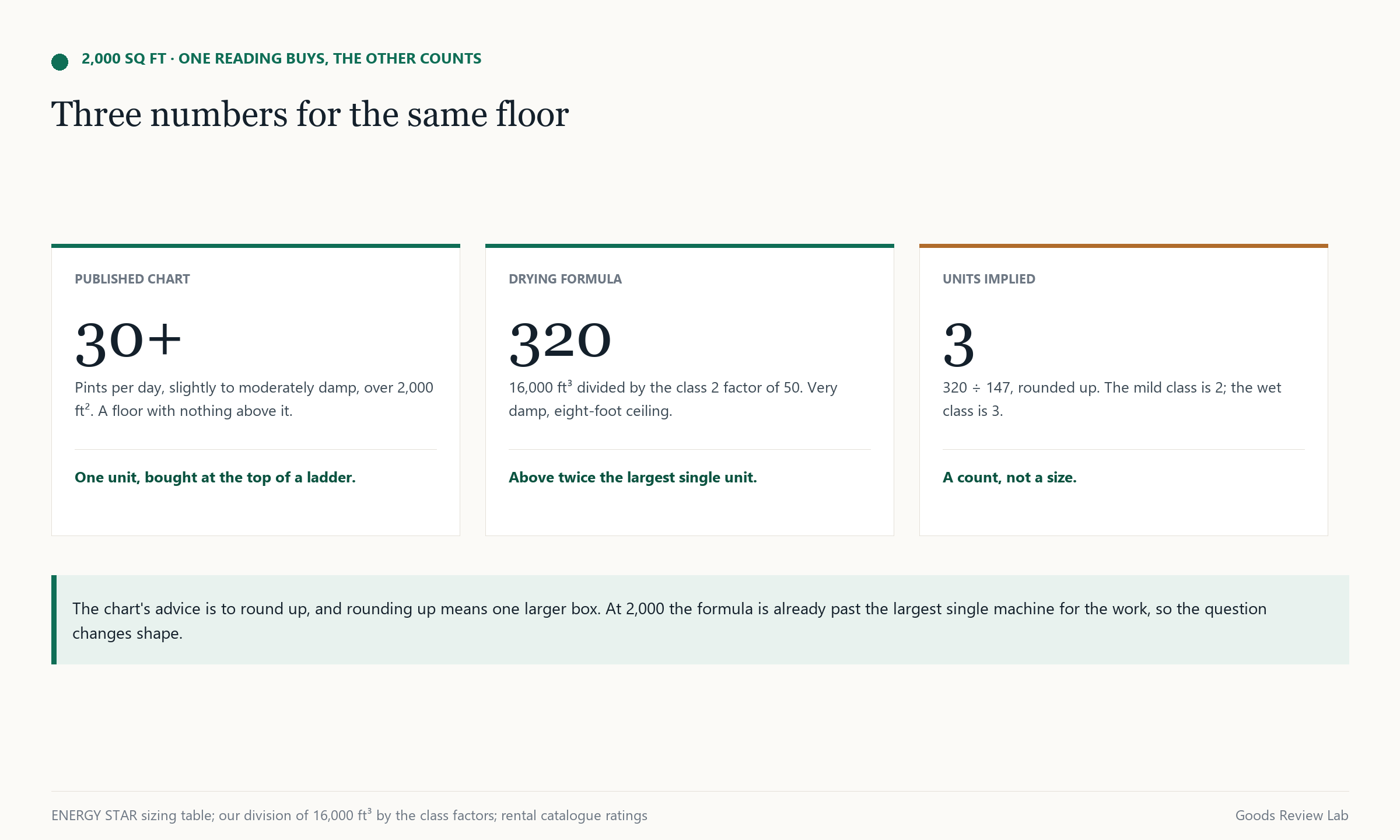
That “or more” is both the most honest part of the published chart and the least useful part of it at this size. It is honest because the table genuinely has no row above 2,000 — the second band is the last band — so there is nothing for it to quote. It is useless because a buyer cannot order “more”. Every document we read for this page states the floor and stops; none of them states where the floor stops. We are not going to supply a number that no source gives, and any page that quotes you one has made it up.
What a floor with no ceiling does to the advice to round up
Rounding up is good advice when the ladder you are rounding up has rungs on it. Below 2,000 the rungs are retail sizes, and the advice works: take the top of the cell, add a step, and you have a unit that will hold the room. The consumer calculators we read do exactly that — they resolve every answer to a single unit, and the examples on those pages name 30-, 50- and 70-pint models.
The chart itself stops at “50 or more”. So a household buyer rounding up from the top cell is choosing between 50 and 70 pints per day, while the formula on the same floor is asking for 320. The advice is not wrong. It was written for a ladder that ends roughly 250 pints below where the other reading starts.
Two readings, one scale
Top group: the published cell above 2,000 ft², taken at its floor. Bottom group: our division of 16,000 ft³ by the class factors. Both groups are drawn on the same 0–400 axis, which is the point of the figure.
The six bars share one axis, so the gap is a length rather than a description. The cells are the published ones and are drawn at their floor because that is all the published table gives; the formula’s bars are our division of 2,000 ft² × 8 ft by 100, 50 and 40.
How many units, and the restatement that adds one
The count is one division. Take the formula’s answer for 16,000 cubic feet, divide by the top of the single-unit range in the catalogue, 147 pints per day, and round up, because nobody sells two thirds of a machine. 160 is two units. 320 is three. 400 is three. At the low end the arithmetic is closer than it looks — two units at 130 pints each is 260, which clears 160 comfortably, but a single 147-pint unit does not clear it at all.
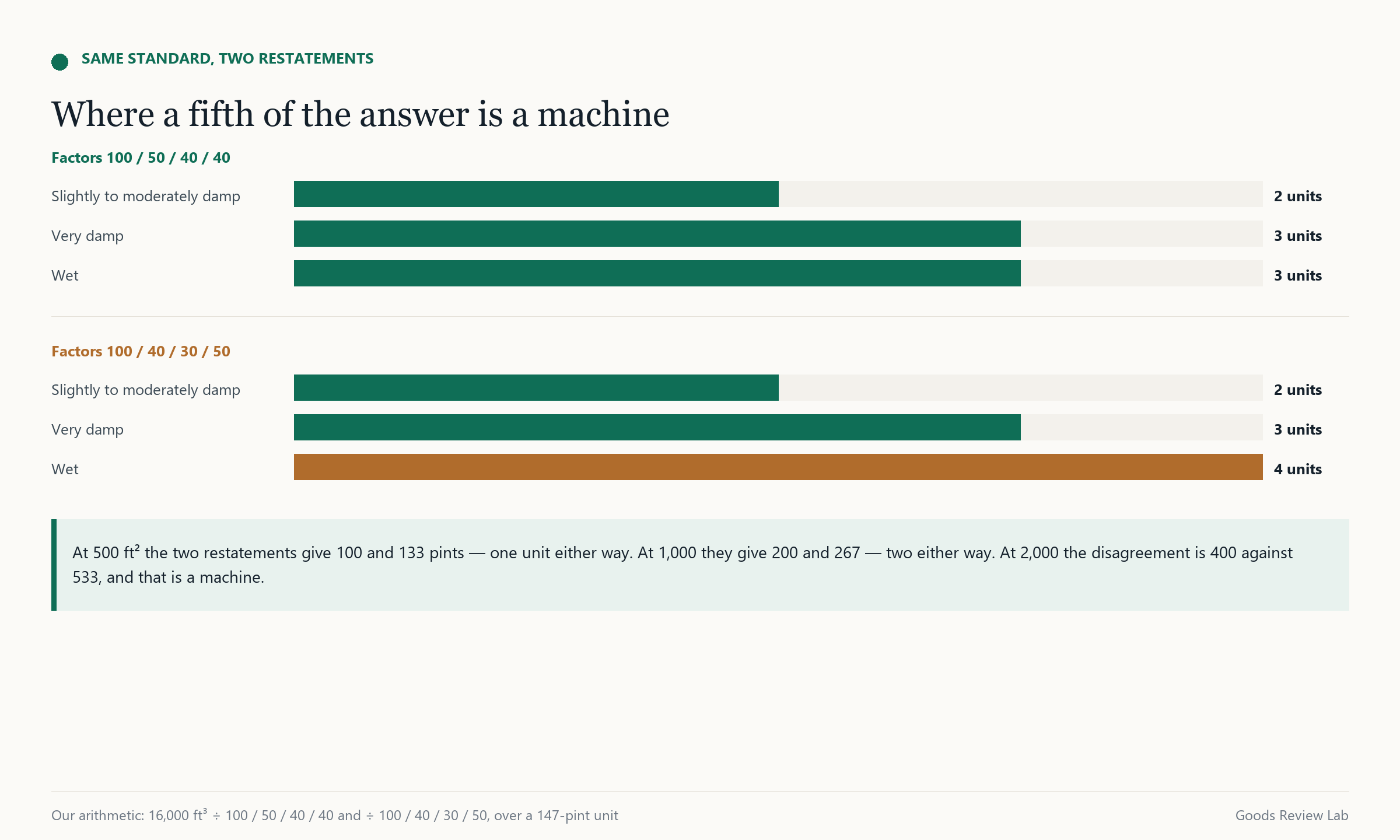
Then there is the part that makes this size behave differently from 500 and 1,000. The drying standard is restated by different calculators with different class factors: two of the ones we read use 100 / 50 / 40 / 40, and a third uses 100 / 40 / 30 / 50. On 16,000 cubic feet, class 3 is therefore 400 pints or 533 pints depending on which page you open. That difference is a machine. Three units becomes four.
At smaller areas the same disagreement does not cost anything, which is why it is easy to dismiss until you reach this one. At 500 square feet the two restatements give 100 and 133 pints, and both of those are one unit. At 1,000 they give 200 and 267, and both of those are two. The coefficient argument only changes what you buy at 2,000, where the numbers are large enough for a fifth of the answer to be a whole machine.
One input moves the count further than either coefficient set does, and it is a reading of ours rather than anything the standard says. The formula’s input is the volume of material that is actually wet, not the volume of the building. A 2,000 square foot floor with one wet room in it is not 16,000 cubic feet of water damage, and treating it that way is how people end up hiring equipment they cannot use. We found no document that says how to carve a 2,000 square foot floor into an affected volume, so this page will not pretend to have one: measure the wet part, run the division on that, and let the count fall where it falls.
The tank, at 40 to 50 gallons a day
Pints per day is a rate almost nobody can picture, so it is worth converting once. Eight pints make a US gallon. The division below is ours; the pint figures are the chart’s and the standard’s.
| Condition | Chart cell, pints/day | Chart cell, US gallons/day | Formula, pints/day | Formula, US gallons/day |
|---|---|---|---|---|
| Slightly to moderately damp | 30 or more | 3.75 or more | 160 | 20 |
| Very damp | 40 or more | 5 or more | 320 | 40 |
| Wet | 50 or more | 6.25 or more | 400 | 50 |
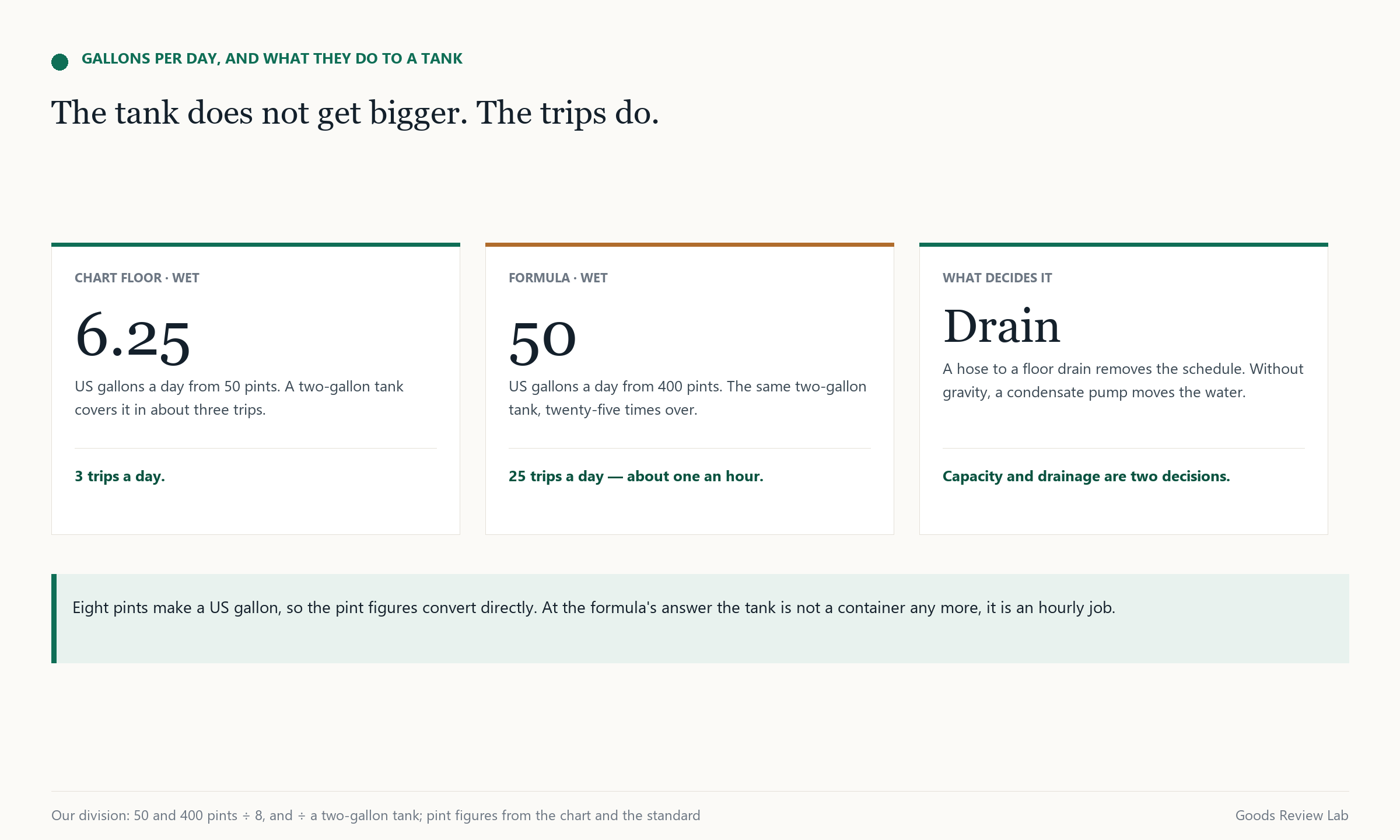
At the chart’s floor a wet 2,000 square feet is a little over six gallons a day, and a two-gallon tank is emptied three times. At the formula’s answer it is fifty gallons, and the same tank is emptied twenty-five times — about once an hour across a day. That is the point at which the tank stops being a feature and becomes a schedule. A drain hose to a floor drain removes the schedule entirely; where there is no gravity drain, the unit needs a condensate pump, and a pump is a different decision from a bigger tank because it moves the water without adding any capacity.
Which reading is yours
The choice between the two is not a preference and not a matter of which page you trust. One fact about your space decides it, and it is a fact you already have.
Three spaces, three answers
- A lived-in space, nothing got wet
- The chart’s cell, at its top. That is one unit, and at this area the cell is a floor rather than a range, so “top of the cell” means the smallest machine that is defensible. Read the condition off the space with everything switched off, because the tiers describe a room behaving on its own.
- Materials that got wet
- The formula, on the affected volume, with the water class taken from what is actually soaked. Expect a count rather than a size: 2 units at the mild end, 3 in the middle, 4 if you use the other restatement of the factors. Expect the number to be a drying target on a schedule, not a comfort setting.
- A space that runs cold
- Neither figure as printed. The label figure is measured at 65 °F for a portable unit and 73 °F for a whole-home one, the older trade basis is 80 °F, and the rule text allows for units running anywhere from 55 to 80 °F in the field. A cold 2,000 square feet is not the space either number was measured in, and the fix is a unit rated for it, not a bigger count.
What neither reading covers
- A whole house through ducts. Sized from a moisture load on the building rather than from one room’s floor area, and rated at a third test temperature again. The chart above is a room-scale chart and will not stretch to cover it.
- A sealed crawlspace. Neither document addresses it, and the formula’s volume is the affected volume, which in a crawlspace is rarely the volume you would get by measuring the floor and the ceiling.
- Standing water or a live leak. A drainage problem before it is a capacity problem, and no count of machines wins it. Pump it out first; size afterwards.
- Anything past this area. The chart has no third band. Above 2,000 ft² every cell it returns is a floor, so a bigger space gets the same three numbers as this one and no more guidance.
Prefer the cell named for your numbers instead of read off a band? The dehumidifier calculator runs the same table and shows which cell it used. The 1,000 sq ft page works the two readings from below the line, where both still describe one machine, and the 500 sq ft page sits at the small end of the same band. A basement at this size brings its own catches — the basement sizing page has those — and what any of it costs to run is worked through on the running-cost page.
Questions this page answers
- What size dehumidifier do I need for 2,000 sq ft?
- 30, 40 or 50 pints a day is the published floor for a lived-in space, and it is a floor rather than a range. For materials that got wet, the drying formula returns 160, 320 or 400 pints a day on the same floor at an eight-foot ceiling — our division of 16,000 cubic feet by the water-class factors.
- Is 2,000 sq ft one dehumidifier or more than one?
- One for a lived-in room, two to four for wet materials. The formula's 320 pints at the middle water class is above twice the largest single unit for this work, which is rated 130 to 147 pints a day, so 320 divides into three units; the mild class divides into two, and the wet class into three or four depending on which restatement of the class factors you use.
- Why does the chart say “30 or more” instead of a number?
- Because 2,000 square feet is the last band the table has. Its floor-area axis runs under 2,000 and over 2,000 and then stops, so every cell above the line is a floor with nothing quoted above it. None of the documents we read states where that floor stops, which is why this page gives a count of units instead of an invented ceiling.
- How big a tank does a 2,000 sq ft dehumidifier need?
- Big enough that you stop emptying it. At the chart's floor a wet 2,000 square feet removes 3.75 to 6.25 gallons a day, so a two-gallon tank covers it in about three trips. At the formula's answer it is 20 to 50 gallons a day and the same tank is emptied 10 to 25 times, which is why the drain, not the tank, is the decision at this size.
- Does 2,000 sq ft need a whole-home unit?
- Only if the damp is house-wide. A ducted whole-home unit is sized from a moisture-load calculation on the building rather than from a room chart, and it is rated at a different test temperature again. One damp 2,000 square foot space is a portable job, or a count of portable units; a damp house is not.
Where these numbers come from
The chart’s cells, the three condition descriptions and their humidity ranges are from ENERGY STAR’s dehumidifier sizing guidance, the AHAM-derived table; the rating basis behind it is AHAM DH-1-2008 at 80 °F, and the current federal procedure that replaced it is AHAM DH-1-2017 at 65 °F. The drying formula — affected cubic feet divided by a class factor — and the class factors are the IICRC S500 restoration standard’s, as restated by the published restoration calculators we read: two print the four factors as 100 / 50 / 40 / 40 and one prints them as 100 / 40 / 30 / 50, which is why the class-2 answer on this page can read 320 or 400. The 130–147 pints per day ceiling on a single unit for this work is the top of the range in Allied Rental Company’s equipment catalogue, the rental catalogue this page reads. The rating temperatures, the definition of capacity in section 2.14 of appendix X1, and the 55–80 °F field range are from the Department of Energy’s dehumidifier test-procedure rule text. The divisions of 16,000 cubic feet by 100, 50 and 40, the unit counts and the ceiling comparisons are our arithmetic and are labelled as ours. No number on this page was estimated, and none of it is a test we ran.