How to clean an air purifier filter
Most of the filter in a purifier cannot be cleaned at all — it can only be replaced. One layer can be washed, and the manufacturer’s own guide puts a number on how often. This page tells you which layer you are holding, what may be done to it, and the one step that decides whether the job works.
What it comes down to
- Which layer can be washed
- Only the outer pre-filter. The manufacturer guide we read names a washable pre-filter and then, in the same section, states that its other filters cannot be washed or reused. If the layer in your hand is pleated paper or a carbon mat, water is not a cleaning step — it is the end of that filter.
- How often
- Every 2 to 4 weeks for the pre-filter. That is the guide’s own interval, not an estimate. The air-quality sensor sits on a different clock — about every two months.
- How to clean it
- Vacuum or rinse, then dry it completely before it goes back. The drying is written as a condition rather than a tip: the guide’s wording is that the filter should be allowed to dry completely before reinstalling.
- The part nobody cleans
- The sensor. A spotless filter behind a dust-covered air-quality sensor still leaves the machine running at the wrong speed, because the machine sets its speed from what that sensor reports.
Search for how to clean an air purifier filter and the answers all describe one procedure applied to one object. The object is not one thing. It is two or three materials stacked in a frame, each built for a different particle size, and the word “clean” means something different to each of them — rinse, vacuum, or nothing at all. This page sorts the stack by what may be done to it, gives the one layer that can be washed its published interval, and is explicit about the layers you should not put in water.
What we read
Three documents, all named in the sources section: one air purifier manufacturer’s published maintenance guide, the US Environmental Protection Agency’s page defining what a HEPA filter is, and the EPA’s guide to air cleaners in the home.
The manufacturer sells replacement filters, so its calendar protects the machine and its filter business at the same time. We have used it for the parts that are mechanical instructions — which layer may be rinsed, how often, and what has to happen before the filter goes back — and treated its replacement timing as the manufacturer’s figure rather than a neutral one. That distinction is labelled again in the sources list.
We did not take a purifier apart for this page, and we are not a laboratory. Where a number comes from a document it is named and dated; where a reading is ours, the text says so.
Three layers, three verbs
A purifier that handles both particles and gases carries at least two filters, because most filters are built for one or the other. The EPA’s guide states it plainly: most filters are designed to filter either particles or gases, which is why a machine that does both usually contains two. Put the coarse screen in front of those and you have the stack most units actually hold.
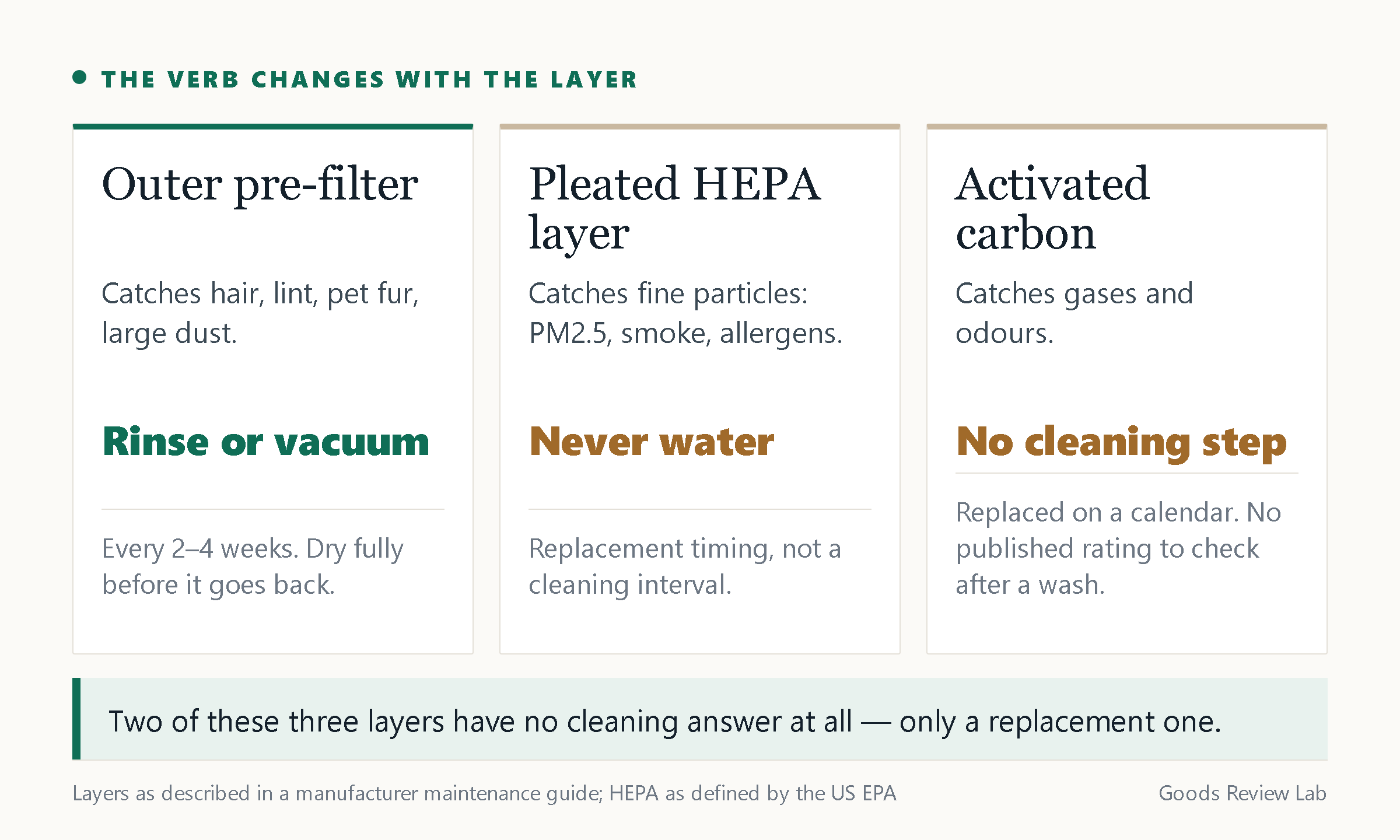
This is the whole page in one sentence, and it is the part generic cleaning advice collapses: the verb changes with the layer. Advice written for the pre-filter gets applied to the pleated layer, and that is where a working filter becomes a dead one.
| Layer | What it catches | What may be done to it | Published timing |
|---|---|---|---|
| Outer pre-filter | Hair, lint, pet fur, large dust | Vacuum or rinse, then dry fully | Every 2–4 weeks |
| Pleated (HEPA) layer | Fine particles — PM2.5, smoke, allergens | Vacuum the outer face at most; never water | Replacement, not cleaning |
| Activated carbon layer | Gases and odours | Nothing — it is replaced | No cleaning interval exists |
Two of those three rows have no cleaning answer, which is why the honest version of this page is short. The long version is the two sections below, which explain what water actually does to the layers that were not built for it — because “it will be fine” is the assumption that costs a filter.
The one layer you can wash, in four steps
This is the whole procedure for the pre-filter. It is short because the job is short. The step that gets skipped is the last one, and the last one is the step the guide writes as a condition rather than a tip.
- Unplug the unit. Out of the socket, not standby. You are about to put your hands into the air path, and on some units the fan will start if the cover closes while the unit still has power.
- Take the pre-filter out. On most units it is the outermost frame, in front of the pleated layer, and it is usually the only part that lifts out without tools.
- Vacuum both faces, or rinse it. The guide offers both verbs — vacuum or rinse — and specifies no detergent, so we do not add one. A soft brush loosens what the vacuum leaves behind.
- Let it dry completely before it goes back. Both faces, not just the one you can see. This is the step that decides whether the next section of this page becomes your problem.
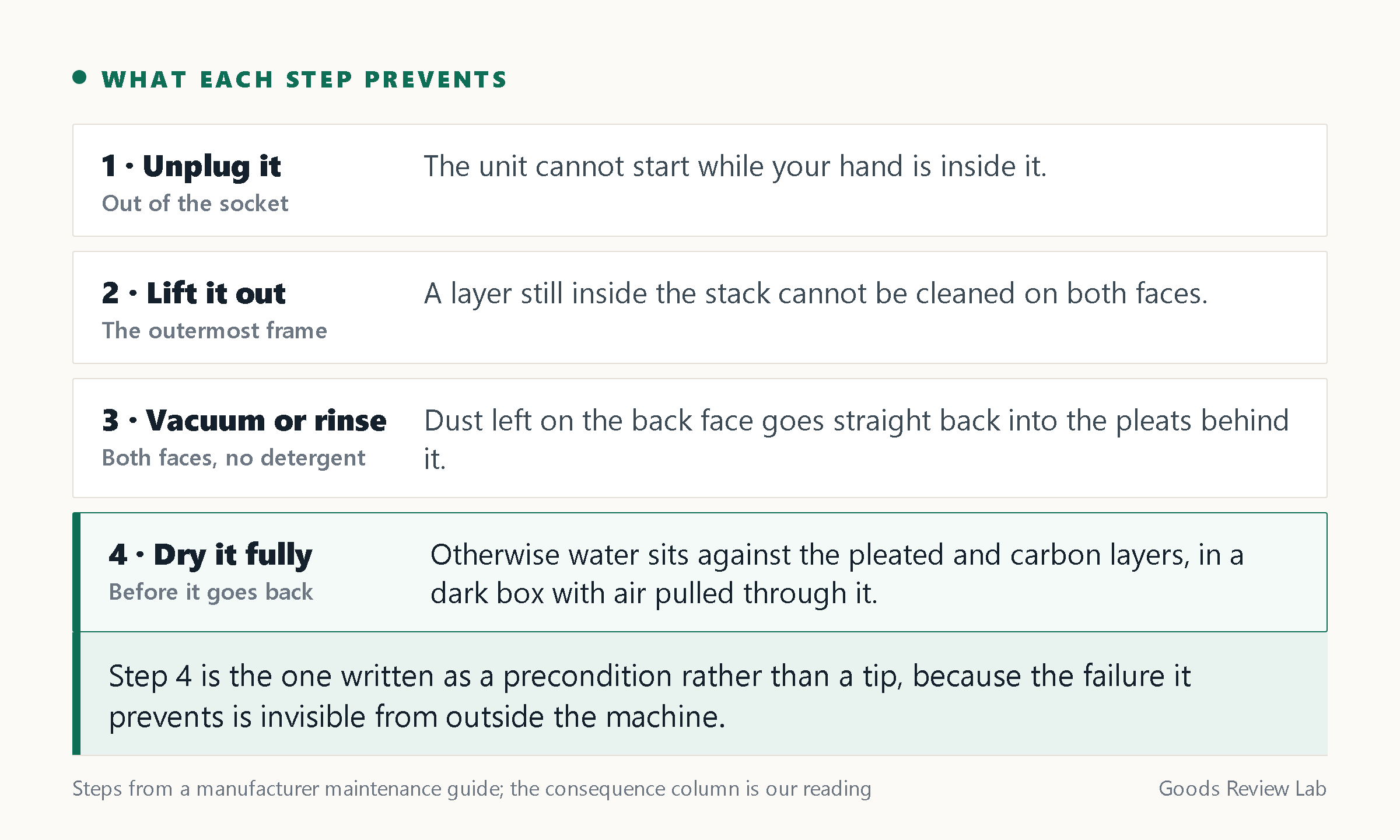
Why drying is a condition and not a nicety: a pre-filter that goes back damp holds that moisture against the pleated and carbon layers behind it, in a dark box with air pulled through it. That mechanism is our reading, not a line from the guide. What the guide states is the requirement — dry completely before reinstalling — and a requirement written that way usually exists because the failure it prevents cannot be seen from outside the machine.
What water does to the other two
A HEPA filter is defined by its medium, not by its housing. The EPA’s definition page describes it as a pleated mechanical air filter, officially defined by the US Department of Energy, that can theoretically remove at least 99.97% of particles with a size of 0.3 microns — the size chosen because it is the worst case, the point at which particles are hardest to capture. Larger and smaller particles are trapped with higher efficiency.
That figure describes the medium as it is manufactured. Nothing in the definition provides for restoring it after it has been wetted, and the manufacturer guide we read offers no washing procedure for it — it states that its filters cannot be washed or reused, in the same section that calls the pre-filter washable. So the reading we would carry to a shop listing is this: a product advertising a washable HEPA is usually describing a washable layer sitting in front of a HEPA stage. The longer argument for that, with what the labels actually mean, is on how often to change an air purifier filter.
The rule this page applies, so you can check it against your own unit: if a layer is pleated and the manual prints no washing procedure for it, treat it as replace-only, whatever the listing called it. If the manual does print a washing procedure for a layer, that layer is the pre-filter — and the procedure it prints is the one to follow, not this page’s. Stated that way, the rule needs one document: the one that came in the box.
The carbon layer is served worse still. The EPA’s guide says activated carbon can be effective provided a large amount of material is used in the filter, and that there are no widely used performance rating systems for portable air cleaners or filters designed to remove gases — the CADR rating system covers particles only. Our reading: with no published number to check, there is nothing to measure after a wash that would tell you whether the layer still works. That is why the carbon stage is replaced on a calendar rather than cleaned on one.
The EPA also supplies the sentence that keeps this page honest: all filters need regular replacement, and a filter that is dirty and overloaded will not work well. Cleaning the pre-filter does not remove that requirement. It delays it — and it protects the layers behind it while it delays.
The second thing that gets dirty
The filter is the part you can see. The air-quality sensor is the part the machine uses to decide how hard to work, and the same manufacturer guide puts it on its own schedule: wipe the air-quality monitor with a cotton swab about every two months.
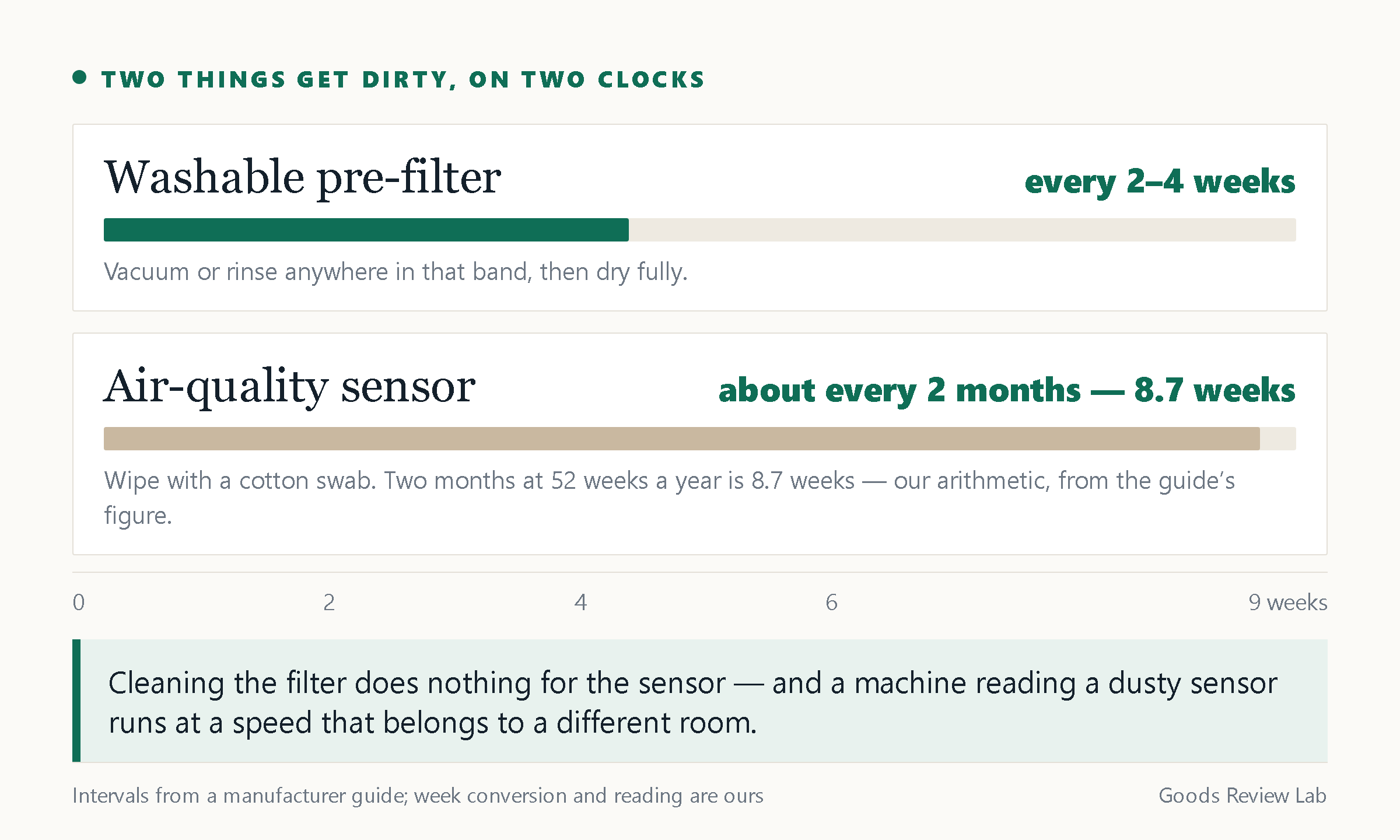
Our reading, and the reason this belongs on a page about cleaning filters: a purifier with an auto mode is not measuring its filter, it is measuring the room. Dust on the sensor changes what the machine thinks the room is, so the fan runs at a speed that belongs to a different room — and the owner, seeing weak airflow or a machine that never ramps up, concludes the filter is clogged. One cotton swab answers a question that a new filter would not have fixed.
The same guide puts the exterior on the same two-month clock: wipe the covers and the air outlets with a dry, soft cloth, so the air has somewhere to come out.
If it is louder, or will not run, after you put it back
Two failures follow a filter change more often than any other, and both are assembly faults rather than filter faults. The guide names the first itself: a loud noise after fitting new filters usually means the plastic packaging is still on them. Our reading: the same applies to a filter you have just rinsed, dried and slid back into its frame — the bag, the cardboard sleeve or the foam spacer can go back in with it.
The second is seating. A pre-filter that is not sitting flat lets air past it, and the coarse load goes straight into the layer you were trying to protect.
If the machine does not run at all after reassembly, that is outside what a cleaning guide covers, and the guide we read publishes no diagnostic for it. We are not going to invent one here. Check the mechanical things first — filter fully seated, cover closed, unit plugged into a socket that works — and if it still will not run, the fault is not the filter, and no amount of cleaning will reach it.
The four intervals, and which of them are published
Four jobs sit on a calendar and one is not allowed at all. Published numbers and rules of thumb are kept apart here on purpose, because a page that mixes them makes every number look equally firm.
| Job | Interval | Where the number comes from |
|---|---|---|
| Rinse or vacuum the pre-filter | Every 2–4 weeks | Manufacturer guide, stated as a range |
| Wipe the air-quality sensor | About every 2 months | Manufacturer guide |
| Wipe covers and air outlets | About every 2 months | Manufacturer guide |
| Replace the filter set | Up to one year, or when the indicator light asks | Manufacturer’s rule of thumb — a rule, not a test |
| Wash the pleated or carbon layer | Never | EPA definition of the medium; manufacturer guide |
The pre-filter interval is the one worth noticing: it is a published range, two to four weeks, and the width of that range is the manufacturer admitting that the room decides. A home with pets, a road outside or a wood stove sits at the short end. The rest sit at the long end, and a pre-filter that is visibly grey before two weeks have passed is telling you where you sit.
When cleaning stops being the answer
If the pre-filter is clean, the sensor is clean and the airflow is still weak, the remaining layer is the answer and no cleaning step reaches it. Two pages take it from here: how often to change an air purifier filter for the intervals, the cost and why the numbers differ between makers, and how long air purifier filters last for why the indicator light is a countdown rather than a measurement.
A humidifier filter is a different object with different rules — it sits in water rather than in air, and its failure mode is growth rather than loading. That one is on humidifier filter replacement. And if you are deciding what to buy rather than what to do with what you already own, Home Air is where the category criteria live.
Questions this page answers
- Can you wash an air purifier filter?
- Only the outermost pre-filter. The manufacturer guide we read lists a washable pre-filter and states in the same section that the other filters cannot be washed or reused, so the answer depends entirely on which layer is in your hand.
- How often should you clean an air purifier filter?
- Every 2 to 4 weeks for the washable pre-filter, which is the interval the manufacturer's own guide publishes as a range. A home with pets or a road outside sits at the short end of that range.
- Can you wash a HEPA filter?
- No. HEPA is a pleated mechanical medium defined by capturing 99.97% of particles at 0.3 microns, and that figure describes the medium as it is manufactured. Water mats the pleats, and no manufacturer guide we read offers a washing procedure for it.
- Why is my air purifier loud after I cleaned the filter?
- Usually because packaging or a spacer went back in with the filter, or because the pre-filter is not sitting flat. The guide names plastic packaging left on new filters as a cause of loud noise, and both faults are assembly problems rather than filter problems.
- Why does my air purifier still say the filter needs changing after I cleaned it?
- Because that light follows a countdown and a reset button, not the filter's condition. Cleaning a filter does not change the countdown, which is why the reminder returns; the reset step belongs to a replacement, not a wash.
What this rests on
One manufacturer maintenance guide and two EPA documents, all three read on 26 October 2026. The manufacturer sells replacement filters; that interest is labelled below and again where its timing is used.
- That the pre-filter is washable and should be vacuumed or rinsed every 2 to 4 weeks and allowed to dry completely before reinstalling; that the other filters cannot be washed or reused; that the air-quality monitor should be wiped with a cotton swab about every two months; that covers and air outlets should be wiped with a dry soft cloth on the same clock; that plastic packaging left on new filters is a cause of loud noise; and that the filter light should be reset after a replacement: a manufacturer’s published air purifier maintenance guide for its own Airmega line, published March 2025. The manufacturer sells the replacement filters this guide describes; we have used its mechanical instructions and labelled its timing as the manufacturer’s figure.
- That HEPA is a pleated mechanical air filter, officially defined by the US Department of Energy, that theoretically removes at least 99.97% of particles at 0.3 microns, and that 0.3 microns is the worst case because it is the most penetrating particle size: the US Environmental Protection Agency’s published page “What is a HEPA filter?”. A government definition page; it does not test a specific filter and endorses no brand.
- That most filters are designed to filter either particles or gases; that all filters need regular replacement and a dirty, overloaded filter will not work well; that activated carbon can be effective provided a large amount of material is used; and that there are no widely used performance rating systems for filters designed to remove gases, the CADR system covering particles only: the US Environmental Protection Agency’s Guide to Air Cleaners in the Home, second edition. A government guidance document, not a test report on any model.
- The reading that the verb changes with the layer, the reading that drying is written as a condition because the failure it prevents is invisible from outside, the reading that a dust-covered sensor makes an auto mode run at a speed belonging to a different room, and the reading that a damp pre-filter is the origin of the smell owners later blame on the machine: our reading of the three documents above. These are not test results, and no purifier was dismantled for this page.
What we did not do and are not going to imply: we have not measured how much a wash restores airflow on a specific model, because no manufacturer we read publishes that figure. The manual that came with your unit is the only document that speaks to your parts, and it outranks this page wherever the two disagree.
What this page deliberately does not do: name a best purifier or a best replacement filter. Which layers your machine has, and whether the outer one lifts out at all, is settled by your manual — and a single recommendation that skips that is the failure mode this page exists to argue against. See Home Air for the rest of what we check in this category, plus how we get paid if you want to know what a commission can and cannot buy here.